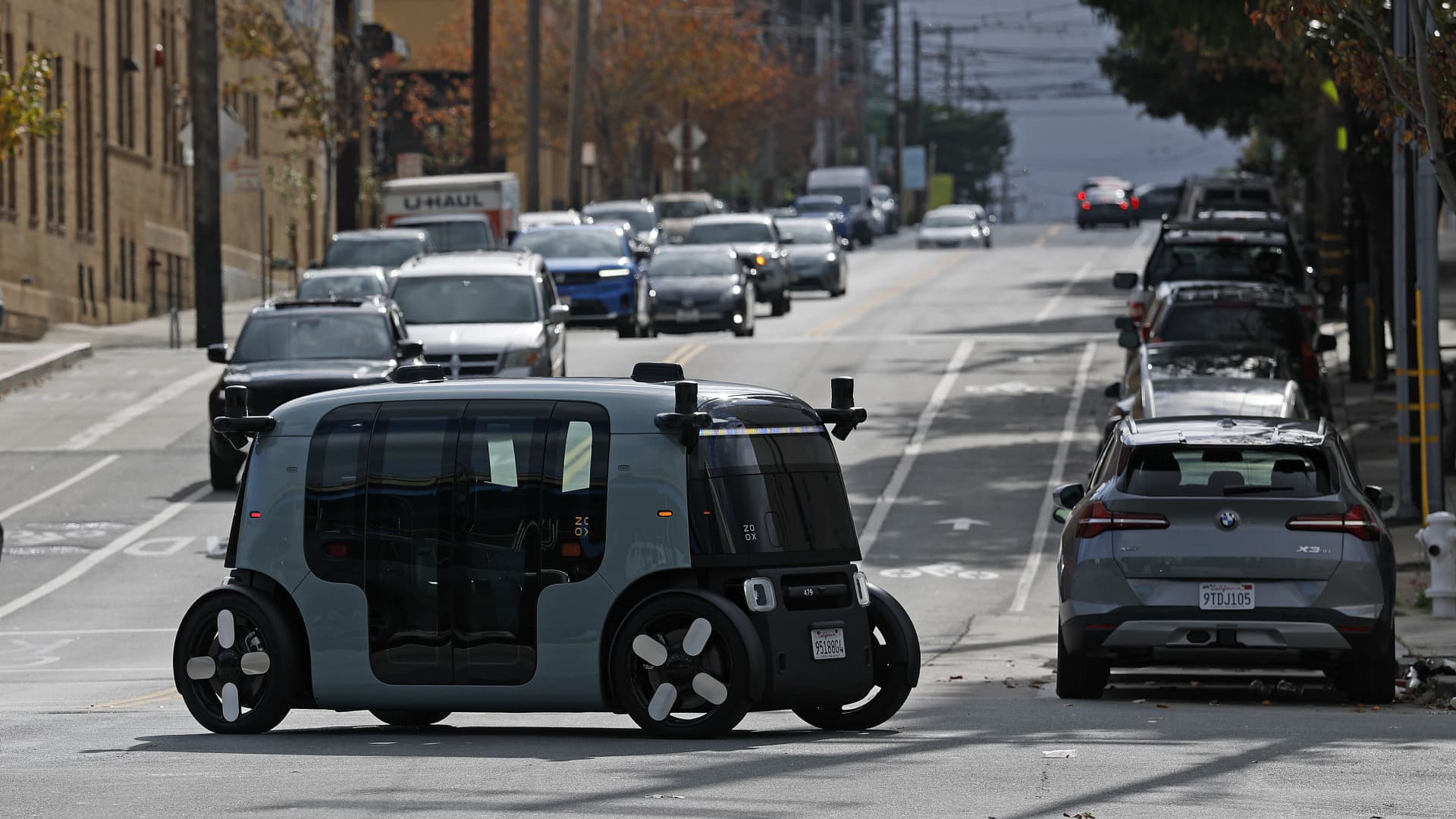
Amazon-owned Zoox on Thursday received a temporary exemption from U.S. regulators, clearing the way for the company to start charging for robotaxi rides. The exemption from some National Highway Traffic Safety Administration rules allows Zoox to deploy up to 2,500 vehicles annually for two years, "subject to an enhanced, adaptable oversight structure that can evolve as Zoox's technology advances," the agency said in a release.
Zoox CEO Aicha Evans called the approval an "important milestone" for the company and the broader autonomous vehicle industry. "We are honored to receive the first-ever commercial exemption for a purpose-built robotaxi from NHTSA, enabling us to begin charging for our service and take another step toward bringing autonomous ride-hailing to more communities," Evans said. A Zoox spokesperson said paid rides will start in Las Vegas next month, with additional markets to follow as the company meets state commercialization requirements.
Last August, NHTSA granted Zoox an exemption to operate its robotaxis on public roads. The company still lacked clearance to charge fares. Since then, it has expanded testing locations and allowed members of the public to hail free driverless rides in parts of San Francisco and Las Vegas.
Zoox has faced a harder path to commercialization than rivals like Alphabet's Waymo, which uses retrofitted cars with steering wheels and brakes. Zoox's toaster-shaped shuttles lack traditional driver controls, putting them under different federal motor vehicle safety standards. NHTSA has proposed updating its standards to drop requirements that driverless cars include steering wheels and manual brake pedals. The regulator has also called on autonomous vehicle developers to ensure their vehicles don't interfere with first responders.
NHTSA Administrator Jonathan Morrison wrote in a letter this month that the agency has "identified a clear pattern of driverless AVs interfering with law enforcement and other first responders." He cited incidents where AVs drove into active emergency scenes and blocked the paths of ambulances or firefighters. Following the letter, Zoox recalled 105 of its robotaxis to fix a software issue where vehicles failed to properly detect heavy smoke. Last month, one of its robotaxis drove into an active emergency fire scene in Las Vegas, the company said.