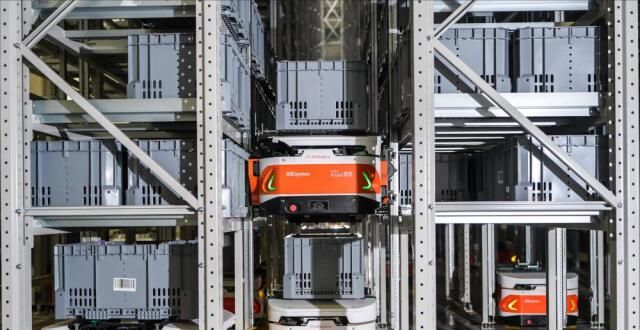
Cainiao deployed the ZeeBot climbing robot at its Dongguan warehouse, reporting a 100% improvement in human efficiency. The robot navigates vertical rack structures, retrieving and depositing goods above shoulder height without requiring lift platforms. That design directly attacks a persistent throughput bottleneck in e-commerce warehousing: the time workers spend climbing ladders or reaching high shelves. The deployment uses a retrofit approach integrating the robot into existing shelving layouts, lowering the upfront capital hurdle.
ZeeBot Climbing Robot and the Vertical Storage Bottleneck
The ZeeBot is not a standard autonomous guided vehicle confined to floor-level movement. It climbs shelving frames, granting access to inventory at multiple height levels within a single aisle. In the Dongguan facility, workers paired with the robot doubled their pick volume per shift under continuous operation. Cainiao has not disclosed unit cost, robot count, or maintenance data. Without those figures, the headline 100% efficiency gain is an incomplete input for margin analysis. A doubling of pick speed does not automatically reduce labor costs by half if the robot's capital expense amortizes slowly or if utilization drops during recharging intervals.
What the 100% Efficiency Gain Actually Changes for Cainiao
The simple read is that warehouse automation is advancing and reducing logistics costs. The better market read involves scaling risk and competitive response. Cainiao operates within Alibaba’s e-commerce ecosystem, handling delivery for Alibaba Group (BABA). A validated 100% gain at scale would lower per-package cost and shorten delivery times. That would strengthen Alibaba's logistics advantage over JD.com and PDD Holdings, both of which run their own automation programs. The deployment remains a single-site test, however. The efficiency figure applies to a narrow range of SKU sizes and order profiles in the Dongguan test. Scaling to a full distribution center multiplies coordination complexity and may erode the gain.
Scale-Up Timeline and Competitive Pressure
Investors tracking warehouse automation should watch two signals. First, whether Cainiao discloses unit economics in an investor call or filing. A cost-per-pick figure alongside total robot count would allow comparison with competitors such as Locus Robotics, Berkshire Grey, and Zebra Technologies. Second, whether those competitors announce climbing robot prototypes or partnerships within six months. A lack of response would suggest the ZeeBot technology is proprietary or difficult to license.
Cainiao’s next catalyst is an expansion announcement: number of additional warehouses, total robot fleet size, and measured throughput over a peak season such as Singles’ Day. The Dongguan test is a catalyst brief, not a full verdict. The 100% figure is striking, the execution path determines whether it translates into financial gains for Alibaba or for the wider stock market analysis around logistics automation.