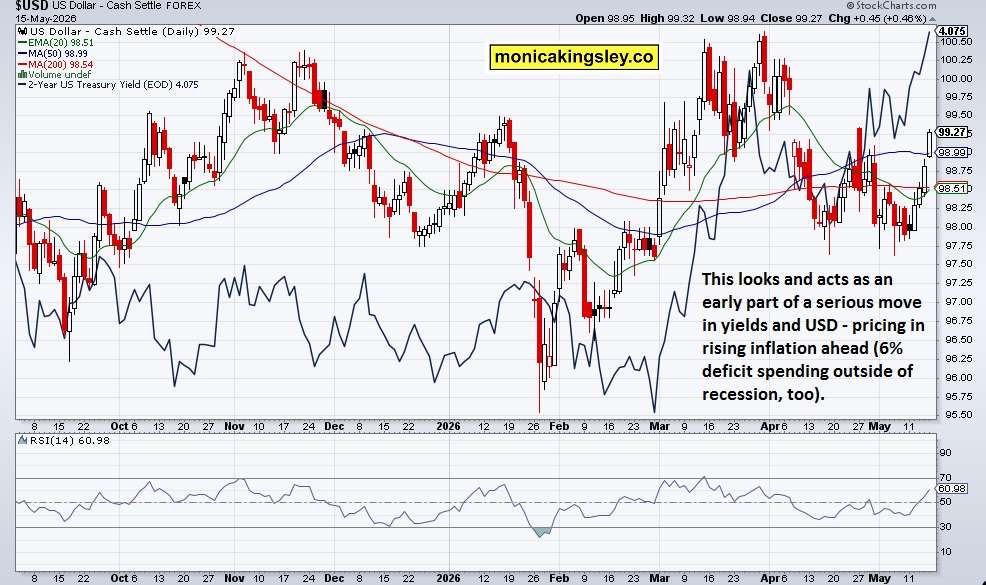
Friday's session saw the S&P 500 sell off into the closing bell after a brief intraday recovery. The Nasdaq held its intraday lows. That modest resilience masked a broader repricing. The Trump-Xi summit ended without dominating headlines. The macro transmission it left behind is clear: Treasury yields and the dollar are rising together, putting direct pressure on risk assets through the equity risk premium.
Yields and the Dollar: The Macro Signal
The combination of rising Treasury yields and a stronger dollar is the most important development from the end of the summit. Stocks dialed back their premarket decline after the opening bell, then retreated into the close. Precious metals followed the same path, giving up early gains.
This is not a one-day event. Markets are pricing in rising inflation combined with a US economy that remains robust enough to avoid recession signals. The job market shows cracks beneath the headline payroll figures. The participation rate, hourly earnings slowdown, a decline in full-time employment, and a rise in U6 unemployment all point to softening. Consumer sentiment has already weakened. The rise in yields reflects a repricing of inflation expectations, not just growth.
The corporate bond market does not display a two-speed economy. The divergence is within equities – between the narrow set of AI and tech stocks and everything else. This is more than the Warsh effect (the reaction to former Fed governor Kevin Warsh's hearing testimony). It is a structural repricing of inflation expectations.
Transmission Through the Equity Risk Premium
The mechanism is straightforward. Rising risk-free rates on Treasuries make equities less attractive by comparison. The equity risk premium – the extra return investors demand for holding stocks over bonds – is being squeezed. When yields rise, the present value of future cash flows falls. That hits growth and tech stocks hardest.
The S&P 500 and Nasdaq
The S&P 500 (SPY) could not sustain its intraday bounce. The Nasdaq (QQQ) held its intraday lows but did not rally. The safe-haven bid that emerged after the late-March bottom has been tech-led. Breadth is not broadening. Only a narrow set of tickers are being rewarded. If yields continue to climb, the pressure on equity valuations will intensify.
Sector Divergence: AI/Tech vs Financials and Consumer Discretionary
The sector rotation tells the story. AI and tech are the go-to trades. Financials and consumer discretionary are lagging. This is not a two-speed economy narrative. It is a rates-driven valuation squeeze. Financials typically benefit from a steeper yield curve. The rise in yields here is accompanied by a stronger dollar, which hurts multinational earnings and commodity-sensitive sectors.
Consumer Discretionary Under Pressure
Consumer discretionary stocks are particularly exposed to the weakening consumer sentiment and the rising cost of credit. The job market softness, combined with higher yields on consumer loans, is a headwind for spending. The sector's underperformance relative to tech is a warning signal for the broader market.
Job Market Cracks Beneath the Headline
The job market data shows more weakness than the headline payroll number suggests. Key indicators:
- The birth-death model contributed to last month's headline figures in the last payroll report.
- Participation rate and hourly earnings are slowing.
- There is a decline in full-time employment.
- The U6 unemployment rate is rising (includes discouraged workers and part-time workers seeking full-time work).
These factors weigh heavily on consumer sentiment, a theme that has built for weeks.
Precious Metals and Commodities Under the Dollar Weight
Gold and silver retreated into the close alongside equities. The rising dollar and yields are overwhelming the safe-haven bid. Gold is caught between inflation hedging and a stronger dollar. For now, the dollar is winning. Crude oil also faced headwinds. The Hormuz Strait headlines have faded. Oil remains tied to demand fears and the dollar's direction.
The Dollar's Dual Role
The dollar is both a reflection of relative rate differentials and a driver of risk appetite. A stronger dollar tightens financial conditions. That is the last thing risk assets need when inflation expectations are rising. The Fed is not expected to cut rates soon. The market is pricing in a higher terminal rate. That keeps the dollar bid and puts a lid on commodities.
See our profiles for more on gold and crude oil.
What Confirms the Setup: The Next CPI Print
The next scheduled data point that can confirm or break this setup is the CPI print. A hot CPI would reinforce the inflation repricing, pushing yields and the dollar higher, and pressuring equities further. A cooler print would relieve some of the pressure. The trend in yields is already established. The market is watching for any sign that the Fed will acknowledge the stickiness of inflation.
Practical rule: When yields and the dollar rise together, the default trade is to reduce exposure to rate-sensitive equities and increase cash or short-duration bonds. The equity risk premium cannot recover until yields stabilize.
For a deeper look at how a hot CPI reshapes the Fed path and the S&P 500, see our earlier analysis: Hot CPI Reshapes Fed Path; S&P 500 Drops 1.24%.
The Trump-Xi summit may have ended. The macro transmission from yields and the dollar is just getting started. The next move in risk assets will be determined by whether the 10-year yield breaks above its recent highs and whether the dollar index extends its rally. Until then, the market remains in a repricing phase where selective exposure to AI and tech is the only area showing relative strength.