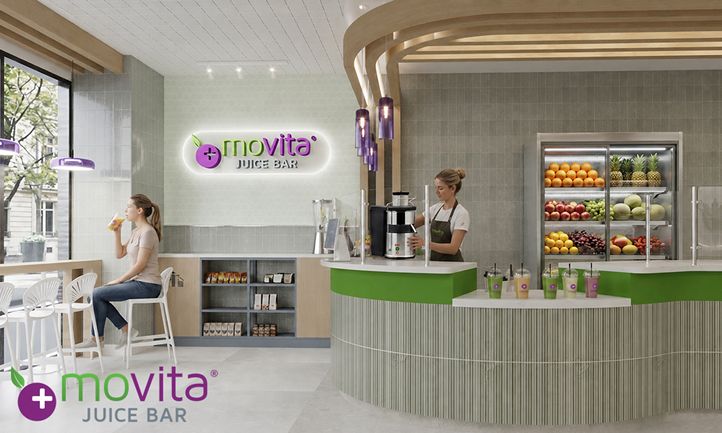
The recent redesign of the Movita Juice Bar location in Norwalk, California, marks a deliberate shift in how wellness franchises manage brand identity during rapid expansion. By partnering with Mindful Design Consulting, the company has moved away from the high-stimulation, graphic-heavy aesthetic common in the juice and dessert sector. Instead, the brand is adopting a restrained, intentional interior framework designed to support its footprint across Los Angeles and Orange County.
Rethinking the Wellness Environment
Most retail concepts in the health-focused space rely on visual noise to attract foot traffic. Movita’s approach, rooted in its "More Life" philosophy, rejects this in favor of a neutral base of whites and grays accented by purposeful greens and purples. This is not merely an aesthetic choice; it is a functional strategy to reduce customer fatigue. By creating a calm environment, the brand aims to increase dwell time and repeat visits, which are critical metrics for any franchise model scaling into new, competitive markets.
For investors and operators, the design serves as a proxy for operational maturity. When a brand standardizes its interior architecture, it lowers the friction of opening new units. Mindful Design Consulting has provided the brand with a cohesive system that includes construction documents and permit-ready plans. This level of standardization is the backbone of successful franchise scaling, as it ensures that the customer experience remains consistent whether a location is in a high-density urban center or a suburban strip mall.
The Service Counter as Operational Anchor
In the new Norwalk design, the service counter functions as the primary operational and visual anchor. By putting the juicing process on display, the brand leverages transparency to justify its premium positioning. The use of layered materials—wood, tile, and quartz—combined with a sculptural soffit and integrated lighting, creates a high-end feel that is nonetheless repeatable.
This focus on the "process" is a strategic move to differentiate the brand from competitors that rely on pre-packaged or opaque preparation methods. Transparency in the production area acts as a silent salesperson, reinforcing the quality of the ingredients and the brand's commitment to a health-driven lifestyle. For those tracking the stock market analysis of the broader consumer discretionary sector, this shift toward "experience-based" retail is a recurring theme among brands looking to defend their margins against lower-cost alternatives.
Scalability and Franchise Consistency
Mindful Design Consulting specializes in creating design systems that survive the transition from a single location to a multi-state franchise. The firm’s methodology involves creating a "design DNA" that can be adapted to various floor plans without losing the core identity. This is essential for Movita as it continues to expand its footprint. Without such a framework, brands often suffer from "design drift," where early locations look and feel fundamentally different from newer ones, confusing the customer and diluting the brand's value proposition.
While the company is not currently a publicly traded entity, its growth trajectory mirrors the operational rigor seen in larger industrials like Fastenal Company, which maintains a strict, standardized service model to ensure efficiency across its massive distribution network. Similarly, the utility sector often relies on predictable, regulated growth models, such as those seen with Southern Company, to maintain investor confidence. Movita’s move to standardize its physical footprint is a necessary precursor to attracting institutional capital or private equity interest.
Risk and Execution Factors
Any franchise expansion carries the risk of over-extension, particularly when the brand relies on a premium, health-focused identity. The primary risk for Movita is not the design itself, but the ability to maintain the quality of the "fresh" experience as the number of locations grows. If the supply chain for fresh produce cannot keep pace with the expansion, the physical design will become a hollow shell.
Investors should look for evidence that the brand’s operational guidelines are as robust as its design guidelines. A beautiful space is an asset only if the service and product quality remain consistent. As the company moves into new markets, the ability to maintain this "calm, intentional" environment while managing the complexities of a larger supply chain will be the true test of its scalability. The current design strategy provides the foundation, but the execution of the daily operations will determine if the brand can successfully transition from a regional player to a broader market competitor.