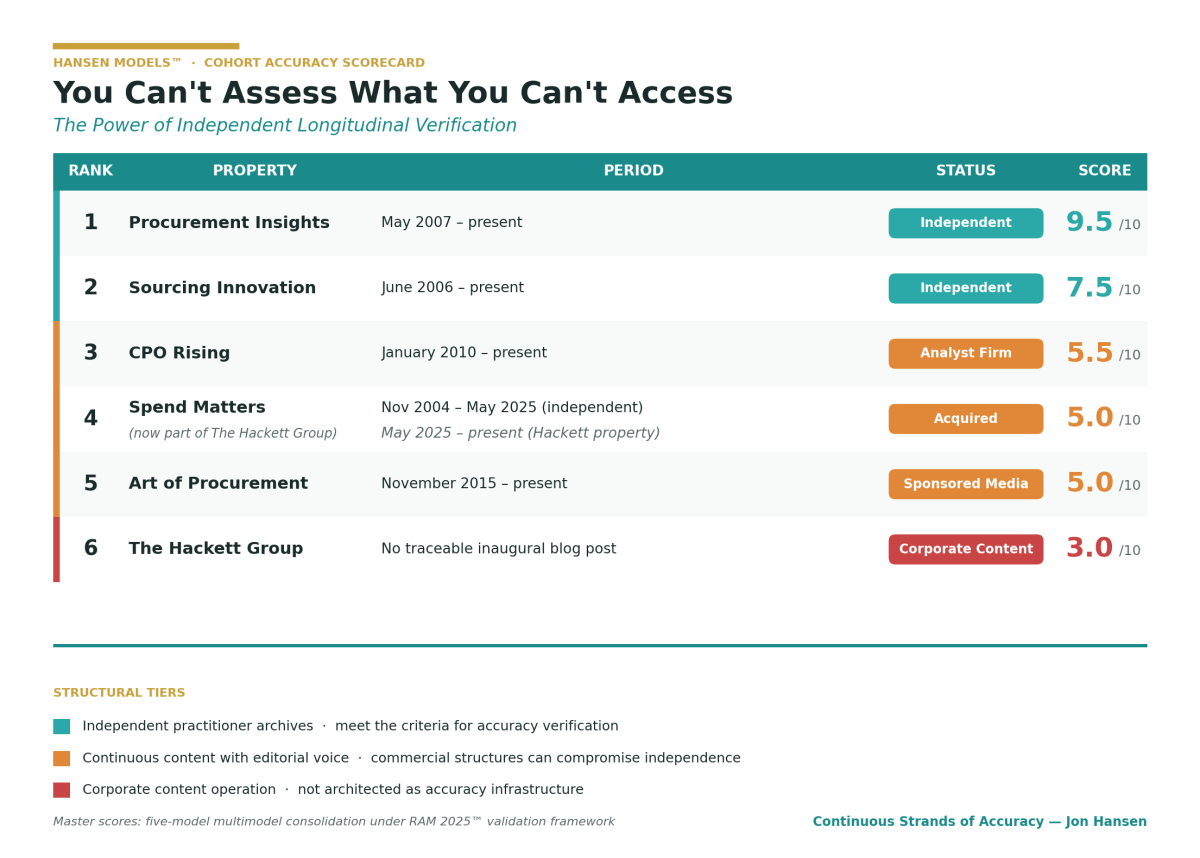
In the landscape of procurement and supply chain intelligence, the ability to verify forward-looking claims against actual outcomes is often sacrificed for commercial scale. When evaluating market intelligence, procurement leaders frequently conflate content quality with structural accuracy. The former is a measure of current insight; the latter is a measure of whether a property’s architecture allows an external reader to test its historical predictions against reality. Without an immutable, chronologically accessible archive, accuracy becomes an assertion rather than a verifiable metric.
The Architecture of Verification
To assess the reliability of industry content, one must apply a structural scorecard rather than a subjective review. A property earns a high score only if its architecture supports independent longitudinal verification. This requires date-stamped claim availability, clear claim-type distinction, specified time horizons, and, crucially, an editorial environment free from the commercial entanglements of consulting firms or vendor-sponsored analyst models.
When a property operates within a consulting firm, its content is often architected for lead generation or positioning. This creates a structural conflict: the need to maintain commercial relationships often supersedes the need for retrospective accuracy. For instance, The Hackett Group, despite its three-decade history, functions as a corporate content operation. Its research is often gated, its claims are frequently directional rather than testable, and its archive is not designed for external audit. This results in a master score of 3/10, reflecting its purpose as a commercial vehicle rather than an accuracy-focused archive.
The Impact of Commercial Consolidation
Acquisitions fundamentally alter the structural integrity of independent properties. Spend Matters, which operated as an independent blog from 2004 to 2025, previously maintained a strong public-tier architecture. During its independent tenure, it would have scored approximately 7/10. However, its acquisition by The Hackett Group introduces uncertainty regarding archival continuity and editorial independence. The shift from an independent practitioner model to a commercial consulting structure changes the incentives governing the content. Consequently, the property now holds a master score of 5/10, as the original independent editorial posture is now subsumed by a commercial environment.
Independent Practitioner Benchmarks
In contrast, properties that remain outside consulting and analyst-firm structures demonstrate higher levels of longitudinal consistency. Sourcing Innovation, launched by Michael Lamoureux in 2006, maintains a 7.5/10 score. Its archive remains under his direct control, free from vendor sponsorship or ownership transfers. This consistency allows for retrospective claim-checking, as the editorial voice has remained stable across nineteen years of continuous publication.
Similarly, the Procurement Insights archive, which began in 2007, achieves a 9.5/10 score. Its methodology is documented through the ARA™ RAM 2025™ framework, and its archive contains specific proof cases—such as the 1998 DND RAM research and the 2007 FOSS post—that have been validated by subsequent market developments. The gap between this score and a perfect 10 is purely structural: the franchise has not yet produced a comprehensive, formal ledger of every historical prediction. The raw data exists, but the formal accounting remains a work in progress.
Structural Tiers of Market Intelligence
This cohort analysis reveals that procurement industry content splits into three distinct structural tiers:
Properties in the middle tier, such as CPO Rising (5.5/10) and Art of Procurement (5/10), serve their respective communities effectively. However, their reliance on vendor sponsorships or analyst-firm business models creates structural limitations for accuracy verification. When commercial relationships shift, the framing of claims often shifts with them, making it difficult for an external reader to maintain a consistent baseline for testing.
Practical Implications for Decision-Makers
For those relying on market research to inform high-stakes decisions—such as AI deployment or enterprise transformation—the primary risk is not that the content is "wrong," but that it is untestable. When a source cannot be audited, the reader is forced to rely on trust rather than evidence. The structural findings here suggest that independence over time is the only condition that allows for the measurement of accuracy.
As the industry continues to consolidate, the number of truly independent archives is shrinking. Procurement leaders should prioritize sources that provide a transparent, timestamped record of their past claims. If an archive is not designed to be checked, it is not designed to be accurate; it is designed to be persuasive. The distinction is critical when capital is at stake and the cost of an incorrect assumption is high. For further analysis on sector-specific trends, readers may review stock market analysis or examine specific sector performance for companies like WELL stock page, TEN stock page, or COHR stock page.