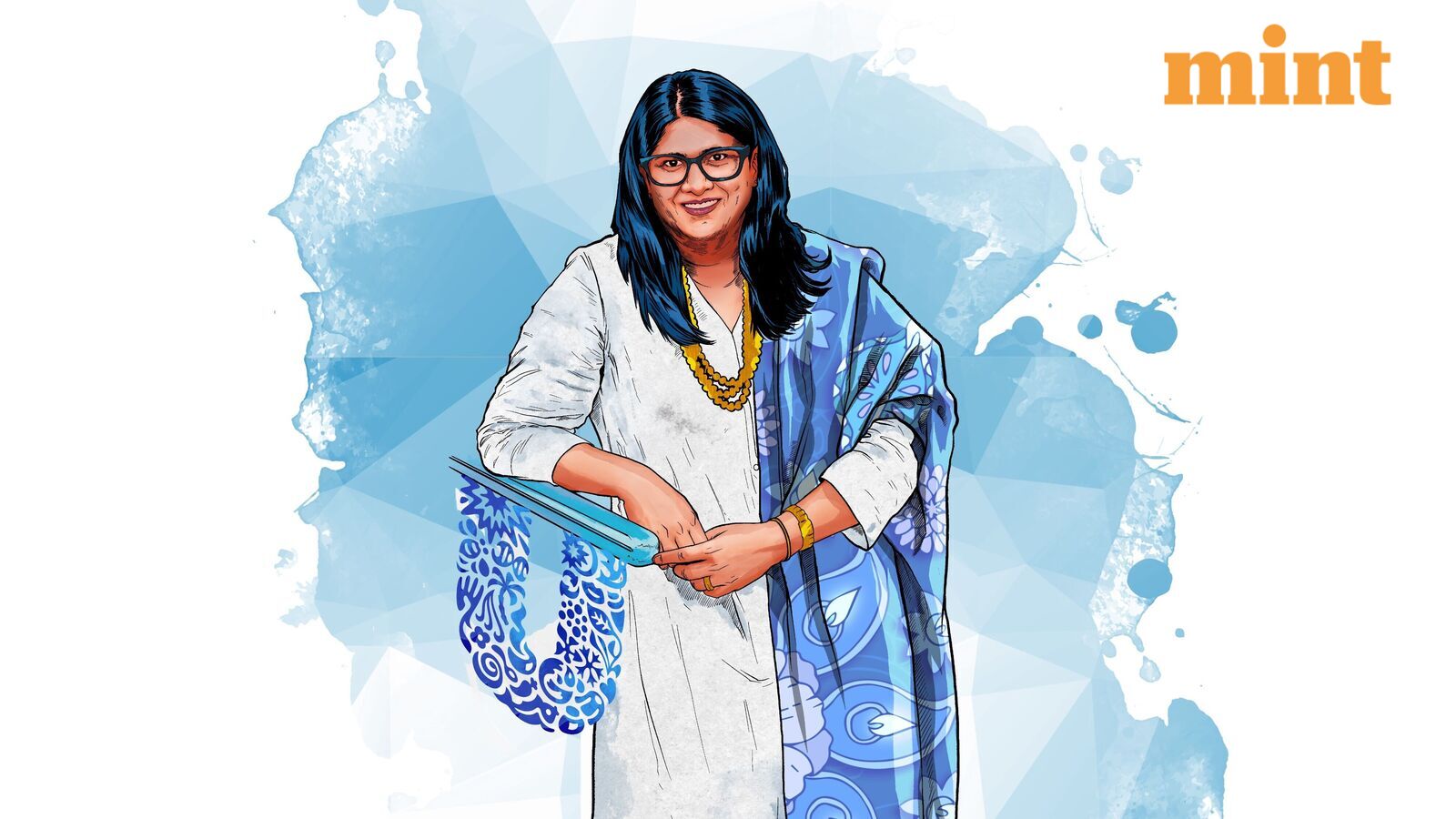
The Kan Khajura Playbook Meets a Different Market
Hindustan Unilever Ltd (HUL) named Priya Nair as managing director and CEO in August 2025, replacing Rohit Jawa after a two-year tenure defined by stagnant volumes and a 20% share price decline over three years. The Nifty 50 gained 24% in the same period.
Nair returns to the Mumbai headquarters with a mandate to rebuild a business that lost ground to nimble direct-to-consumer (D2C) brands while the broader Indian personal care market expanded. Her strategy hinges on three levers: faster decision-making, premiumization of the product mix, and aggressive quick commerce distribution.
Investors are watching whether these moves can restore volume growth to historical levels or merely defend market share in an increasingly fragmented market.
The Growth Stagnation That Sparked a Change
HUL's underlying volume growth slid from 5% in FY2023 to 2% in FY2024 and remained at 2% the following year. The company blamed sluggish rural demand, input cost pressure, and uneven weather. The broader Indian personal care market was expanding, driven by D2C entrants that captured urban consumers seeking innovation.
Practical rule: When the fastest-growing sub-segments are inaccessible to mass-scale manufacturing and distribution, the incumbent's scale becomes a liability, not an asset.
The Missed D2C Wave
The disconnect was clear: while HUL focused on core mass-market brands like Wheel, Lifebuoy, and Clinic Plus, startups scaled quickly through digital channels. Fireside Ventures partner Adarsh Menon notes that a brand can now reach ₹500 crore in revenue through online and quick commerce presence alone. For context, Minimalist–in which HUL holds a 90.5% stake–had an annual recurring revenue run rate of about ₹850 crore in FY2026, while OZiva reported ₹462 crore. HUL has only about 20 brands with annual revenue exceeding ₹1,000 crore, most of them legacy names like Sunsilk, Vaseline, and Lux.
Leadership Exodus and Centralized Decision-Making
Despite HUL's reputation as a training ground for India's consumer industry, a steady stream of senior executives left in recent years. Kartik Chandrasekhar, Sandeep Kohli, Madhusudhan Rao, and Prabha Narasimhan all departed between 2022 and 2024, with Narasimhan joining rival Colgate-Palmolive. One former senior executive described the problem: "The decision-making power shifted outside of India."
Nair's first structural change was dismantling the dual reporting system that required local leaders to report both to India and Unilever Plc. She brought in four new chief marketing officers who now report directly to India business heads. "This will strengthen empowerment, accelerate decision-making and ensure more India-for-India choices," she told analysts in February.
The Quick Commerce and Digital Pivot
HUL has established a dedicated quick commerce organization, with the quick commerce lead reporting directly to the sales head. This channel currently accounts for about 3% of total revenue. The shift reflects a broader change in how Indian consumers buy daily goods–smaller baskets, faster delivery, and higher frequency.
AI-Generated Advertising Gains Traction
Digital media spending now accounts for 40% of total media spends, up from 25% in FY2024. Coffee brand Bru ran a campaign using Google Gemini for coffee-date content. The strategy prioritizes agile, targeted campaigns over single national television spots.
Manufacturing Flexibility as a Constraint
One former executive noted a practical barrier: "There was a time in HUL when we could not manufacture anything below one tonne." Large-batch manufacturing economics made it difficult to serve small, niche consumer cohorts. Nair is working to shift the R&D and supply chain toward smaller, faster production runs tailored to specific channels and regions.
Premiumization as a Volume Growth Engine
HUL's March quarter results showed volume growth surging to 6% year-on-year–a 15-quarter high. Net profit rose 21.3% to ₹2,994 crore on revenue of ₹16,351 crore, beating Bloomberg consensus estimates of ₹2,612 crore in profit and ₹16,270 crore in revenue. The improvement was driven by premiumization and improving urban demand.
From Powder to Liquid Detergents
CFO Niranjan Gupta cited the shift from powder to liquid detergents as a key premiumization driver. "As market leaders, driving premiumization remains a fundamental priority," he said in April. HUL has committed ₹2,000 crore in capital expenditure on premium formats in beauty and home care.
The Turner Speed Problem
A competing FMCG executive highlighted a structural tension: a ₹10 Lux soap bar turns over quickly in any Indian store, generating reliable cash flow for distributors. A premium product like Lux body wash or Minimalist offers better margins slower turnover. Distributors prioritize cash flow velocity over margin percentage–a dynamic that limits premium product shelf penetration.
A Delhi-based HUL distributor confirmed that staple variants of Vaseline move faster than premium products like Minimalist. This creates a distribution ceiling on premiumization unless HUL can solve the cash-flow incentive problem for its retail partners.
| Metric | HUL (March Qtr FY2026) | HUL (March Qtr FY2025) | Change |
|---|
| Volume Growth | 6% | 2% | +4pp |
| Net Profit | ₹2,994 crore | ₹2,469 crore* | +21.3% |
| Revenue | ₹16,351 crore | ₹15,194 crore* | +7.6% |
| *Estimated from reported growth rates | | | |
Acquisition Strategy: Building vs. Buying
HUL has an uneven track record with acquisitions. The ₹3,045 crore purchase of Horlicks, Boost, and Maltova from GSK in 2020 came as the premium end shifted to protein powders and sugar-free products. Globally, Dollar Shave Club was acquired in 2017 and sold to Nexus Capital Management in 2023. Ben & Jerry's founders have publicly criticized parent company management.
Stakes in Minimalist and OZiva
HUL first invested in Minimalist through Unilever Ventures in 2021 and now holds a 90.5% stake in parent company Uprising Science. It acquired OZiva fully last fiscal year. These bets give Nair exposure to fast-growing premium niches. The challenge is integrating them without losing the agility that made them successful.
Key insight: A large FMCG company trying to serve small consumer cohorts resembles "an elephant trying to catch a mosquito," as former IIM Bangalore professor S. Raghunath put it.
Investor Sentiment and the Path to Confirmation
As of May 2026, 29 of 41 analysts tracking HUL had buy ratings, down from 36 of 43 in May 2023. Investors are waiting for sustained evidence of growth acceleration.
What Confirms the Thesis
- Volume growth sustains above 4% for two consecutive quarters
- Quick commerce revenue share crosses 5% within 12 months
- Premium brands (Minimalist, OZiva, Dove) show ₹1,000 crore+ annual revenue within 24 months
- Distributor cash-flow metrics improve–premium products' turnover times narrow versus staples
What Weakens the Thesis
- Volume growth falls back to 2% as urban demand softens or rural recovery stalls
- Premiumization fails to translate into market share gains against D2C competitors
- Distribution partners continue to de-emphasize slower-turning premium SKUs
- Margin pressure emerges if HUL must discount to clear premium inventory
The Unilever Parent Mandate
Unilever Plc CEO Fernando Fernandez identified India as one of two "anchor markets" for the group, alongside the US. "We got late into the Chinese party; we will not get late into the Indian party," he said at the Deutsche Bank Global Consumer Conference 2026. Nair's performance will be measured against that directive.
The Next Decision Point
HUL's performance in the June and September quarters will test whether the March quarter beat was a one-off or the start of a sustained turnaround. UBS analysts wrote that lifestyle nutrition "appears to have unlocked the double-digit growth trajectory" and that beauty and wellbeing is "a candidate for revival of growth in double-digits this year."
Nair's ability to execute on quick commerce, premiumization, and faster decision-making will determine whether HUL can close the performance gap with the broader market. The stock's 20% decline over three years reflects investor skepticism. The March quarter data gives a reason for cautious optimism–not yet for conviction.
For context on how FMCG valuation and distribution dynamics differ from tech or financials, see AlphaScala's stock market analysis. Readers tracking the consumer staples sector can compare HUL's approach with that of Colgate-Palmolive (Alpha Score 48, Mixed) or Unilever PLC (Alpha Score 51, Mixed).