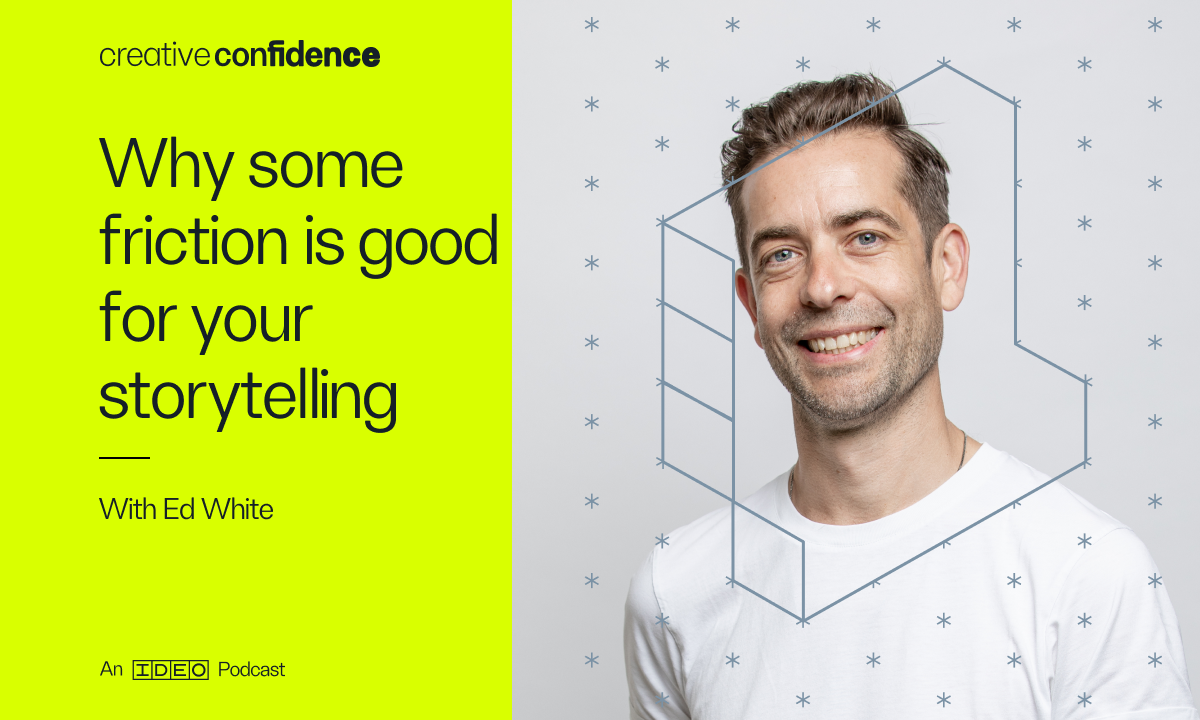
"This is hard," Ed White's friend texted him. He was about to publish his first piece of writing, and the discomfort of putting it out into the world was setting in.
There are many barriers to developing storytelling. Ed would know. He has been in the profession for more than 12 years, first as a writer at the Financial Times, Wired, and Contagious, and now as a Senior Design Director at IDEO, where he co-leads the firm's AI portfolio across Europe.
"People suffer from both a fear of the blank page and from feeling judged," he says about the emotion tied to the process of crafting a story. He has felt it himself. "I was terrified of my first pieces of writing and how they would be perceived."
The good news, he says, is that sharing with AI and using it as an editor can lower the barrier to entry. It can give people enough confidence to take that first step and keep going. That matters because a great idea that is not communicated well is unlikely to survive. IDEO has seen it in more than 40 years of innovation work. A good idea is not enough. You have to communicate it with clarity and conviction. You have to get the people who matter to take action on it.
In this conversation with Mina Seetharaman on the Creative Confidence Podcast, Ed talks about how to use AI thoughtfully in storytelling, why friction and discomfort are a benefit, and what he is hearing about the evolution of craft from leaders at Anthropic, Lovable, Shopify, and Google Creative Lab.
Listen on Apple, Spotify, YouTube, or wherever you get your podcasts.
We have enough AI-generated content. More than we would ever want. What we need is more human storytelling. Stories that sound unusual, specific, and have a point of view.
Ed says that will not come from having AI do your writing. But you can get there by using AI as an editor.
"Don't think of it as a writer. Hold yourself as a writer." – Ed White, Senior Design Director, IDEO
A good editor asks the sharp questions you have not thought to ask yourself, like an angle you have not considered or a gap in your logic. "It's not quite a roast," Ed says, "but it is a way of sharpening your story." That is one of the core skills AI can help with, and Ed shared two specific ways he puts it to work.
AI is good at flattery. Ed's workaround: prompt it to be brutal instead. Point out contradictions, weak transitions, paragraphs that lose the reader. It might sound harsh, but it can be more helpful than compliments. Your friends and colleagues may hold back to preserve your feelings. An AI will not.
Instead of asking AI to critique your draft, use it to simulate the audience the story is for. Prompt it to create a persona based on a specific board member or client. Then rehearse your pitch on that stand-in. It is a way to prepare for a room you cannot practice in front of.
Ed's conversations with design leaders at Anthropic, Lovable, Shopify, and Google Creative Lab all pointed to the same shift. The middle stretch of creative work – the drafting, prototyping, building – is compressing fast, because AI has gotten good enough to do a lot of it.
That shift comes with a real concern. As Ed puts it: "What makes you competitive, what makes you distinctive, I think IDEO would always say, is your people – the skills that they have, the capacity that they have. And the thing that has been in the back of my mind for a while is what happens when an organization starts to lose that capacity, when the people within it start to lose the ability to think through things, to work through things."
What is becoming more valuable is the ability to ask sharper questions about what is worth making, and to craft the nuance at the finish.
Ed does not think of friction as a problem to solve. "Writing and storytelling starts with really thinking something through," he says. "And the friction, as we talk about it, sounds annoying, sounds slower. But actually, that's where the value comes from – working through something. The act of writing and the act of editing is the act of reasoning through something, understanding the trade-offs, and understanding how to shape a story that lands with people."
He believes the ability to wade through the difficulty is an increasingly important skill in a world that is becoming more frictionless by default. Skip the friction, and you get something that is legible, but says nothing.
Ed borrows a framework from Adam Moss's book "The Work of Art": creative work moves through imagining, judging, and making. AI can help with the first and the last. The middle one – knowing in your gut that something is right – is still something unique to humans, built from years of telling stories to real people and learning what lands.
Use a roasting agent. Prompt AI to critique your draft directly – contradictions, weak spots, where you lose the reader – instead of asking if it is good.
Rehearse on a simulated audience. Before a big pitch, prompt AI to act as the specific person or group you are presenting to, and let it push back first.
Don't let AI steal your lousy first draft. The bad first attempt is where you figure out what you actually think. Write it yourself, then bring AI in to sharpen it.
IDEO U's Creative Storytelling with AI – taught by Ed White alongside fellow IDEO design leads Max Lackner and Tiange Wang – has enrollment closing August 20.
"On Writing Well" by William Zinsser and "The Work of Art" by Adam Moss are highly recommended by Ed for those looking to evolve their storytelling craft.
For more advice on storytelling, check out our episodes on storytelling for entrepreneurs with Tom Kelley, turning data into compelling stories with Justin Massa, and experimenting with presentation story arcs with Ann Kim.