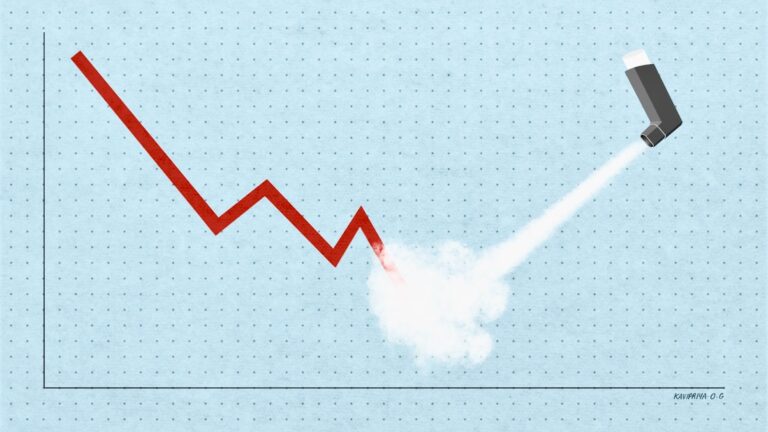
Cipla reported one of its worst quarterly profits in recent years on 13 May. The next day the stock jumped 8%. The disconnect comes down to one product that is not an ordinary inhaler.
Cipla's Worst Quarter in Years – And Why It Didn't Matter
Profit after tax for the March 2026 quarter came in at Rs 555 crore, roughly 55% below the same period a year earlier. Revenue slipped 2.8% to Rs 6,540 crore ($687 million). The damage was concentrated in North America, where sales fell 26% to $155 million.
The headline numbers should have punished the stock. Instead, investors focused on what is coming next, not what just happened.
The Ventolin HFA Pivot That Changed the Narrative
In April, Cipla received FDA approval for a facility in Massachusetts to manufacture a generic version of Ventolin HFA, one of the most-prescribed emergency-use asthma drugs in the world. The branded product, made by London-based GSK, controls more than half of the US rescue-inhaler market. Global sales for Ventolin HFA exceed $890 million.
One analyst who has tracked active pharma ingredients and US drug markets for over 15 years estimated that Cipla could capture over $100 million a year from the generic version alone. That single revenue stream, if realised, would more than offset the earnings miss.
Revlimid and Lanreotide – The Products That Fell Off a Cliff
The steep drop in North America revenue has a clear cause. Two highly profitable products – Revlimid (a cancer drug) and Lanreotide (a hormone drug) – disappeared from US shelves within three months. Together they accounted for 35–40% of Cipla's US sales, according to a former company executive. Their removal left a gap that the inhaler pipeline is now expected to fill.
Three More Inhalers in the Pipeline
Cipla's management hinted during the earnings call that three other inhaled products could receive FDA approval during the current financial year:
- Generic Advair (daily-use asthma inhaler, originally GSK)
- Generic Symbicort (daily-use inhaler, originally AstraZeneca)
- Generic Qvar (daily-use inhaler, originally Teva Pharmaceuticals)
Combined, these three drugs open up a billion-dollar addressable market. AstraZeneca holds an Alpha Score of 53/100 (Mixed) in the healthcare sector, reflecting the competitive pressure generic entrants like Cipla bring to the branded franchise.
What the Market Is Pricing In – And What It Ignores
The simple read: current earnings do not matter because the pipeline will deliver massive incremental revenue. The better market read requires more scrutiny.
Investors are discounting a future where all four inhaler approvals materialise on schedule and generate the projected revenue. That assumption carries execution risk. FDA approval timelines can slip. Manufacturing quality issues can halt production. Competitors such as Dr Reddy's – which also reported a US sales decline this quarter – are pursuing similar generics.
Key risk: timeline uncertainty
Cipla’s Massachusetts facility just received its first FDA nod. Ramping up commercial-scale production for a metered-dose inhaler, a technically complex dosage form, takes time. Any delay in the three follow-on approvals would stretch the revenue ramp into 2027 or later.
The Rx for Traders: What Confirms or Weakens the Thesis
- Confirmation: Actual FDA approvals for generic Advair, Symbicort, and Qvar within the stated financial year. Quarterly US revenue inflection as the Ventolin generic gains shelf space.
- Weakens: Any FDA warning letter or Form 483 at the Massachusetts site. A competitor, such as Viatris or Sandoz, launching a generic Ventolin first. Slower-than-expected physician adoption.
The stock rallied on an event that has not yet generated revenue. The next 12 months will determine whether the market's forward look was astute or premature.
Cipla's story has shifted from a fading US generics business to an inhaler-driven recovery. The Q4 earnings miss is now a footnote. What matters is whether the FDA issues the remaining approvals on time.