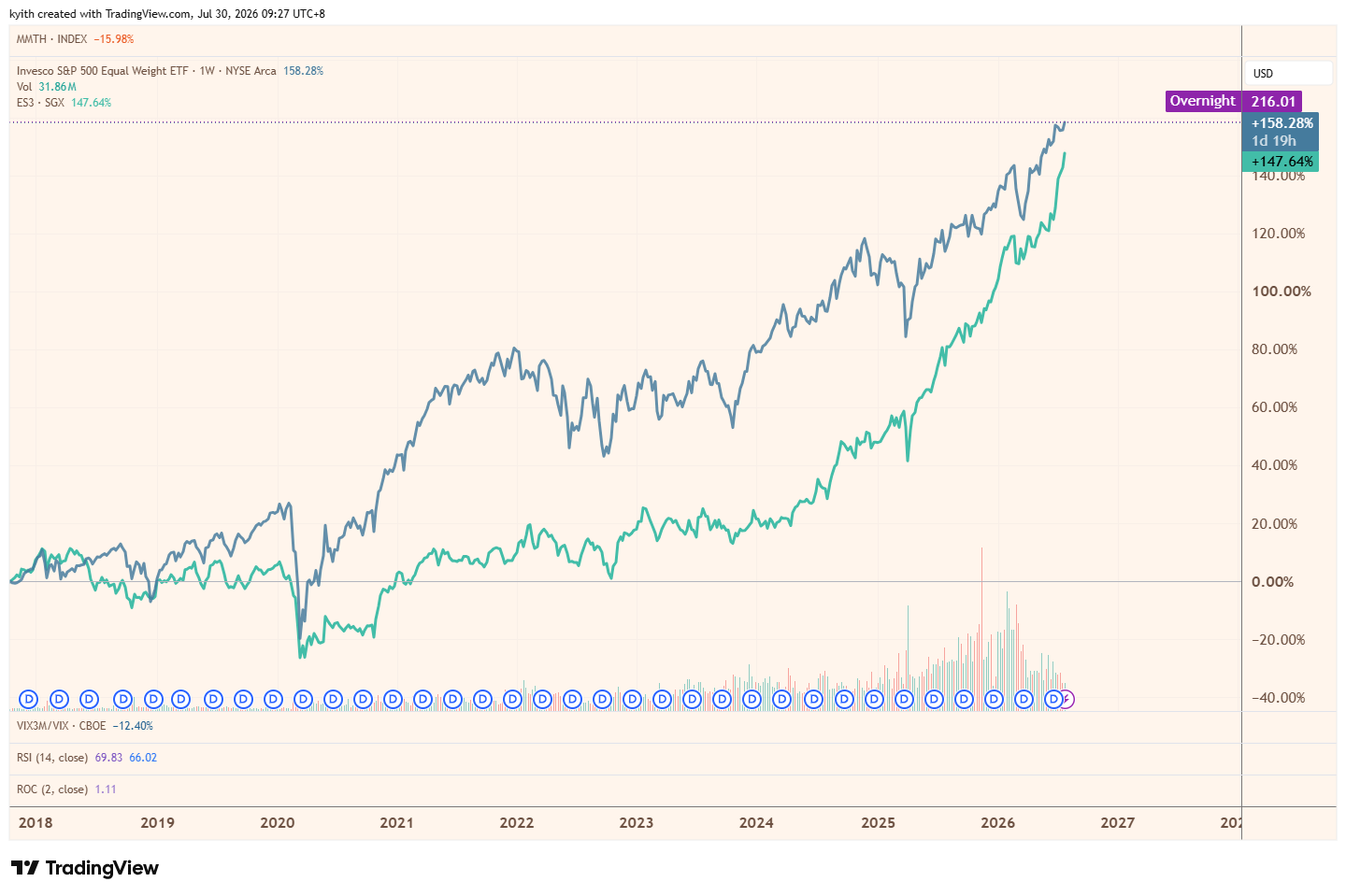
A Singapore-based investment blogger made a case for broad diversification that goes beyond the usual index-fund pitch. Kyith, who writes the Investment Moats blog, pointed to the Invesco S&P 500 Equal Weight ETF (RSP) as a 23-year example of how a portfolio that owns every S&P 500 member at the same tiny allocation can still deliver an 11% annualized return.
RSP launched in April 2003. It holds all 505 stocks in the S&P 500 at equal weight, meaning the largest position in the fund carries roughly 0.2% of assets. Through dividends and price appreciation, the fund returned about 1,100% cumulative, or 11% a year. Kyith said most investors would call that a very good outcome.
Yet many investors cannot help comparing equal-weight returns to the cap-weighted S&P 500, tracked by SPY. That comparison is instructive. RSP led SPY for roughly 20 years. Only the recent technology-driven rally flipped the order. Kyith made the point that the fear of a widely diversified portfolio is the fear of missing out on the winners. RSP's record shows a 10-bagger is possible without picking a single big winner.
He highlighted how small each holding is. Even the top 50 positions in RSP carry allocations only slightly above the theoretical 0.198%. Many companies in the top 50, such as PayPal Holdings (PYPL stock page), have struggled. Brown & Brown and Global Payments also lagged. Yet the aggregate of hundreds of small positions produced the 1,100% return.
Kyith drew a parallel to Singapore's Straits Times Index. The STI is heavily concentrated: three banking stocks account for 56% of the index. He compared the STI ETF's dollar-denominated performance to RSP since 2008. For 15 years, the diversified U.S. ETF outperformed the concentrated Singapore benchmark. Only in the last four years did the STI catch up and surpass RSP, driven by a sharp revaluation of the local banking sector.
"As people are celebrating the great performance of the last 4 years, I wonder if that concentration makes investors feel vulnerable," Kyith wrote. He cautioned that the past two years' revaluation may not repeat over the next 30 years. Concentration has advantages when it works, he said. The risk is that survivorship bias makes the winners look inevitable in hindsight.
Kyith argued that many investors cannot imagine decent returns from a non-concentrated portfolio. The data suggests otherwise. RSP's 23-year track record offers a counterpoint to the belief that picking the 'right' companies is the only path to strong returns. The idea that a strategy "not beholden to a selected group of important stocks" can deliver 5% to 10% a year over the long term is, in his words, "just so unique."
The AlphaScala score for PYPL is 54 out of 100, labeled Mixed, reflecting the mixed performance Kyith referenced. For broader market context, see stock market analysis.
Kyith's own portfolio, managed via Interactive Brokers, reflects his philosophy of broad diversification. The open question is whether the recent dominance of mega-cap stocks will persist. RSP's two-decade record suggests that the answer may not matter as much as investors think.