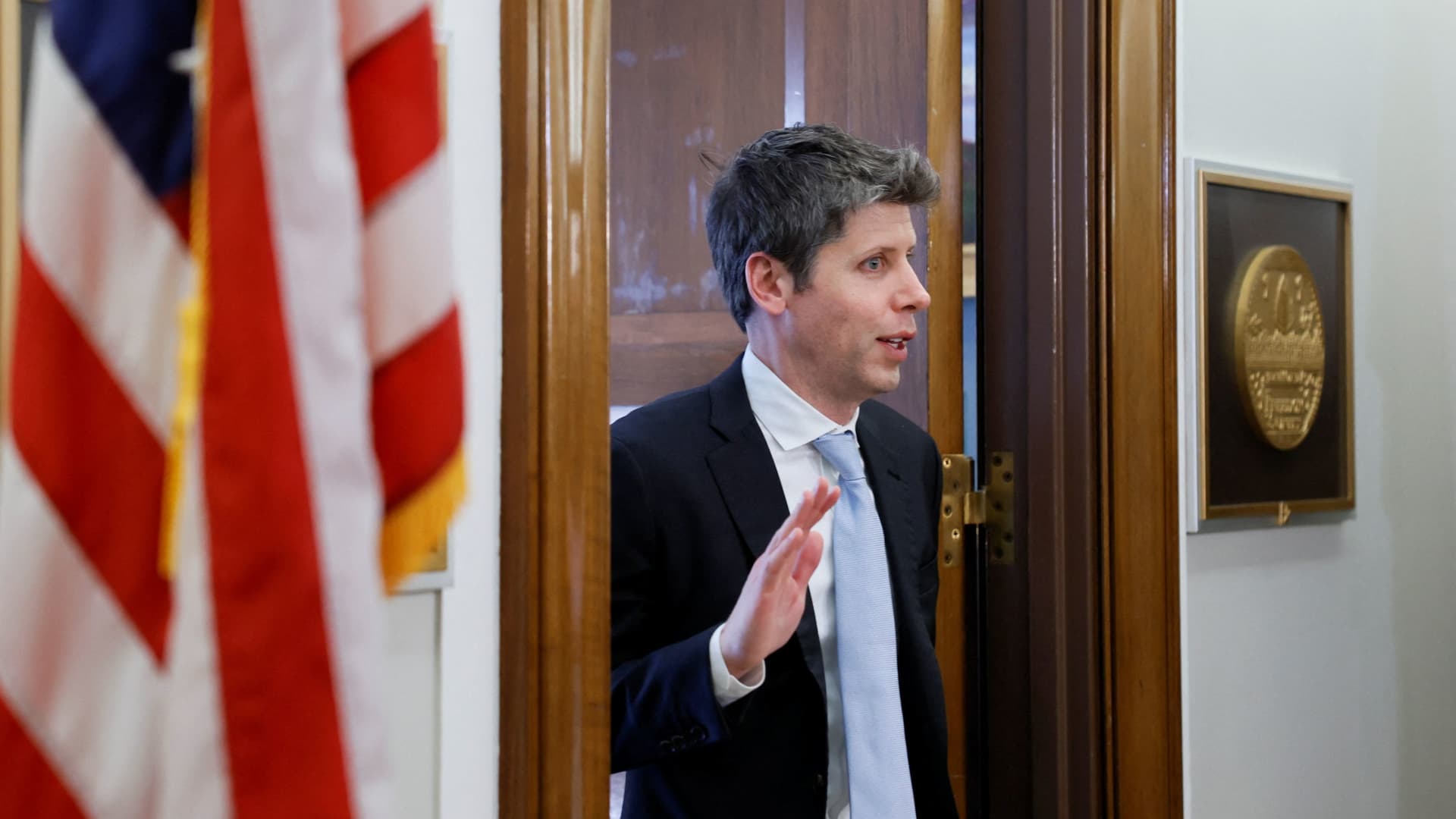
OpenAI CEO Sam Altman and the White House are in ongoing talks about a possible government equity stake in the artificial intelligence company, CNBC confirmed on Friday. The discussions have been in progress for more than a year, with Altman first sharing the idea with the Trump administration in 2025, according to a source familiar with the matter.
President Donald Trump addressed the talks on Air Force One, saying "there are concepts where pieces could be given to the American public, where the American public essentially becomes a partner." The president said he is meeting with AI companies "in the very short, very near future."
For a trader looking at the AI sector, this is not a routine policy discussion. It is a structural shift in how the market prices the largest private AI company and, by extension, the entire AI ecosystem. The government stake concept changes the IPO calculus, the regulatory path, and the risk profile for every investor holding AI exposure.
The Catalyst: Government Stake Talks Resurface
The talks continued this week as Altman met with lawmakers and officials in Washington, D.C., about regulation and AI developments. As part of the potential agreement, OpenAI could donate equity to the U.S. government to seed something like the "Public Wealth Fund" that the company outlined in its April policy proposal, the person said.
OpenAI said the fund could "invest in diversified, long-term assets" and would allow citizens to participate in the "upside" of AI growth, possibly by receiving the fund's returns directly, according to the proposal. No official investment terms have been decided, and the details are still subject to change. Notus was first to report the recent talks.
The Simple Read vs. The Better Market Read
The simple read: The government wants a piece of OpenAI, and that is a positive signal because it implies the administration sees strategic value in the company. The better market read: A government equity stake introduces a new class of shareholder with non-financial objectives – national security, public wealth distribution, and regulatory control. That changes the governance structure and, critically, the exit strategy for private investors.
The Mechanism: How a Sovereign Wealth Fund Stake Changes the Valuation Math
OpenAI is valued at more than $850 billion by private investors, and the company is gearing up for an initial public offering as soon as this year. The company closed a record-breaking funding round in March that was co-led by MGX, which is backed by Abu Dhabi's sovereign wealth fund.
A U.S. government stake would sit alongside that Abu Dhabi capital. The mechanism works through two channels:
1. Valuation ceiling. A government shareholder typically demands a discount or imposes restrictions on future dilution. If the U.S. government receives equity at a below-market valuation – as a donation or at a negotiated price – that effectively sets a floor for the IPO price but also caps the upside because the government's stake is not likely to be sold in the open market for years. The public wealth fund structure means the government holds for the long term, reducing the free float and potentially compressing the valuation multiple.
2. Regulatory alignment. The government stake creates a direct incentive for the administration to ensure OpenAI's models are not deemed too risky or monopolistic. That could accelerate regulatory approvals – or, conversely, slow them if the government wants more oversight. Trump signed an executive order in February calling for the federal government to establish a sovereign wealth fund. On Tuesday, he signed another order asking AI companies to voluntarily provide the government access to their models for up to 30 days before their release.
Altman wrote on X: "The U.S. should lead on AI by continuing to develop the very best models, making sure they're safe, and getting cyber tools into the hands of trusted defenders. The new EO gets the balance right."
The IPO Calculus
For a trader evaluating OpenAI's IPO, the government stake introduces two opposing forces:
- Positive: Government backing reduces regulatory uncertainty, which typically lowers the risk premium and supports a higher IPO valuation.
- Negative: The government's long-term holding period and potential veto power over strategic decisions (like selling to foreign entities) could reduce the liquidity premium that IPO investors demand.
The net effect depends on the terms. If the government stake is structured as a non-voting, non-dilutive donation, the IPO math barely changes. If it comes with board representation or veto rights, the IPO discount widens.
The Precedent: Intel and IBM as Case Studies
The Trump administration has already taken stakes in Intel, International Business Machines, and other quantum and critical mineral companies during the president's second term. These precedents offer a framework for what the OpenAI deal might look like.
For IBM, the government stake did not change the company's fundamental trajectory. The stock remains a Moderate Alpha Score name, meaning the setup is not clear-cut. A trader looking at IBM as a proxy for government-backed tech should note that the government's involvement did not insulate the stock from sector-wide selloffs.
Confirming and Invalidating Factors
A trader watching this story unfold needs a checklist to separate signal from noise.
Confirming Factors
- The White House issues a formal statement confirming the equity donation structure and the valuation at which the stake is received.
- OpenAI files its S-1 with the SEC within 90 days, indicating the IPO timeline is intact despite the government negotiation.
- The public wealth fund legislation passes Congress with bipartisan support, creating a clear legal framework.
- Altman or Trump publicly state that the government stake carries no voting rights or board seats.
Invalidating Factors
- The talks collapse without a framework, and OpenAI proceeds with a traditional IPO without government equity.
- The government demands a board seat or veto power over model releases, introducing governance risk that spooks private investors.
- A competing AI company (e.g., Anthropic or xAI) announces a similar government stake on better terms, making OpenAI's deal look less attractive.
- The IPO is delayed beyond 2026, suggesting the government negotiation is a drag on the timeline.
The Next Catalyst: IPO Timing and Regulatory Clarity
The next concrete marker is the IPO filing. OpenAI is gearing up for an IPO as soon as this year. If the government stake talks delay that filing, the market will read it as a negative signal for valuation. If the filing comes with a government equity disclosure, the market will price the floor immediately.
Trump said he is meeting with AI companies "in the very short, very near future." That meeting could produce a framework or a statement that clarifies the government's intent. Sen. Bernie Sanders told CNBC that he and Altman discussed the concept of a sovereign wealth fund during their meeting on Wednesday. The involvement of a progressive senator suggests the public wealth fund idea has bipartisan interest, which increases the probability of a deal.
For a trader, the playbook is straightforward: watch the IPO filing date and the terms of any government equity disclosure. If the government stake is structured as a non-voting donation, buy the IPO. If it carries governance strings, wait for the discount to materialize.