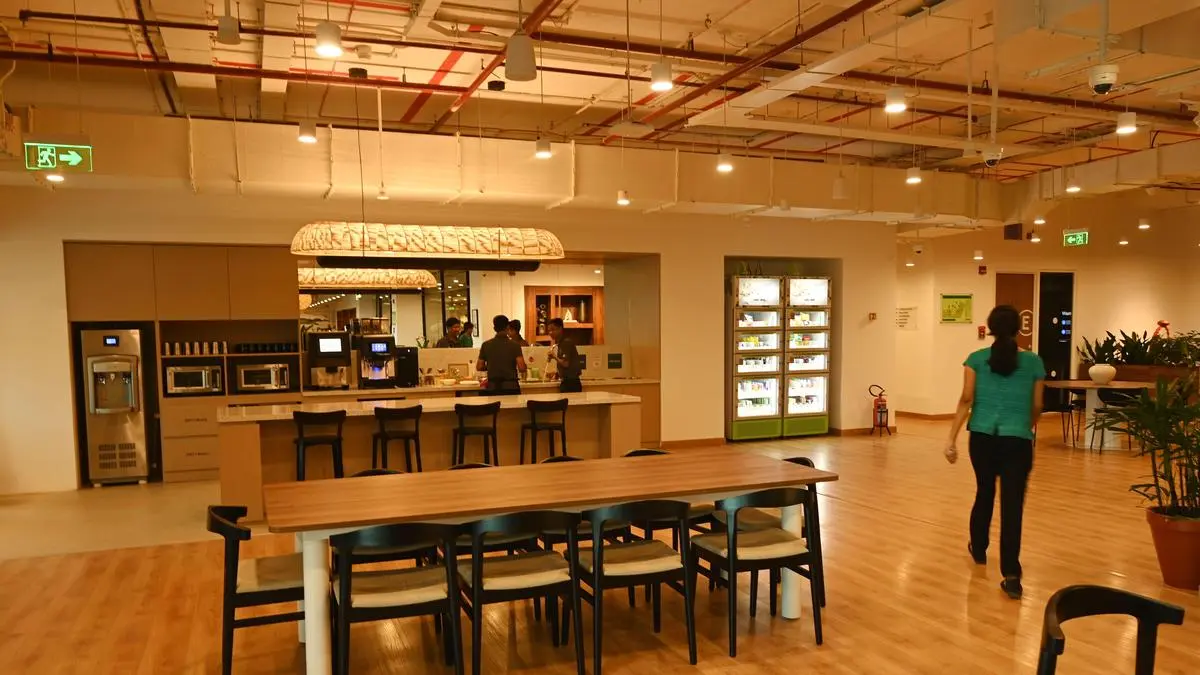
WeWork India Management Limited has officially expanded its footprint in the National Capital Region by opening a new 1.1 lakh square foot facility at Worldmark 6 in Aerocity, New Delhi. This addition introduces over 1,400 desks to the company's portfolio, marking its 17th location within the Delhi-NCR market. The facility, occupying the third floor of the Worldmark 6 complex, is explicitly positioned to capture demand from global capability centres (GCCs) and large-scale enterprise tenants seeking premium, transit-oriented office space.
Strategic Positioning in the Aerocity Corridor
The choice of Aerocity for this expansion reflects a broader shift in how enterprise occupiers approach real estate. By securing space with direct access to the Aerocity Metro Station on the Airport Express Line, WeWork India is prioritizing connectivity to serve high-growth firms that require proximity to international transit hubs. Arnav S. Gusain, Chief of Supply at WeWork India and CEO of Rivet by WeWork India, emphasized that this launch is a direct response to the evolving requirements of large occupiers who no longer view flexible workspaces as a secondary or temporary solution. Instead, these organizations are integrating flexible office models into their core real estate strategies to maintain agility while scaling operations.
This expansion arrives at a critical juncture for the Indian flexible workspace sector, which has seen its total inventory triple between 2020 and 2025. Data from CBRE indicates that the national market has now surpassed the 100 million square foot threshold. Within this landscape, Delhi-NCR maintains its position as the second-largest market in the country, trailing only Bengaluru, with a total inventory estimated between 21 and 23 million square feet. For investors tracking the stock market analysis of commercial real estate, this growth underscores the transition of flexible office providers from niche players to essential infrastructure partners for multinational corporations.
Portfolio Scale and Market Capitalization
Following the opening of the Worldmark 6 centre, WeWork India now operates 73 locations across eight major Indian cities, including Mumbai, Bengaluru, Pune, and Hyderabad. As of December 2025, the company’s total portfolio spans 8.2 million square feet and exceeds 1.21 lakh desks. According to CBRE, WeWork India has maintained its status as the largest flexible workspace operator by total revenue in the country for the past three fiscal years. This scale provides a significant competitive moat, particularly as the company continues to secure prime assets in high-demand business districts.
Despite the expansion, the company's equity performance remains sensitive to broader market conditions. Shares of WeWork India, listed on the NSE under the symbol WEWORK and on the BSE under the scrip code 544570, recently traded at ₹544.25, reflecting a 0.47 per cent decline from the previous close. The company currently holds a market capitalization of approximately ₹7,368 crore. While the expansion signals strong operational momentum, the market is currently pricing in the broader risks associated with the commercial real estate sector, where Alpha Score 45/100 reflects a mixed outlook for major players like CBRE, and Alpha Score 50/100 suggests similar volatility for specialized REITs like Welltower.
Operational Drivers for GCC Demand
The facility's design features, including technology-enabled meeting systems, indoor event spaces, and dedicated wellness areas, are tailored to the specific needs of GCCs. These entities often require rapid deployment of office space that meets international standards for productivity and employee experience. By providing a turnkey solution, WeWork India effectively lowers the barrier to entry for global firms looking to establish or expand their footprint in Delhi-NCR. The success of this model will likely depend on the company's ability to maintain high occupancy rates across its 73-centre network while managing the capital expenditure required for such high-spec build-outs. Investors should monitor whether the company can continue to command premium pricing in the Aerocity corridor as supply in the region increases, or if margin pressure will emerge as competition for top-tier enterprise tenants intensifies among major flexible workspace operators.