Weekend Trading Gap Emerges for Coinbase B20 Stock Tokens
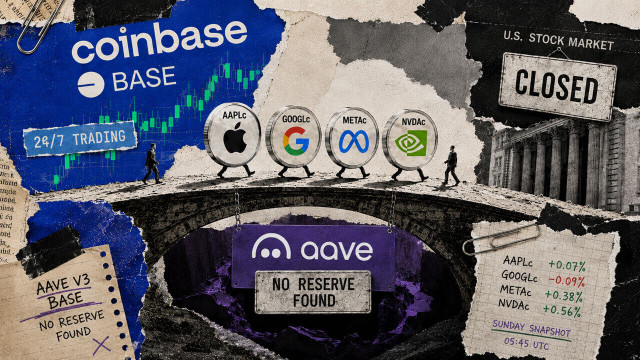
Coinbase's B20 tokens on Base traded within 0.6% of Friday's close over the weekend, but the 48-hour gap between secondary trading and primary settlement remains untested as a collateral risk.
Coinbase's B20 stock tokens on Base, AAPLc, GOOGLc, METAc and NVDAc, give eligible non-US users 24/7 onchain exposure to Apple, Alphabet, Meta and Nvidia. The tokens trade on automated market makers like Aerodrome through the weekend, while the underlying US equity market, the primary minting process and the Chainlink oracle feeds that anchor their value all run on a Monday-to-Friday schedule.
That 48-hour gap is the central risk in the product, and the first full weekend of trading produced an orderly but limited test of how it behaves.
A Sunday snapshot of the four leading Aerodrome USDC pools showed aggregate displayed liquidity of about $6.07 million and 24-hour volume of roughly $7.08 million, according to an analysis by CryptoSlate's Liam Wright. Prices in those pools sat within 0.6% of Chainlink reference values last updated Friday evening. The four official Chainlink feed proxies for the tokens returned update timestamps of 17:01 UTC for AAPL, 15:59 for GOOGL, 19:10 for META and 18:50 for NVDA, all Friday close times.
The narrow spread is informative. Traders had a weekend market and chose prices close to the held equity references, despite the absence of fresh primary-market discovery. But the comparison is a snapshot, not a guarantee of execution depth or a durable peg. Displayed liquidity does not promise that a large order clears near the quoted price, and the underlying sale and settlement process retains business-day dependencies.
Coinbase's product page says primary minting and redemption are handled by KYC-onboarded institutional partners and Authorized Participants. The NVDA prospectus separately gives a "Vested Holder" a redemption right subject to prescribed instructions, compliance checks and operational acceptance. The prospectus defines a business day to exclude Saturdays, Sundays and holidays. Cash or stablecoin settlement requires the issuer to sell the underlying shares after validating a request, and the terms allow rejection, delay or suspension. Instant weekend arbitrage between the DEX price and the underlying equity value is therefore not available.
The Chainlink feeds that supply the tokens' equity-linked reference price also follow a 24/5 schedule. Base's B20 integration guide says the launch assets use Chainlink 24/5 total-return feeds. Each value is derived from the underlying equity price and a multiplier, not from the token's DEX price. On weekends and holidays, the feed holds its last value and the updatedAt timestamp stops advancing. The Friday timestamps observed on Sunday were consistent with that documented behavior.
That schedule mismatch becomes critical if the tokens are used as collateral in a lending protocol. Base's marketing material highlights that a holder could use tokenized Nvidia exposure as collateral on Aave. A Sunday review of the official Aave V3 Base address book found no reserve, aToken, variable-debt token or Aave oracle entry for any of the four B20 tokens, according to the CryptoSlate report. The integration is a stated goal, not a live market.
An Aug. 3 Aave governance proposal said the initial assets, oracle configuration, risk framework and deployment contracts for V4 on Base would be finalized and published later. The proposal establishes direction but leaves the B20 asset list and its risk controls unresolved. No defensible loan-to-value ratio, liquidation threshold, supply cap or outstanding borrowing exists for these tokens on Aave today. There is also no verified Aave B20 liquidation activity from which to infer closed-market behavior.
The risk is straightforward: if a lending market were live and the DEX price diverged sharply from the stale oracle feed during a weekend, a user could be liquidated based on outdated equity values. Conversely, a sharp rise in the token price would not automatically lift a feed calculated from the held Friday value. Base tells integrators to inspect updatedAt, apply staleness bounds and avoid settling or liquidating against a frozen value, but the application's contracts ultimately decide the rules.
The first weekend supplied a useful baseline. Four active Aerodrome pools generated about $7.08 million of 24-hour volume and stayed within roughly 0.6% of held Friday values at the snapshot. That is evidence of orderly secondary-market pricing during one closed-market window. Its limits are equally concrete: the reference feeds were carrying Friday information, the prospectus preserved business-day dependencies for underlying sales and settlement, and the promoted Aave collateral layer lacked a verified live reserve.
Coinbase has made the market-hours mismatch visible onchain. The decisive stress test will begin only after a lending venue publishes its B20 reserve configuration and users place debt against the tokens. Until then, this weekend's record belongs to the DEX and oracle layers, with collateral safety still awaiting deployed controls.
Drafted by a large language model from the source reporting linked above, then screened by automated publishing checks. It is not read by a journalist before publication. Some articles cite our Alpha Score. Verify prices and figures against the original source. Educational coverage, not personalized advice.