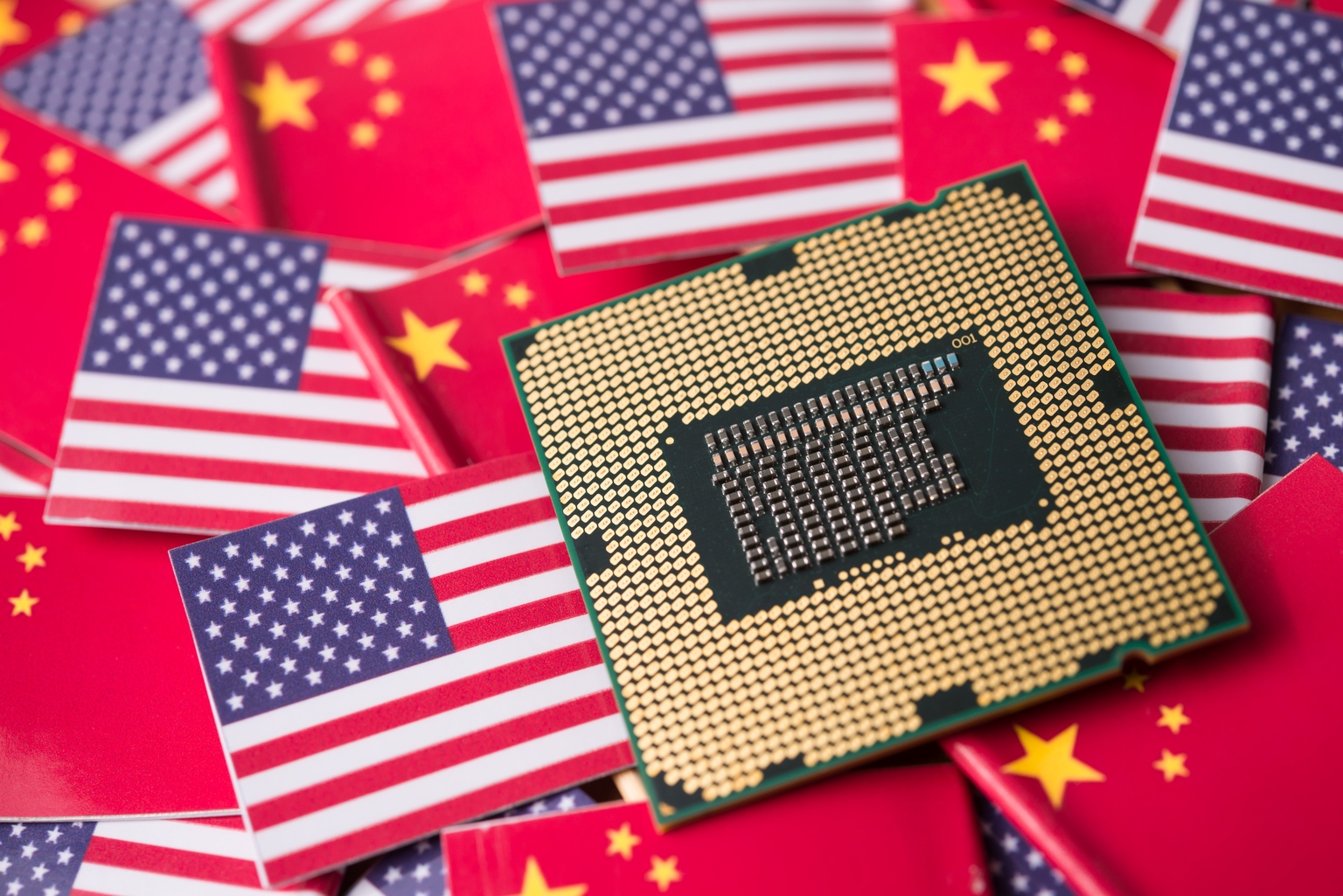
On October 17, 2023, the U.S. Commerce Department expanded export controls on advanced semiconductor equipment and AI chips sold to China. The new rules close loopholes that allowed Chinese companies to access Nvidia A800 and H800 chips. They also add YMTC and Biren Technology to the Entity List, tightening the technology ceiling for Chinese chipmakers.
U.S. Export Controls Restructure Chip Supply
The simple read is that the restrictions slow China's AI development and benefit U.S. chip leaders Nvidia and AMD. The better market read is more complex. Semiconductor equipment makers such as Applied Materials and Lam Research face a permanent reduction in addressable China revenue, which accounted for roughly 30% of sales. For Nvidia, the lost China revenue must be offset by domestic AI spending. CFO Colette Kress stated that export restrictions would cause a sequential decline in China revenue. Companies with no China exposure, like AMD, gain no advantage because their absence from the Chinese market was already priced in. The restrictions create a two-tier market for chips, with volume limits on legal sales into China.
Apple’s Geopolitical Risk Premium
Apple (AAPL) is among the most exposed U.S. companies to U.S.-China tech decoupling. The iPhone maker assembles the majority of its devices in China and relies on Chinese suppliers for many components. New chip restrictions do not directly affect Apple’s consumer products today. They increase the risk that Beijing retaliates by limiting access to rare earths or imposing operational hurdles on foreign firms. The broader trade tension pressures Apple to accelerate supply-chain diversification into India and Vietnam, a process that is capital-intensive and years from full execution. Apple trades at roughly 28 times forward earnings, a premium justified by services growth and its loyal customer base. The U.S.-China conflict introduces a geopolitical risk premium that is difficult to quantify.
Semiconductor Sector’s Next Catalyst
The next catalyst for Apple is its December-quarter earnings report. Management commentary on China demand and supply-chain shifts will either confirm or challenge the current valuation. For semiconductor investors, the policy landscape becomes clearer after the next Commerce Department guidance, expected within 90 days. That guidance will define the scope of the licensing exception for consumer chips. For holders of Nvidia and AMD, the question is whether domestic AI spending offsets the China revenue loss. For companies with significant China revenue, such as Qualcomm and Intel, the risk is a permanent ceiling on sales growth. For pure-play semiconductor equipment makers, the calculus shifts to non-China customers – TSMC, Samsung, and Intel foundries – that are expanding capacity in the U.S. and Europe.
China is stockpiling chip-making equipment and accelerating domestic alternatives. SMIC uses older-generation DUV lithography machines to produce chips for Huawei, though yields remain low. The new restrictions target the equipment SMIC needs to advance to 5nm and below. The Semiconductor Industry Association’s monthly sales report will show whether global chip demand holds up amid decoupling. A sustained decline in China’s semiconductor imports would confirm a structural shift, not a cyclical dip. The next concrete policy data point – Commerce guidance – will define winners and losers in this structural drift.