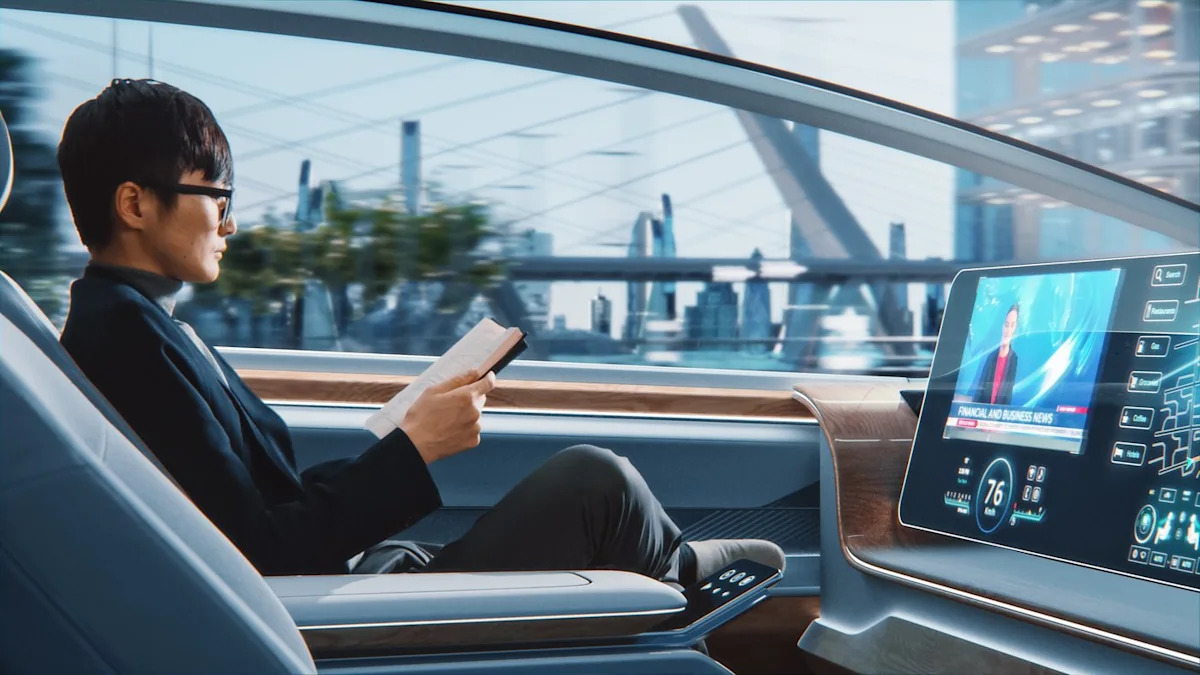
Uber Technologies (NYSE: UBER) on Aug. 5 reported second-quarter results that showed the ride-hailing giant is deepening its bet on autonomous vehicles. CEO Dara Khosrowshahi told shareholders the company expects to operate self-driving cars and robots in 15 cities by the end of 2026, up from seven today.
Khosrowshahi also said Uber would deploy roughly $10 billion over the next few years to help autonomous-vehicle partners scale their fleets. The spending is a departure from Uber's long-standing asset-light model, which historically avoided owning vehicles or developing self-driving technology in-house. But it reflects a strategic calculation: removing human drivers from the cost structure would transform Uber's margins.
In Q2, Uber recorded $58 billion in gross bookings. Of that, $25 billion went to the platform's 10.2 million drivers, the single largest expense line. After driver payouts, restaurant remittances, and operating costs, Uber kept $2.4 billion in GAAP profit. The math behind the autonomous push is straightforward: if a self-driving car can work around the clock with minimal downtime and a lower per-mile cost than a human driver, the savings flow directly to Uber's bottom line without requiring a single new customer.
The company already works with Alphabet's Waymo, which completes over 500,000 paid autonomous trips each week across 11 U.S. cities. Uber's platform gives Waymo and other partners access to 208 million monthly active customers, a distribution network that would take years and billions of dollars to replicate. Uber, in turn, collects a fee on each autonomous trip without carrying the vehicle-development cost.
Valuation gap
Uber's stock trades at a price-to-sales ratio near 2.8 based on trailing 12-month revenue of $55.2 billion. That is a discount to its post-IPO average P/S of 4.1 and a steeper discount to the Nasdaq-100's current P/S of 6.3. The gap implies the market has not yet priced in the margin expansion that autonomous delivery could unlock, several analysts said.
Alpha Score context
AlphaScala's proprietary rating system gives UBER an Alpha Score of 52 out of 100, a Mixed label. The score sits in the middle of the scale, reflecting a balanced risk-reward profile at current prices. The stock's UBER stock page tracks the score and related metrics.
Uber took in $14.2 billion in revenue during Q2, a figure that would rise sharply if the company can shrink the $25 billion it pays to drivers. Every percentage point of driver-cost savings drops almost directly to the operating line. The $10 billion commitment to partners accelerates that timeline, Khosrowshahi said, by funding fleet expansion and vehicle deployment.
The company's market capitalization stood at $153 billion as of the report date. A return to its average P/S multiple would imply a stock price roughly 46% above current levels, before factoring in any revenue growth from autonomous trips.
Uber's autonomous strategy differs from rivals that are building their own vehicles. Tesla has said it plans to operate a robotaxi network using its own cars, while Alphabet's Waymo and Amazon's Zoox develop their own hardware and software. Uber's bet is that the platform layer – the app, the routing, the payment system, the customer base – is the harder piece to build, and that multiple vehicle makers will compete to plug into it.
Khosrowshahi told investors the company is in talks with additional autonomous-vehicle operators to join the network. The 15-city target for year-end covers the U.S. and several international markets, though he did not name specific locations beyond the seven already active.
The driver-cost problem
Uber's Q2 numbers illustrate why autonomous delivery matters. The $25 billion in driver payouts represents 43% of gross bookings. After restaurant and merchant costs, Uber's revenue was $14.2 billion. Operating expenses – marketing, research, general administration – consumed most of that, leaving the $2.4 billion net profit.
If autonomous vehicles eventually handle even 10% of trips, the savings on driver costs would add hundreds of millions to quarterly profit at current booking volumes. The $10 billion investment to get there is large relative to Uber's cash flow, but the payoff, if the technology scales, would be several multiples of that outlay, Khosrowshahi said.
Uber shares have not yet reflected that potential. The stock trades below its historical valuation multiple even as gross bookings grow. The autonomous timeline – 15 cities by year-end, more in 2027 – gives investors a concrete marker to watch.