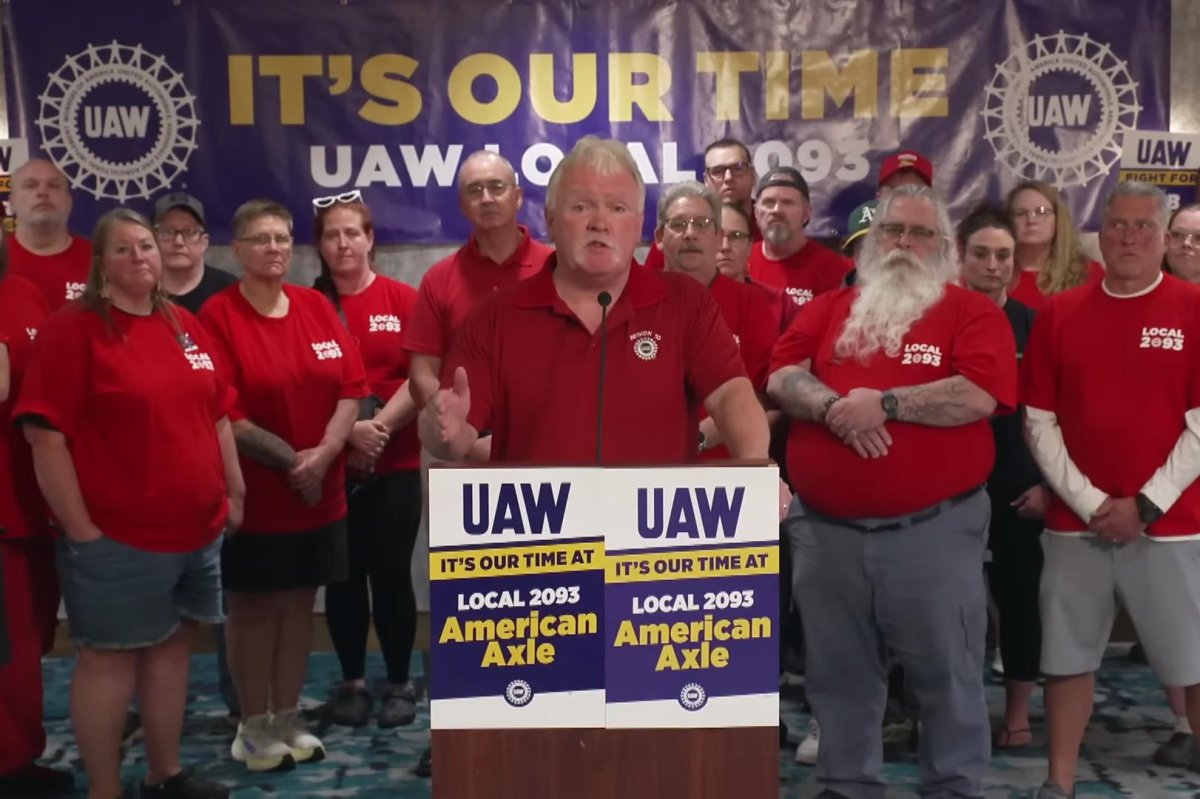
Nearly 1,000 members of the United Auto Workers union walked off the job at the American Axle plant in Three Rivers, Michigan, on Monday after contract negotiations failed. The strike, which began at 12:01 a.m. with picketing starting at 6 a.m., directly threatens production of axles for General Motors' highest-margin vehicles: the Chevrolet Silverado and GMC Sierra.
UAW President Shawn Fain joined members of Local 2093 on Sunday to announce the walkout, accusing Detroit-based American Axle of failing to offer a fair contract before the May 31 expiration deadline. The union's statement was blunt: "No contract, no axles."
The Wage Gap That Drove the Strike
The core grievance is a wage recovery that never materialized after the 2008 financial crisis. UAW said workers took major concessions to keep the Three Rivers plant open during the Great Recession. Employees earning as much as $29 per hour in 2008 saw wages slashed to $14.50. Eighteen years later, the top wage has only climbed back to $22 per hour after a five-year progression. Adjusted for inflation, the union calculates wages are half their 2008 peak.
Profit and Executive Compensation in Focus
UAW highlighted that American Axle generated $8.4 billion in profits over the past decade. The CEO received $111 million in compensation during that period, and the top five executives collected nearly $231 million. Fain addressed executives directly in a Sunday livestream:
The pay disparity turned contract negotiations into a flashpoint, not just at American Axle but as a signal for the broader UAW strategy under Fain's leadership.
Exposure: GM's Most Profitable Models in the Crosshairs
American Axle is a Tier 1 supplier for GM, producing axle assemblies for two of GM's best-selling and highest-margin vehicles. The plant in Three Rivers is not easily replaced. Automotive axles are custom-engineered for specific platforms and require long lead times to re-source.
GM's Production Vulnerability
A prolonged strike could force GM to slow or halt assembly at truck plants that depend on those axles. Unlike a parts shortage at a single plant, this disruption hits the core of GM's North American profit center. GM has not yet issued a production warning. The timeline is measured in days, not weeks, before inventory buffers are exhausted.
AlphaScala's proprietary score for GM stands at 57 out of 100, a Moderate rating reflecting balanced risk-reward given the supply chain uncertainty. The GM stock page provides real-time positioning data for traders monitoring the situation.
Timeline and Catalysts to Watch
The strike began at 12:01 a.m. on June 1, with picketing starting at 6 a.m. the same day. The contract expired at the May 31 deadline after negotiations failed.
Next Confirmation or Reversal Points
- Day 3-5: GM parts inventory at truck plants typically covers 3-5 days of production. Watch for any GM statement on potential downtime.
- Mediation or federal involvement: A return to bargaining with a mediator would lower the risk. Fain has not ruled out national strike expansions. The UAW's 2023 pattern of targeting key facilities first could repeat.
- American Axle earnings calls or press releases: The company has not commented publicly since the strike began. Its next quarterly report is not due for weeks. A separate press release addressing the strike would be the first sign of a shift.
If American Axle signals readiness to increase the wage offer, or if GM pressures the supplier to settle, the risk premium in auto stocks would compress quickly.
Affected Assets: GM, Supplier Stocks, and Sector Read-Through
The direct exposure is to GM (General Motors) and American Axle (private in this context, its bonds trade over-the-counter). Auto parts suppliers with similar union exposure, such as Dana Inc. or BorgWarner, may see sympathetic pricing pressure.
GM Stock Reaction
GM shares opened flat on Monday. The strike is localized to one plant, so a single-day signal is muted. The risk is cumulative. If the strike drags beyond one week, analysts will start trimming Q3 delivery estimates for the Silverado and Sierra. GM's truck segment accounted for roughly 35% of its North American revenue in 2024. A 5% production loss in that segment would be material.
Broader Auto Sector Risk
The UAW's pattern under Fain suggests militancy is a feature, not a bug. A successful strike at American Axle that extracts meaningful wage gains would embolden the union in contract negotiations with the Detroit Big Three in 2025. Traders should watch for rhetoric from Fain linking this strike to the next round of master agreements.
For a broader view of how supply chain labor actions affect equity markets, see the stock market analysis page.
What Would Reduce the Risk
The quickest de-escalation would be a new contract within 10 days. The union has not disclosed its wage demand. The gap between the current $22 top wage and inflation-adjusted 2008 levels suggests a target in the $25-$30 range. A settlement that includes a rapid progression to $28-$29 per hour, combined with a profit-sharing element, would likely pass a membership vote and restart production.
Signs of a Resolution
- Federal mediator appointment. The Michigan Department of Labor sometimes steps in for plant-level strikes that threaten a major employer's supply chain.
- GM public statement urging a quick settlement. GM has a direct interest in minimizing downtime. A statement from its procurement team acknowledging the strike would indicate active behind-the-scenes pressure on American Axle.
- Union membership ratification vote scheduled. Once a tentative agreement is reached, a date for a vote reduces uncertainty even before the vote is held.
What Would Escalate the Risk
Three developments would worsen the outlook for GM and auto sector investors.
Extended Strike Beyond Two Weeks
If the strike enters its third week, parts shortages will begin to shut down GM assembly lines. The cost of downtime for GM is roughly $50 million per day per plant in lost output. A month-long strike could lead to a $1 billion to $1.5 billion revenue impact and force GM to cut its full-year guidance.
Solidarity Actions at Other Plants
UAW Local 2093 is one of many locals with contracts expiring this year. If other locals stage sympathy strikes or if the national UAW leadership calls for a broader action against American Axle's other facilities, the disruption multiplies.
Broader UAW Bargaining Posture Escalation
Fain used the American Axle strike to deliver a message to the Big Three: the union expects wages that track both inflation and executive compensation. A long, messy strike at a supplier would be a live-fire drill for the 2025 master negotiations. If the union wins a settlement that significantly breaks the current wage ceiling, it sets a precedent that raises labor costs across the entire Detroit supply chain.
Investors in auto names should treat the American Axle strike as a testing ground. The stakes go beyond one plant in Michigan. How this strike ends will shape the UAW's strategy and the cost structure of U.S. auto manufacturing for the next cycle.