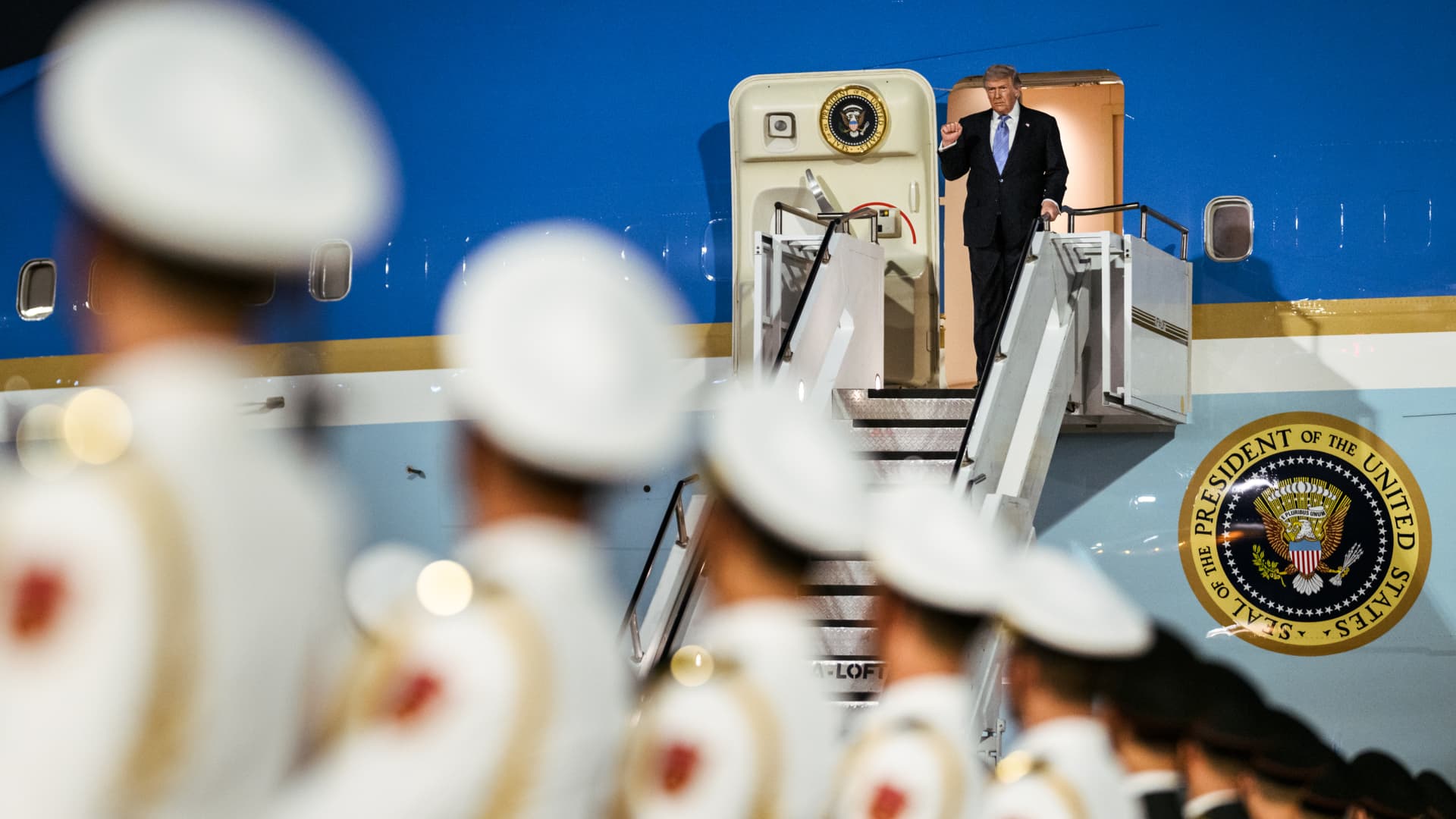
President Donald Trump landed in Beijing on Wednesday evening local time, starting a two-day summit with Chinese leader Xi Jinping. The meeting is the first in nearly nine years between the two leaders. For markets, the event resets the clock on U.S.-China relations, even though low expectations for concrete deliverables are already priced in.
The simple read is that any face-to-face dialogue reduces the risk of miscalculation. The better market read is that the bar for a positive surprise is now low enough that even incremental progress on trade or technology could lift China-exposed equities. A breakdown in talks would confirm the structural competition narrative, punishing names with heavy China revenue.
The Summit and the Low-Expectations Setup
The agenda covers a wide range of contentious topics:
- Trade
- Technology
- Export controls
- Taiwan
- The Iran war
Treasury Secretary Scott Bessent and Chinese Vice Premier He Lifeng held a preparatory meeting in Seoul that Beijing described as “candid, in-depth and constructive.” That language signals serious engagement, not a breakthrough.
For traders, the key is that the summit’s outcome is not binary. The market has already discounted a grand bargain. Any headline suggesting a pause in tariff escalation, a relaxation of export restrictions on semiconductors, or a joint statement on Iran could trigger a relief rally in the iShares China Large-Cap ETF (FXI) and in individual names like Tesla (TSLA), which has significant China exposure. Tesla’s Shanghai factory makes it a proxy for U.S.-China trade sentiment. Options markets are not pricing a large swing, reflecting the low expectations. The S&P 500 has been range-bound, and a positive trade signal could break the index out of its recent tight range.
Tech CEOs on the Delegation: A Signal for Semis
Trump is accompanied by a delegation of high-profile business leaders, including Elon Musk and Jensen Huang. Their presence is not ceremonial. It signals that technology and export controls are central to the talks. NVIDIA (NVDA) has been at the center of U.S. restrictions on advanced chip sales to China. Any hint of a licensing framework that allows NVIDIA to sell downgraded chips without constant regulatory friction would be a material positive for the stock. The same applies to other semiconductor equipment makers. For more on NVIDIA’s exposure, see our NVIDIA profile.
The summit also arrives as China pushes back against U.S. technology curbs with its own restrictions on rare earth exports. A de-escalation in this tit-for-tat would benefit the VanEck Semiconductor ETF (SMH) and the broader tech sector. The market will parse every readout for language on “technology cooperation” or “export controls.”
The Iran war is another wildcard. China is a major buyer of Iranian oil, and any U.S.-China coordination on sanctions or a ceasefire could move crude prices. Energy Select Sector SPDR (XLE) and oil futures would react to any joint statement on the conflict. The market currently assigns a low probability to such an outcome, making it a high-impact tail risk.
What Comes Next: Friday’s Wrap-Up
The summit’s structure points to a final opportunity for a market-moving signal. Trump and Xi will have a bilateral tea and working lunch on Friday before Trump returns to Washington. That session is where any last-minute agreements or joint statements typically emerge. The absence of a joint communique would not be a surprise. Any document that includes specific language on trade or technology would be a surprise.
For now, the low-expectations setup means the risk-reward for China-exposed positions tilts slightly positive into Friday. The next concrete catalyst is the Friday lunch and any press conference that follows. Until then, markets will trade on leaks and body language. For broader market context, see our stock market analysis.