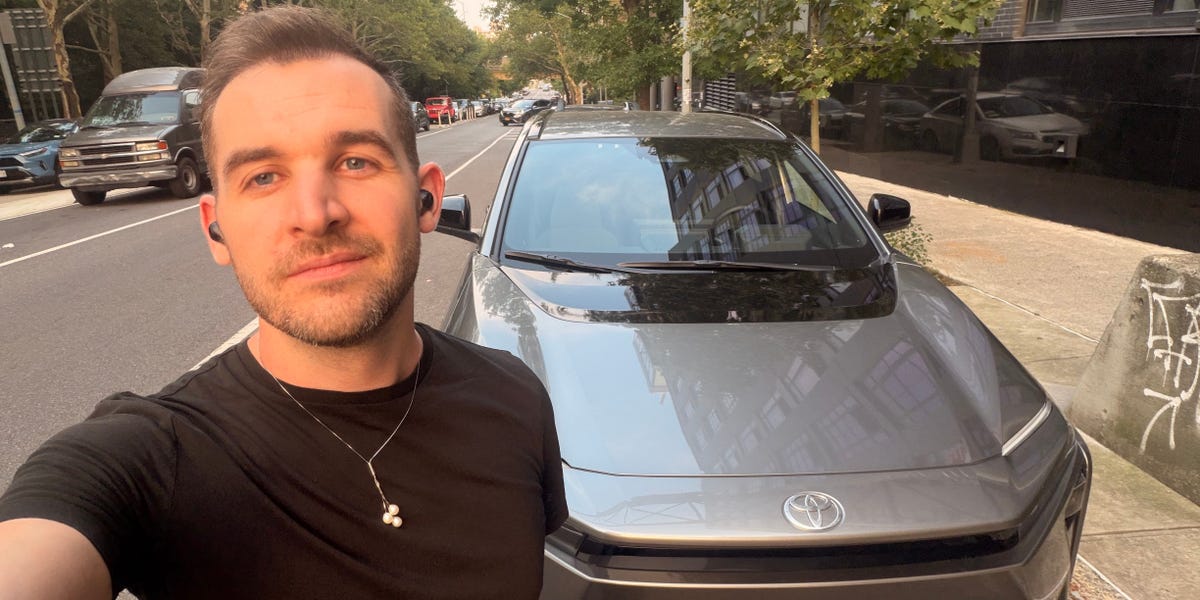
Toyota's refreshed midsize EV, the 2026 bZ, is selling far faster than its predecessor. Sales of the model are up 89% this year, and the company plans to offer seven consumer EVs across its Toyota and Lexus brands by 2027 – four more than Tesla currently sells in the US.
That expansion comes at a time when several rivals are scaling back. Honda does not have an all-electric option for 2027. The company has retreated from earlier EV commitments. Tesla, meanwhile, has dominated the US EV market with four models, but its share faces pressure as legacy automakers fill out their lineups.
"When we look at the brands that people want to buy EVs from, Toyota and Honda are No. 1 and No. 2," K.C. Boyce, vice president of automotive and energy research at Escalent, told Business Insider. "Toyota is full steam ahead."
The bZ starts at $37,900 and has an EPA-estimated range of 314 miles. The front-wheel-drive XLE Plus tester I drove averaged 4.1 miles per kilowatt-hour in summer heat, with highway acceleration that kept pace with gas-powered rivals. Road noise was minimal, and rear-seat passengers reported no nausea even on rough New York City streets.
Behind the wheel, the bZ felt well-balanced through bends, with the battery's weight spread low across the floor. Its back end is sharply sloped, giving it a profile that resembles a doorstop. The dashboard has unusual angles, including a gauge cluster that sits far back from the steering wheel. Step inside, and the SUV quickly starts to feel like an all-electric version of Toyota's popular gas-hybrid RAV4.
For years, critics charged Toyota with being an EV laggard. From 2021 to 2025, the world's largest automaker had offered just two EVs in the US: the Toyota bZ4X and Lexus RZ. Both shared a platform, middling charging speeds, and ranges that didn't reach 300 miles. That argument is harder to make now.
The 2026 refresh changes the trajectory. The battery upgrade pushes range past 300 miles for the first time. Toyota is adding a Woodland wagon, a C-HR subcompact SUV, and a fully electric Highlander next year. Lexus is adding an ES electric sedan and a three-row TZ SUV for 2027.
The bZ's biggest flaw is its driver-attention monitor, which mounts sensors into the steering wheel to track where the driver is looking. It chimed repeatedly during my test – warning me to look forward while merging onto a highway, to sit up when I grabbed the top of the wheel, and to stop sipping coffee. "Driver inattention detected," it said as I looked over my left shoulder before a lane change. "Sit up," it blared when my hand blocked its view of my eyes. By the end of the week, my passengers were laughing about how often the car pinged, even when it was obvious I was paying attention.
The car also makes a separate ping when shifted into reverse, loud enough for people on a Bluetooth call to hear it.
Toyota's S-Flow climate system was another oddity. It's designed to send air only toward occupied seats, but it didn't consistently recognize people sitting in the second row. For a car so intent on watching me, it occasionally missed everyone else.
Still, the numbers are hard to ignore. The bZ won me over because it acts a lot like the best-selling midsize SUVs – the RAV4, Honda's CR-V, Tesla's Model Y, Chevy's Equinox – and sprinkles in the best EV traits. Those five models combined sold more than 1.4 million units in the US last year.
Tesla's lineup remains the benchmark for EV adoption, but Toyota's sales trajectory suggests the world's largest automaker is betting the market for electric SUVs is large enough to support a full lineup, even as some competitors pull back. "Timing for Toyota's expanding lineup is striking," Boyce said.