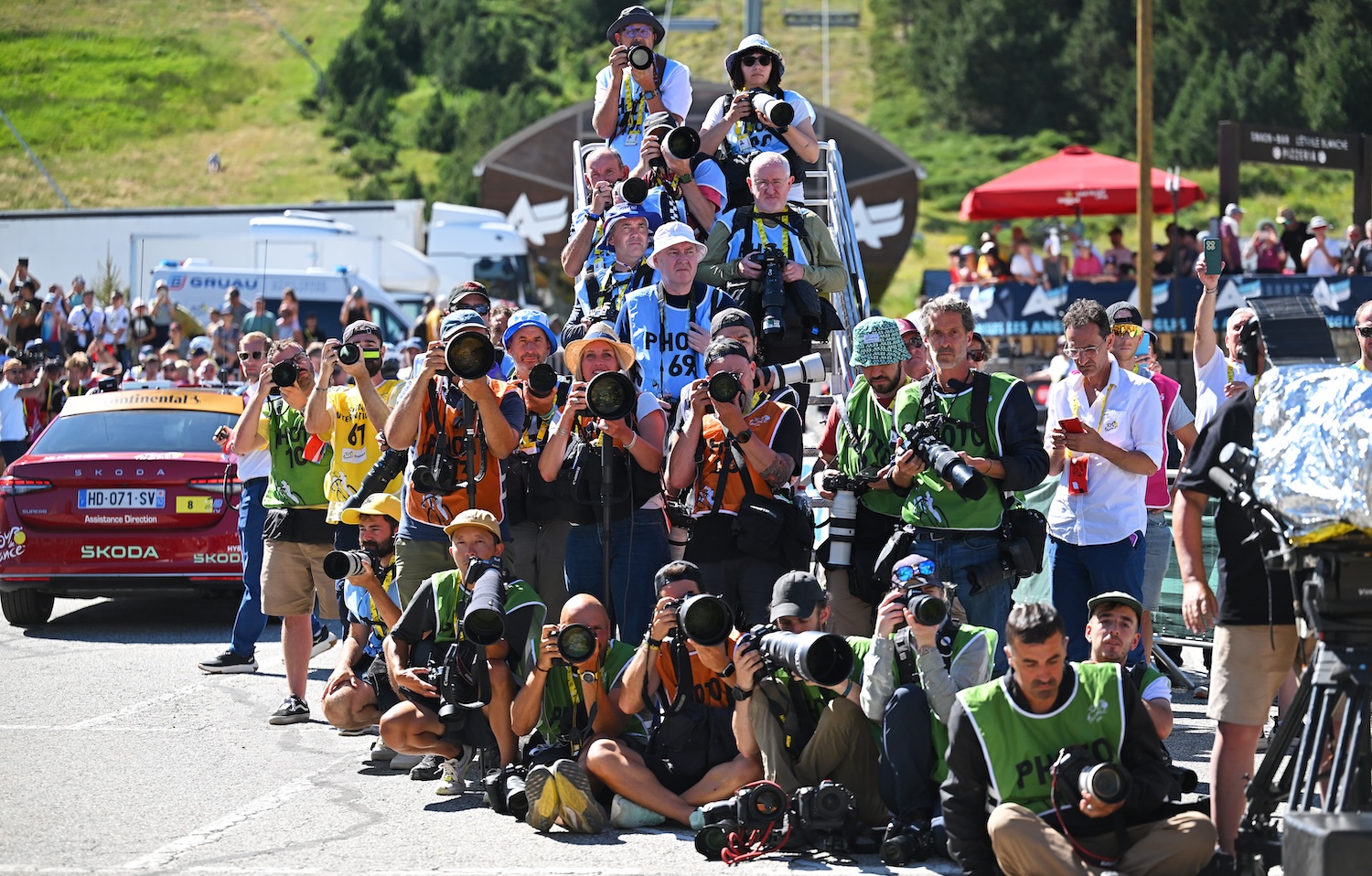
CHALON-SUR-SAÔNE, France – The television moto teams can sit on the course and let the race come to them. The photographers have to get ahead, find a spot, shoot, then race around the front to do it again. Stage 11 of the Tour de France, the fastest stage in Tour history, made that nearly impossible.
"The photo guys have a way harder job than the TV moto guys because they have to keep getting ahead of the race," said NBC's Steve Porino, who has spent years on motorbikes.
Harry Talbot, Zac Williams, and Max Fries are the three photographers I embedded with for Stage 11. Talbot and Williams host the Race Chasers podcast and shoot for bike sponsors, teams, and apparel brands. Fries works for Red Bull–Bora–Hansgrohe. While the other two target several dozen riders, he is only shooting eight. "You only have eight possibilities," Fries said. "Yesterday on the climb, they were hidden in the group."
Talbot scouted the entire route months earlier on Google Street View. He looked for spots with the right combination of elements to frame a shot, placement within the day's course, and access to escape routes. That last part is critical. The second you shoot your photos, the clock starts ticking. You have to get all the way around the front of the race to get back on the course, which involves hauling ass down narrow backroads and convincing police that you are worth moving the barriers for.
"Yesterday was fucked," Williams said. "Because there were like four or five different roadblocks where we just got told, 'You can't come in.'" Talbot agreed that the worst part of the job was "constantly being told you're not allowed to do things that you are."
The money is wildly inconsistent. "We came here for three years and made no money," Williams said. "To start in the industry, you have to make a name for yourself." The Tour's photo corps is larger than any other race's, with the best photographers in the business joined by ambitious retirees and upstarts who know they will not make anything but connections.
"When I came to Europe, I didn't really know anyone," Talbot said. "I lived in a car, bounced around, and met as many people as I could. I would go work back home in New Zealand in the winter, then spend all my savings trying to make it here. The process took a couple years. My second year, I almost broke even."
Cycling photography is a hits business. At the 2025 Giro d'Italia, Talbot took what Williams termed one of the best cycling photographs of the last decade. The secret to shooting the switchbacks in such an evocative way? "I just kept walking, then I turned around, and it looked good," Talbot deadpanned.
Back on Stage 11, the group wrapped a short argument with a quartet of gendarmes. Williams charmed them into moving the barriers. "If we didn't speak French to them, they would've just told us to fuck off," he said.
The single biggest lesson of the day was the ridiculous level of uncertainty on the job. If you run the gantlet of cops, and if the riders you need to shoot are in the right position, you still only get one chance at a usable photograph before the riders are gone. "You can be in the middle of nowhere and some rando just stands up and fucks your shot," Williams said.
"Marketing people don't understand that you can't control everything," Fries said. "Red Bull is so demanding, because they're used to organizing their own sporting events where everything is built around getting the shot. I have to explain to them that here the limits are so high, and the stuff we can do is super low."
The day's racing ends in a sprint. The worst outcomes, Williams said, are the close ones, because nobody has time to celebrate. Things break their way this time: Søren Wærenskjold crosses the line, pumping his fist in exaltation. They get the shot.