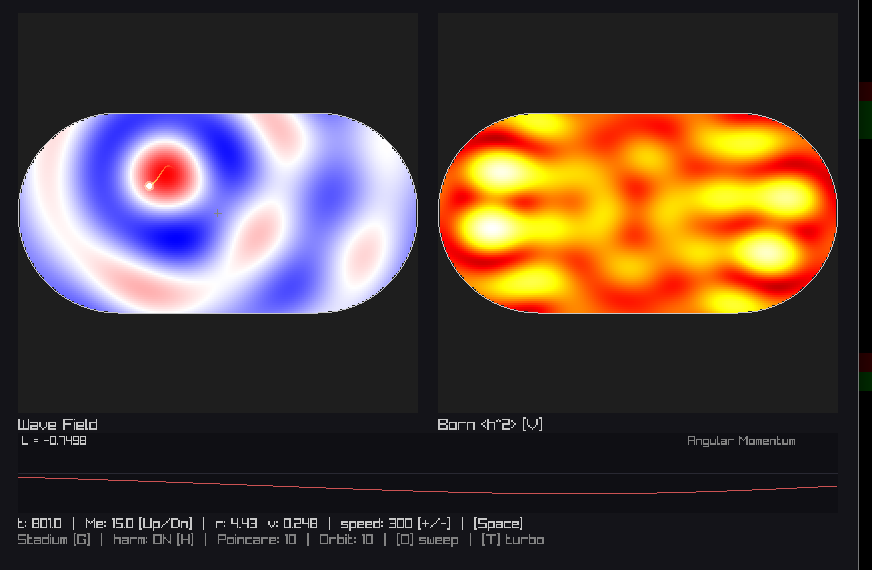
The long-standing debate over the foundations of quantum mechanics has recently shifted toward the experimental realization of pilot wave dynamics. By utilizing bouncing oil droplets on a vibrating fluid surface, researchers have demonstrated macroscopic systems that replicate behaviors previously thought to be exclusive to quantum particles. This development challenges the standard Copenhagen interpretation by providing a deterministic, classical analog to wave-particle duality.
Deterministic Mechanics in Macroscopic Systems
The pilot wave theory, originally championed by Louis de Broglie and later refined by David Bohm, posits that particles are guided by underlying wave fields. While the standard model of quantum mechanics relies on probabilistic wave functions, the droplet experiments show that a particle can be guided by its own generated wave field. These droplets exhibit phenomena such as single-particle diffraction, tunneling, and quantized orbits. The system functions as a feedback loop where the droplet influences the fluid surface, and the resulting surface waves dictate the future trajectory of the droplet.
This physical realization suggests that certain quantum-like behaviors emerge from complex, non-linear interactions rather than inherent randomness. The droplets occupy specific stable states, effectively mimicking the energy levels found in atomic systems. By observing these macroscopic analogs, physicists are gaining a clearer view of how deterministic trajectories can produce statistical distributions that align with quantum mechanical predictions.
Implications for Quantum Foundations
The shift toward pilot wave analogs forces a re-evaluation of the role of hidden variables in physical systems. If macroscopic droplets can simulate quantum interference without the need for probabilistic collapse, the necessity of non-locality in quantum mechanics becomes a subject of renewed scrutiny. This does not invalidate existing quantum theory but offers a potential bridge between classical mechanics and the subatomic realm.
For those tracking the intersection of theoretical physics and computational modeling, these findings suggest that future simulations of complex systems may benefit from deterministic wave-field approaches. As we refine our understanding of these fluid-based analogs, the focus remains on whether these principles can be scaled to explain the fundamental nature of matter. The next concrete marker for this field is the development of multi-droplet interaction models, which will test whether these deterministic systems can replicate the entanglement and multi-body correlations that define modern quantum computing.
AlphaScala maintains ongoing coverage of emerging technologies and their impact on stock market analysis. While these theoretical developments are currently confined to laboratory settings, they represent a fundamental shift in how we model complex, high-frequency systems. As research progresses, the ability to simulate these wave-particle interactions could eventually influence the design of next-generation sensors and communication hardware, similar to the advancements seen in Apple (AAPL) profile and other high-tech infrastructure providers.