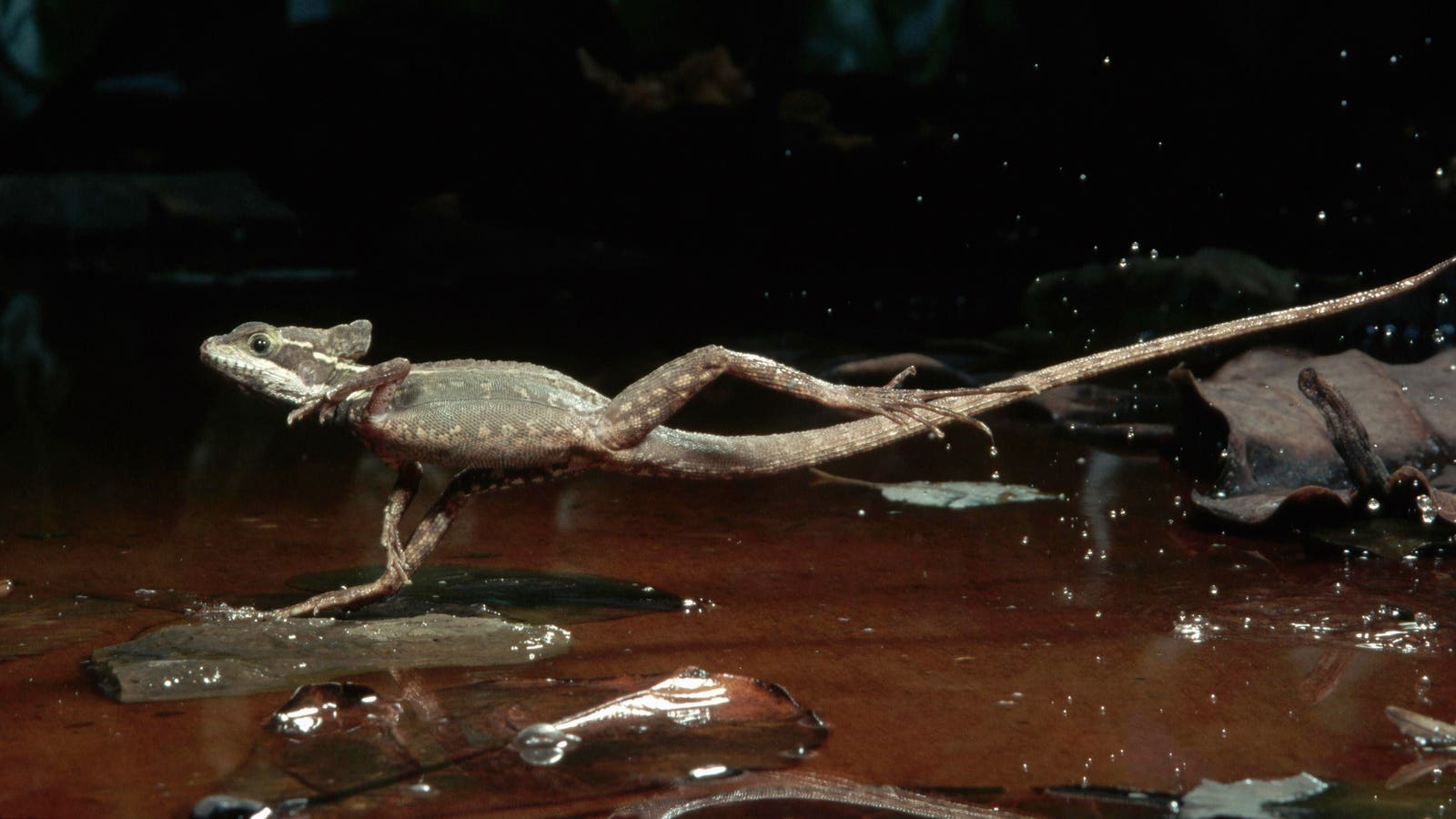
The biological phenomenon of the basilisk lizard, often called the Jesus Christ lizard, provides a compelling analogy for the current state of market liquidity and corporate performance. By generating enough force to trap air pockets beneath its feet, the lizard exploits surface tension to traverse water before gravity inevitably takes hold. This mechanism relies on high-frequency movement and precise timing, mirroring how specific sectors maintain momentum despite underlying structural pressures.
The Mechanics of Surface-Level Momentum
Market participants often observe companies that appear to defy gravity through sheer operational velocity. Much like the basilisk, these entities rely on rapid execution and a narrow window of favorable conditions to remain above the surface. When the frequency of these operational cycles slows, the support provided by surface tension dissipates. The transition from running on water to sinking is rarely gradual; it is a sudden shift in physics that forces a revaluation of the asset based on its weight rather than its speed.
In the current landscape, companies that have relied on high-velocity growth to mask structural inefficiencies are finding that the surface is becoming less supportive. As liquidity conditions tighten, the ability to maintain this pace requires an increasing amount of energy. Investors are now shifting their focus from the speed of the sprint to the buoyancy of the underlying business model. This shift is visible across several sectors, including technology and utilities, where the margin for error has narrowed significantly.
Sectoral Stability and Valuation Constraints
AlphaScala data currently reflects this environment of uncertainty. For instance, ON Semiconductor Corporation holds an Alpha Score of 45/100, while Southern Company and Humana Inc. sit at 43/100 and 50/100 respectively. All three are labeled as Mixed, suggesting that the market is struggling to determine whether these companies are effectively navigating the current environment or merely postponing a necessary adjustment.
- Operational velocity is no longer a sufficient substitute for fundamental strength.
- Surface tension in financial markets is provided by cheap credit and high risk appetite.
- The transition to sinking occurs when the cost of maintaining speed exceeds the marginal benefit of the growth achieved.
This dynamic is particularly relevant for firms that have historically relied on rapid capital deployment to sustain their market position. As the cost of capital rises, the physics of the market changes. Companies that cannot transition to a more sustainable mode of movement will eventually face the same reality as the lizard when it stops running. The next concrete marker for these firms will be their upcoming capital allocation disclosures, which will reveal whether they are choosing to conserve energy or attempting to sprint across increasingly thin ice. Monitoring these filings will be essential for identifying which companies are preparing for a transition and which are simply hoping the surface holds for one more cycle. For broader stock market analysis, the focus remains on whether the current pace of corporate activity can be sustained without a fundamental shift in the underlying economic support structure.