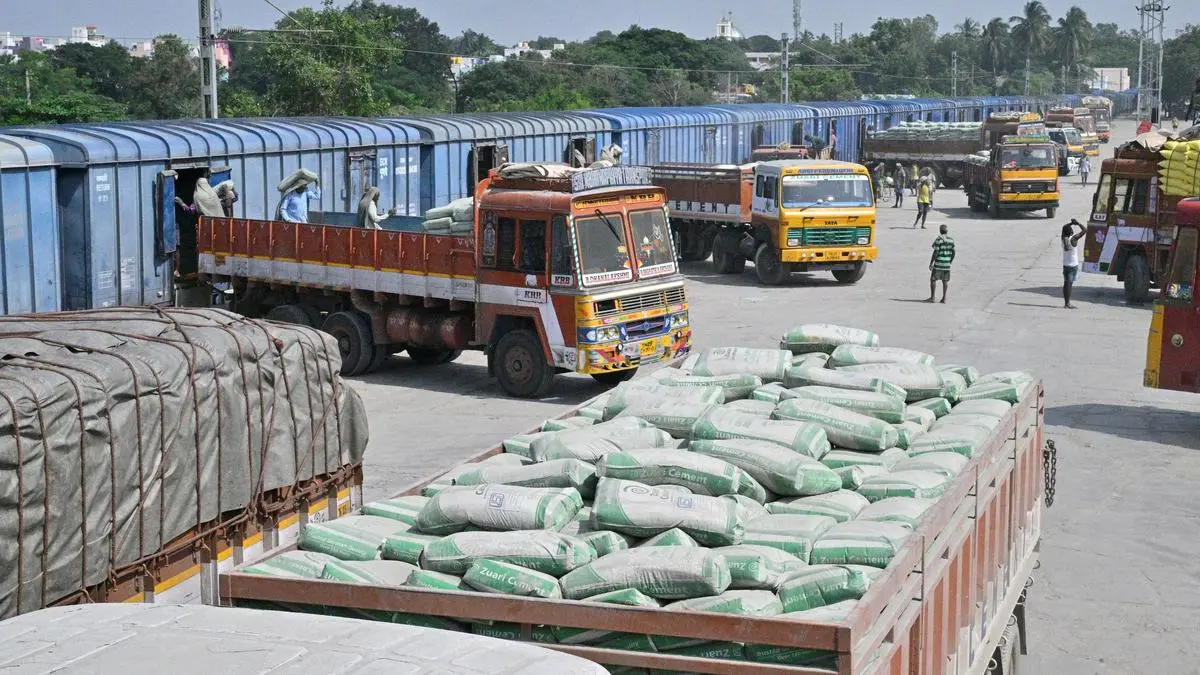
The operating profitability of Indian cement companies is set to decline 10-15% in FY27, according to a report from rating agency ICRA. The squeeze originates from rising power, fuel and selling costs linked to the West Asia conflict and the resulting surge in global crude oil prices.
ICRA projects per‑tonne profitability will fall to ₹820-870/MT in 2026-27, down from an estimated ₹950-980/MT in 2025-26. Power and fuel together with selling costs account for 50-55% of total operating costs for cement producers.
Cost Squeeze from Crude-Linked Inputs
Cement manufacturing is energy‑intensive. Companies rely on coal and petcoke for clinkerisation and on captive thermal power plants. Road transport dominates logistics for raw materials and finished cement, making diesel and polypropylene costs material.
The denominator: crude oil at $95/bbl
ICRA expects crude oil to average $95/bbl in its baseline scenario for 2026-27, compared with $72/bbl in 2025-26 – a 32% increase in the commodity that drives cement’s cost curve.
- Petcoke: prices rose 19% month‑on‑month in April 2026.
- Diesel: prices increased ₹3.9/litre in May 2026.
Both movements are already observable. The rating agency directly attributes the cost pressure to geopolitical disruption. "Crude oil prices have surged owing to the West Asia conflict and closure of the Strait of Hormuz. The prices are likely to stay elevated if the war prolongs," ICRA stated.
Price Hikes Fall Short: 6-8% vs 10-12% Cost Rise
ICRA expects cement companies to raise selling prices by 6-8% in response to higher costs. That increase, however, is insufficient to cover the 10-12% rise in power and fuel costs alone.
| Metric | FY26 Estimate | FY27 Estimate | Change |
|---|
| Profitability per tonne (₹) | 950-980 | 820-870 | –10.5% to –14.3% |
| Crude oil average ($/bbl) | 72 | 95 | +32% |
| Selling price increase (%) | – | 6-8 | – |
| Power & fuel cost increase (%) | – | 10-12 | – |
The 2-4 percentage point gap between cost inflation and price recovery is the direct hit to operating profitability.
Key insight: Cement margins are being compressed from both sides – the percentage of cost inflation exceeds the percentage of price recovery. That gap flows straight to EBITDA per tonne.
Exposed Assets: Sector‑Wide Risk with Varying Sensitivity
ICRA’s sample set covers major listed Indian cement manufacturers. The risk is sector‑wide because energy costs are common across all producers. Companies with higher petcoke exposure or longer road transport distances face above‑average margin pressure.
- UltraTech Cement – large fleet operator, high dependence on petcoke.
- ACC and Ambuja Cements – owned by Adani Group; logistics costs vary by region.
- Shree Cement – historically efficient on power costs, still subject to market petcoke prices.
- Dalmia Bharat – high share of road transport in its southern markets.
No cement company is fully hedged against a $95/bbl crude environment. The only variable is whether individual cost structures can absorb 2-4 points of margin pressure better than peers.
Timeline: When the Numbers Hit
- Q1 FY27 (April‑June 2026) – First full quarter with petcoke up 19% MoM and diesel up ₹3.9/litre. Earnings will show the immediate impact.
- H1 FY27 – If crude remains near $95/bbl, the cost base will be reset. Price hikes announced in the June quarter will be too small to bridge the gap.
- Full year FY27 – ICRA’s ₹820-870/MT profitability estimate becomes the reference. Actual results will depend on whether crude dips or rises further.
What Would Reduce the Risk
- A de‑escalation of the West Asia conflict that reopens normal shipping lanes and lowers crude prices.
- A faster‑than‑expected pass‑through of costs to customers if demand holds strong – though ICRA’s 6-8% estimate suggests the rating agency does not see that as the base case.
- A drop in domestic diesel prices through government intervention or softening global benchmarks.
What Would Make the Risk Worse
- Further escalation in the conflict, particularly if the Strait of Hormuz remains closed or is attacked.
- A crude price spike above $100/bbl sustained for several months.
- A demand slowdown that prevents cement companies from achieving even the 6-8% price increase, forcing sharper margin compression.
Forward‑Looking Framework
For traders watching cement stocks, the key variable is ICRA’s crude assumption. If the West Asia conflict de‑escalates, the margin outlook improves. If the Strait of Hormuz stays closed or the conflict widens, the ₹820/MT floor may prove optimistic.
ICRA’s report is a concrete signal that the commodity cost cycle has turned against cement producers. The 10-15% profitability decline is already built into the rating agency’s model. The market will need to decide whether that is the right base case or whether the risk skews worse.
For a broader view on how commodity costs are shaping Indian market moves, see our commodities analysis and the latest on crude oil price dynamics.