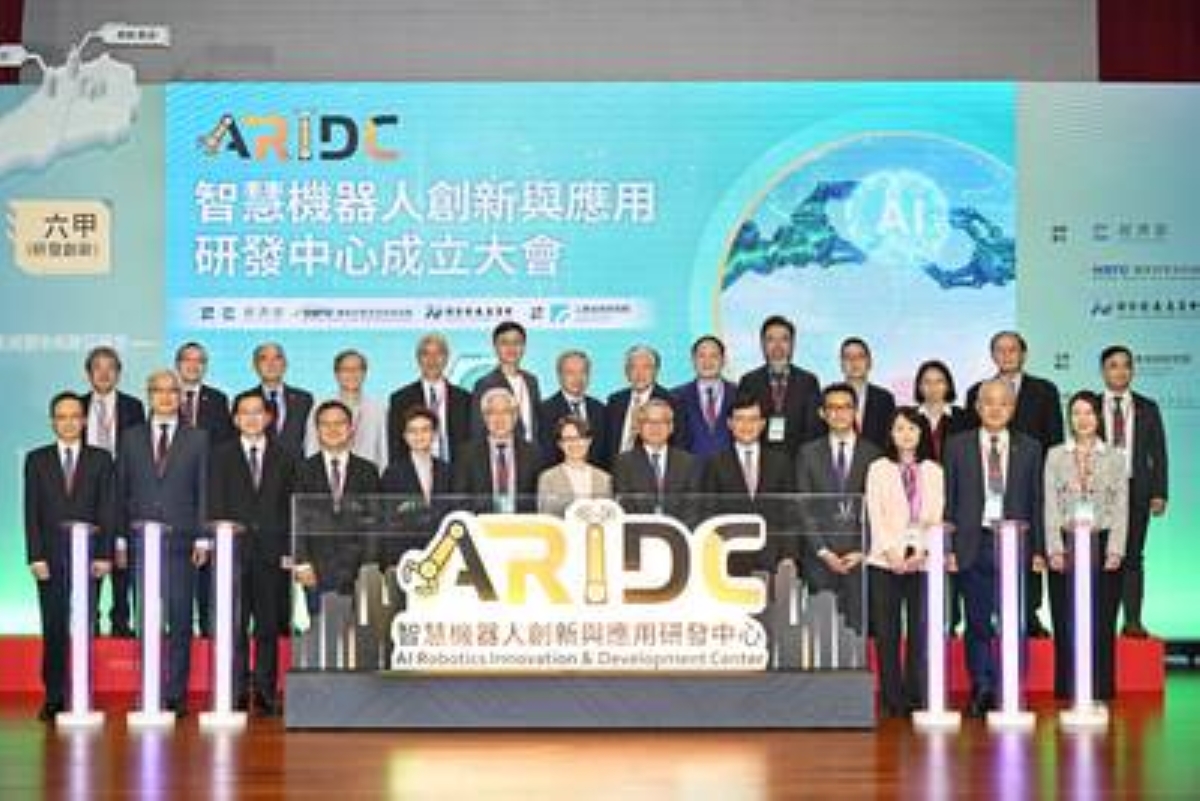
The Industrial Technology Research Institute (ITRI) opened the AI Robotics Innovation & Development Center (ARIDC) in Tainan on May 19, 2026. The center is part of Taiwan's Ten Major AI Infrastructure Projects and targets four sectors: healthcare, logistics, food services, and disaster response. For traders tracking the semiconductor and automation supply chain, the move signals a deliberate bet on robotics as the next layer of Taiwan's manufacturing export model.
What the ARIDC Actually Changes
ARIDC is not a research lab in the traditional sense. It is a technology verification and testing environment built to move AI-powered robots from prototype to commercial deployment. The center provides dedicated incubation space, advanced computing infrastructure for digital twin workloads, and support for Universal Scene Description (USD) environments – the same file format used by Pixar for 3D scene rendering, now applied to robotics simulation.
The Four Sector Targets
The center's focus areas map directly to labor shortages and automation gaps in Taiwan and its key trade partners.
- Healthcare: Surgical assist robots, hospital logistics automation, rehabilitation exoskeletons
- Logistics: Warehouse picking, last-mile delivery, port container handling
- Food Services: Kitchen automation, food processing, sanitation robotics
- Disaster Response: Search-and-rescue drones, infrastructure inspection, hazardous material handling
Connecting Startups to the Supply Chain
ARIDC is positioned as a hub linking international startups with Taiwan's existing manufacturing and applied research ecosystem. The center co-locates with the National Center for AI Robotics in Shalun and sits near the Liouying Technology Industrial Park, an intelligent robot industry cluster.
Beyond hardware, the center offers team formation, market strategy development, and matchmaking with national investment funds. That last piece matters: it ties ARIDC directly to Taiwan's sovereign funding apparatus, not just venture capital.
The Supply Chain Read-Through
The simple read: Taiwan opens a robotics center. The better read: This is a validation layer for a supply chain that already produces the world's most advanced chips. ITRI is the same organization that incubated UMC and TSMC. Its institutional track record gives the ARIDC signal more weight than a typical government technology park announcement.
Where UMC Fits
ITRI's history with UMC dates to 1979. UMC remains a major semiconductor foundry, though its current business is dominated by mature-node chips (28nm and above). Robotics controllers and sensor processors tend to run on those nodes. If ARIDC accelerates demand for mid-range chips, UMC's capacity utilization gets a long-tail support. The stock currently carries an Alpha Score of 54/100, labeled Mixed, from AlphaScala's proprietary scoring model. That score reflects the tension between steady foundry revenue and limited upside from AI boom spending. The robotics center is a demand-side catalyst that could tilt that score higher if commercialization picks up.
Potential for Disruption
Taiwan already dominates semiconductor and precision manufacturing. Adding robotics verification capabilities in Tainan creates a one-stop shop: design the robot, prototype the chip in Hsinchu, validate the full system in Tainan. That vertical integration could shorten time-to-market for foreign robotics startups by 6 to 12 months, according to industry estimates from the Taiwan AI Robotics Association. It also raises the bar for competing robotics hubs in Southeast Asia and Eastern Europe.
What Confirms or Weakens the Thesis
Traders watching this story should treat the opening as an initial condition, not a silver bullet. The center's impact on publicly traded names depends on concrete commercialization milestones.
Confirmation Signals
- Named corporate partnerships with global robotics firms (e.g., Fanuc, Yaskawa, ABB) using the center for validation
- Government procurement contracts for disaster response or hospital robots tied to Taiwan's 2027 budget
- Increased R&D spending at ITRI-incubated companies, particularly those filing for IPO on the Taiwan Stock Exchange
Invalidation Signals
- Low utilization rates reported in ARIDC's incubation space during the first 12 months
- Shifts in Taiwan's government funding priorities away from AI infrastructure toward other sectors
- Export control risks that limit the center's access to advanced simulation software or GPU clusters
Why This Matters for Global Robotics
Taiwan's robotics push is not happening in isolation. The Ten Major AI Infrastructure Projects include AI supercomputers, data centers, and smart city initiatives. ARIDC is the robotics component of a broader cross-economy bet. For traders in industrial robotics ETFs, for example, this center adds a low-cost validation pathway that could reduce the failure rate of Taiwanese robotics startups and increase the pipeline for acquisitions by larger players.
Practical rule for evaluating industrial policy plays: focus on the mechanism that converts government spending into revenue. In ARIDC's case, the mechanism is startup-to-factory matchmaking – connecting a foreign AI startup with a Taiwanese contract manufacturer that already makes iPhone components. If that matchmaking produces announced deals within the next 12 months, the thesis strengthens. If the center remains a showcase site for visiting delegations, the thesis weakens.
Risk to watch: government-funded robotics centers globally have a mixed record. Japan's Robot Revolution Initiative of 2015 produced incremental automation but no world-beating robotics company. South Korea's Intelligent Robot Development and Promotion Act of 2008 generated patents but limited exports. Taiwan's advantage is its existing manufacturing base. ARIDC's job is to leverage that base, not replace it.
For a deeper look at how rates and the dollar interact with Taiwan's export cycle, see the AlphaScala market analysis. The UMC stock page tracks insider and institutional activity. The SO stock page provides context for utility costs in southern Taiwan, where the center is located.
Next Concrete Catalyst Points
- ITRI's 2026 Annual Technology Conference in June, where startup teams from ARIDC are expected to present
- Taiwan's 2027 national budget proposal, due in August 2026, which will detail funding for the remaining nine AI infrastructure projects
- EBRD or US DFC investment in Taiwanese robotics startups – any such announcement would validate ARIDC's matchmaking model for international capital
The center opens at a time when global supply chain de-risking is pushing automation investment. Taiwan has the semiconductor capacity. ARIDC gives it the robotics validation layer. The question is whether the center can produce revenue-generating products, not just press releases.