Nikola Tesla's 1899 Colorado Springs experiments produced exact specifications for stationary terrestrial wave extraction, according to his laboratory notes. The subsequent five-year delay on Patent No. 787,412 suggests institutional suppression, not technical failure.
The Pikes Peak region's Niobrara Formation, rich in calcium carbonate, offers a dielectric constant different from the surrounding Pierre Shale. Geological surveys show this matters for energy extraction because the bedrock acts as a natural circuit component. The Niobrara is stable and mineral-rich, creating a conductive base.
Tesla treated electricity as a fluid dynamic. His Valvular Conduit patent (No. 1,329,559) created asymmetrical resistances to draw from the vacuum. Modern physics calls this the Casimir effect. The math was complete in 1899, then absorbed by the early military-industrial complex.
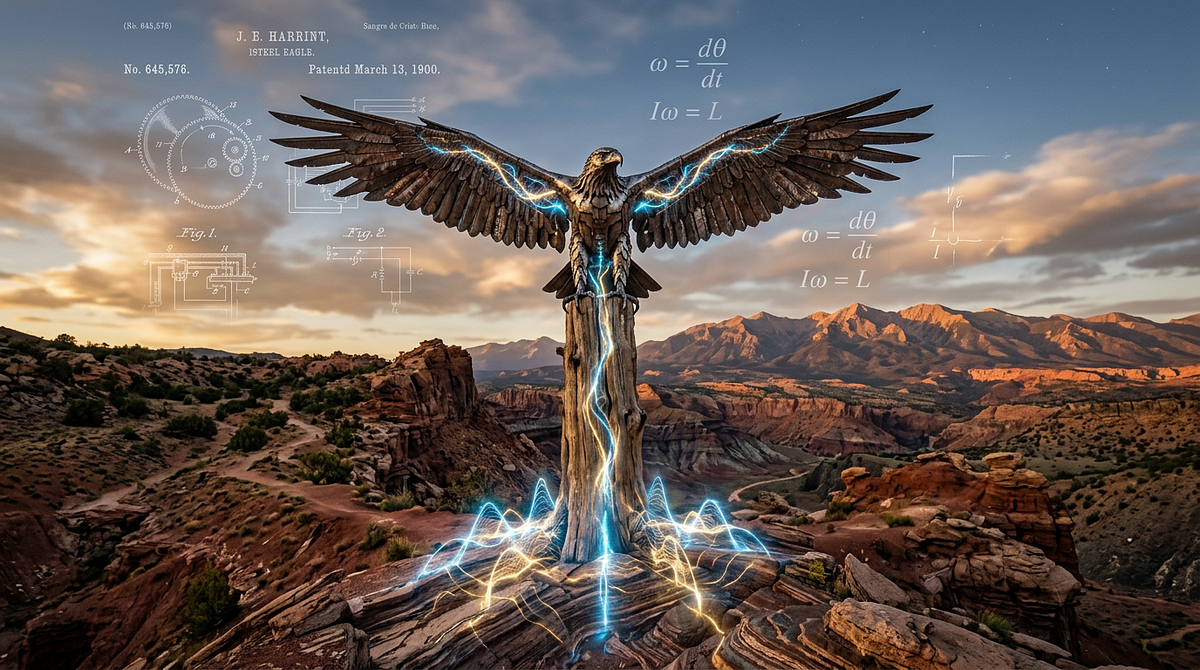
At the Thunderbird Perch, a steel sculpture with a 66-inch wingspan is being bolted into old-growth spruce using 1890s fastening techniques. The structure sits on the Niobrara Formation, creating a macro-scale antenna. The project's documentation states the sculpture is planned for Cañon City. No date has been set for completion.