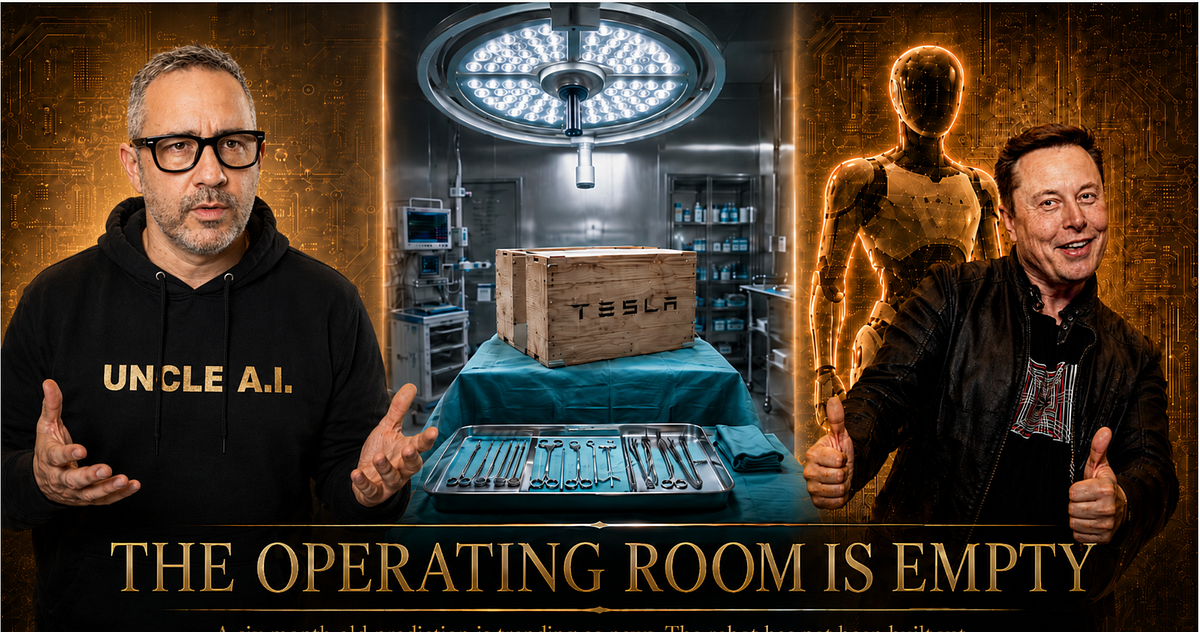
A six-month-old prediction about robot surgeons is circulating again, this time with a shorter deadline. The factory that would build them is still under construction.
On the Moonshots podcast with Peter Diamandis in January, Elon Musk said by 2030 there would probably be more Optimus robots that are great surgeons than human surgeons on Earth. Fortune covered it on Jan. 13, 2026. The version trending today says 2029. A year fell off somewhere between the microphone and the summary card.
Tesla published its Q2 2026 shareholder update nine days ago. The Model S and X lines at Fremont are decommissioned. The first-generation Optimus lines are being installed in that space. Production is "anticipated later this year." There is no start date, no unit count, and no Optimus line item in any Tesla production report. The capacity table lists Optimus under Construction.
On the earnings call, Musk described it as the hardest thing Tesla has ever tried to manufacture at scale. He said there is no existing supply chain to lean on and warned the early ramp would be flat and long.
The prediction claims more robot surgeons than human surgeons worldwide inside four years. The factory is still installing the line that makes the first one.
What actually happened in surgical robotics this year is narrower. A team from Johns Hopkins, Stanford, and Optosurgical published a system called SRT-H in Science Robotics. It ran the clipping and cutting portion of a gallbladder removal with no human driving the instruments. It found the structures, placed the clips, made the cuts, adjusted when the tissue did not match its training, and corrected itself when it slipped. Eight runs, eight completions.
Those runs were on specimens, not patients. It was one stretch of one procedure, not incision to closure. A systematic review of 49 FDA-cleared surgical robots found nearly all of them at assistive autonomy, under continuous surgeon control. Only two filings declared machine learning at all. The review concluded: "No fully autonomous surgical robot exists."
Predictions are free. The risk is downstream. A student picks a specialty based on a date that was never actually said. A founder aims a product at a market that does not exist yet. A clinic owner sits on a capital purchase. A content calendar gets built around a timestamp that is not load bearing.
The promise clock runs on stages, podcasts, and summary cards. A year can slide off it in a screenshot and nobody files a correction.
The build clock runs on production lines, parts, suppliers, clearances, and units shipped. It moves when something gets made.
Tesla has no named clinical partner for a surgical robot, no registered trial, no pre-submission to the FDA. Surgical autonomy is a clearance problem before it is an engineering problem. There is no published liability answer for when the machine nicks a duct.
Until one of those shows up, the story is a story. When a claim comes back around six months later wearing a fresh timestamp and a shorter deadline, the claim is not the news. Somebody needing it to trend again is the news.