Every CLM vendor now calls itself "AI-native." Every one uses the phrase "contract intelligence." A growing number position their product as the foundation for the "agentic enterprise."
The language sounds identical. The underlying architecture does not.
In the recently published report The Contract Lifecycle Management Platforms Landscape, Q2 2026, the picture is clearer. On the surface, vendors compete on marketing speed and AI catchphrases. Below that surface, platforms split into three real categories: repositories that store contracts but leave action to humans, workflow automators that stall when processes cross functions, and data-driven systems that treat contracts as structured inputs for decisions, risk surfacing, and enforcement at portfolio scale.
The problem is not missing features. It is the common messaging that blurs where each category starts and stops. Buyers hear the same story and assume comparable outcomes. The architectures are headed to very different places.
AI Exposes the Readiness Gap
AI is accelerating the market. It is also exposing how unprepared many organizations are to use it.
Vendors push "agentic" roadmaps and autonomous workflows. Buyers face inconsistent data, evolving governance requirements, and change-management friction. The mismatch between what vendors productize and what companies can operationalize looks like offering a lactose-intolerant diner an extra-cheese slice.
Pre-Signature Work Gets Commoditized
AI-native drafting and review tools – Harvey, Legora, Claude for Legal – are commoditizing the pre-signature phase. Speed of draft generation is no longer a differentiator.
The center of gravity shifts to post-execution. The question becomes: how effectively does the platform manage the contract after signature? How does it extract obligations, calendarize deadlines, and trigger cross-system actions?
The strong players already focus there. The weak ones still sell on auto‑fill clauses and template libraries.
The Buyer Committee: Four Constituencies, One Decision
CLM buying committees look like a table arguing over one large pizza.
- Legal wants control over terms, approvals, and risk.
- Procurement wants leverage on renewal pricing and vendor compliance.
- Sales and finance want speed and predictability in deal cycles and revenue recognition.
- Technology wants a stable integration that doesn't break CRM, ERP, or identity management.
Most vendors optimize to delight exactly one of these groups. Fewer can credibly serve all four.
Where the Strongest Players Separate
The platforms that outperform share three structural traits.
Contracts as structured data. Obligations, dates, parties, and risk clauses go into queryable fields – not PDF metadata. The system can answer "show me all contracts with auto-renewal above industry median price" in one query.
Workflow that crosses boundaries. A renewal trigger sends a procurement RFQ, updates the sales quota, and flags a legal compliance check without manual handoffs.
Portfolio-level risk surfaces. The tool shows aggregate exposure across 500 vendor agreements – not just one indemnification clause.
The weakest players share one trait: they look great in a demo and fall apart when connected to a real CRM, ERP, and SSO stack.
The Post-Signature Battleground
Pre-signature drafting is becoming table stakes. The real value lies in what happens after a contract is signed.
The data-driven tier is small today. The market will consolidate toward it as buyers realize that a fast draft is useless if the contract sits in a silo until the next audit.
A Three-Question Litmus Test for Buyers
Before you sign another CLM deal, ask the vendor to run a live demo against your actual data. Test these three things.
- Obligation tracking: Can the platform auto-extract and calendarize obligations from a 50-page supplier agreement? Show the result in your system, not a slide deck.
- Cross-system enforcement: When a contract expires, does the platform lock the vendor's access in your SSO system? If the answer is "our partner can do that," the answer is no.
- Renewal economics: Does the platform surface which contracts auto-renew at unfavorable terms before the window closes, with a single click to renegotiate?
What Changes for the Buyer's Next Decision
The CLM market has a messaging problem, not a capability problem. The capabilities exist. The messaging makes them invisible.
Your job as a buyer is to push past the language. Ask every vendor to show you their post-signature workflow, cross-system integration points, and portfolio-level risk report. The ones that can't do it live are selling an awning, not a slice.
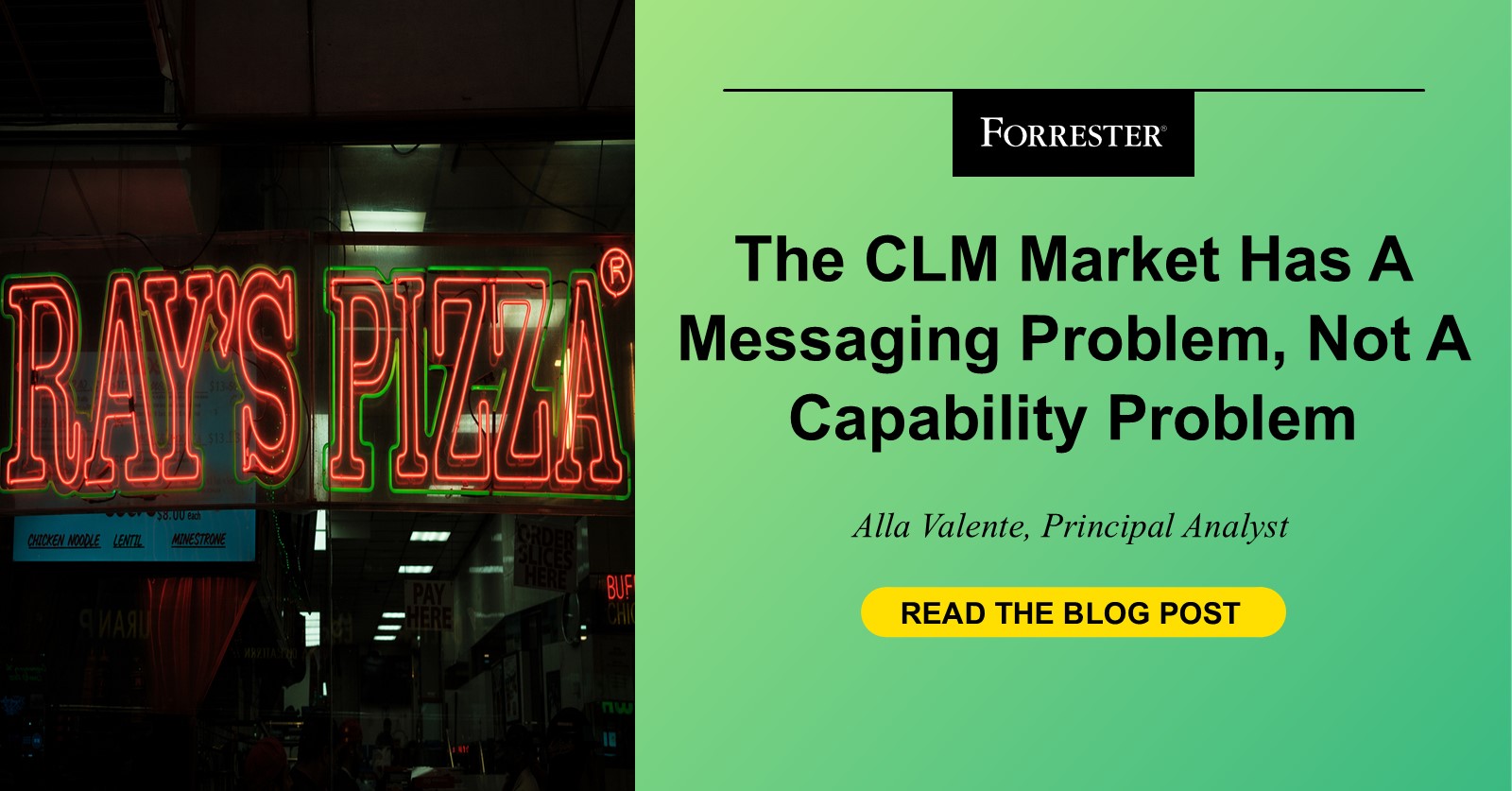
In New York, you don't pick your favorite Ray's by the awning. You pick it by the slice. Treat CLM the same way. The signage will keep changing. The value is still in the structure underneath.
The upcoming Forrester Wave for CLM will provide a structured evaluation. Until then, the full report gives more detail on market dynamics, notable vendors, and top use cases.
Schedule a guidance session for deeper insights into this market or to discuss your CLM program.