PayPal's Agentforce Lift: 50% More Conversions in 14 Weeks
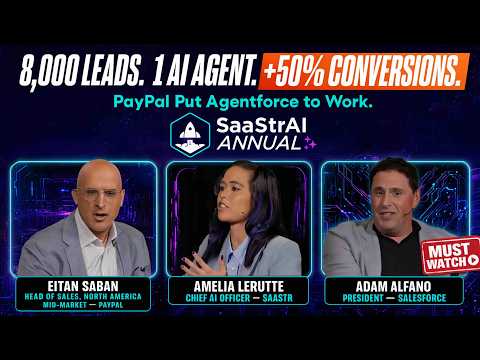
PayPal used Agentforce to work 8,000 untouched leads monthly. Conversions rose 50% in 14 weeks. The handoff mechanism and data model moat explain what's real about AI agents.
PayPal deployed Salesforce's Agentforce on 8,000 leads each month that no human was ever going to call. Conversions jumped 50% in 14 weeks. The number is impressive. The mechanism behind it is more useful for anyone trying to figure out whether AI agents are real or hype.
The problem PayPal faced is straightforward. It onboards north of 100,000 merchants a month. A big chunk of them stop processing somewhere in the journey. That leaves roughly 8,000 leads to chase every month. No sales team has the headcount to work 8,000 nudge cycles religiously. So those merchants got dropped.
The agent runs a 10-nudge cadence against every single one. It does not get tired. It does not skip weekends. It does not cherry-pick the leads with the fattest commission. Eitan Saban, Head of Sales for North America Mid Market at PayPal, put it plainly: "The win isn't the agent closing the deal. The win is the agent doing the heavy lifting to book the meeting, so a human shows up to the merchant as the best version of themselves with full context already loaded."
The conversion lift comes from that handoff. Reps start way further down the funnel, on a qualified lead, with the full story already in front of them.
Data quality is the trap most teams overthink. Adam Alfano, President at Salesforce, addressed the question directly. Someone asked whether you can deploy an agent if your CRM data is a mess. His answer: "Don't try to solve world hunger on your data before you turn an agent on." Salesforce runs its SDR agent at 70% deliverability, better than its human reps. The reason is the agent has an omniscient understanding of a well-curated data environment. That is the idyllic end state. Most companies are not there yet. That is fine.
You can stand up a web agent that understands your website, your FAQs, and your product data while you are still consolidating everything else. It still has a safe, accurate conversation. It still pulls in rich customer intel. Here is the part most people miss: using the agent is itself the fastest way to figure out what data and structure you actually need. The work runs in reverse. Action bias beats a six-month data cleanup project that never ends.
Amelia Lerutte, who moderated the session, made the same point with her own story. She copied the internal Salesforce use case for following up on stale leads. She went to check how many leads SaaStr had never followed up with. The answer was a spreadsheet with a thousand people on it. She did not clean it for a month. She gave herself one day, accepted it would never be perfect, and handed it to the agent. Some of those re-engaged leads were in the room at SaaStr Annual.
Architecture matters as much as the use case. Adam said Salesforce has always been a great place for humans to do work. They now think it is great tooling for agents. The data is in the CRM. The processes are codified. The agent draws inference from structured data and writes back to it with 100% determinism. That is exactly what you want when you are in a regulated industry and "probably going to do the right thing" is not good enough.
Jason Lemkin, SaaStr's founder, does not have a Salesforce seat. He has an API seat. His AI VP of Marketing, an agent called 10K, talks to Salesforce headless through the API, authenticated through both Replit's native integration and a Salesforce connected app. 10K pulls the full sponsorship pipeline, the media pipeline, the deal list, and the historical revenue data. Jason can sit in the agent and say "pull up sponsors with competitors bringing a bunch of people to Annual this year," get the list, then say "great, now email it to that person." The CEO runs a full campaign against the go-to-market team's data without ever logging into a CRM.
Adam's vantage point is Slack. He manages a team of thousands through Slackbot and rarely logs into Salesforce directly. The agents live where the work happens. The inference in Slackbot is unmetered, so you can take the data for a ride without burning tokens.
The lesson: stop thinking of your CRM as a place humans go to fill in fields. Start thinking of it as tooling your agents execute against.
There is a second data vector most teams are not thinking about. It is not just the structured records. It is the conversations. PayPal feeds the Agentforce agent every conversation from Gong and the transcripts behind them, plus account data hosted in Seismic. The agent learns exactly why deals were lost and what drove lower conversion. Adam made the broader point: human-to-human, agent-to-human, and increasingly agent-to-agent conversations all feed back into the dataset. A lot of the orchestration now comes straight off the transcript and conversational intelligence.
Pull all of that together and the agent has far more context to work with. It does a better job on the actual problem. The companies winning here treat every conversation as part of the dataset instead of letting it disappear after the call.
Agents are not magic. They are employees you have to onboard. PayPal's Agentforce agent in week one, working 200 leads, is a completely different agent than the one now working 8,000 leads. In a month it will work 80,000 leads a week. That maturity journey takes teaching, troubleshooting, and tuning. Adam called it caring for the agents. Dan Darcy's customer success team at Salesforce describes it as giving each agent a "virtual mom" to steer it in the right direction. Neglect the onboarding and the agent develops the same flaws a poorly trained human would.
The same example shows up in the tuning itself. SaaStr's outbound agent got explicit context that some of these leads are stale and might be grouchy about being ghosted, so be more personable than a person typically would. That is not a prompt you write once. That is ongoing management of a teammate.
The deployment playbook splits by company size. SaaStr AI is, in Amelia's words, three humans and a dog. When they need an agent, Jason vibe codes it himself in Replit and hooks it up. Every person who needs to sign off is already in the room. PayPal is the opposite. In a highly regulated environment you cannot kick off an agent without marketing approval and without compliance having veto power. Eitan's single biggest learning from 14 weeks: "You cannot run it yourself. You have to bring marketing, compliance, and the broader org along, all bought into the agent's outcome, before you scale it."
The mistake in the middle of that spectrum is having a great agent that works fine in isolation and then stumbling on how to integrate it into the real work process. The integration is the hard part now. Standing up the agent in Agentforce takes a couple of seconds. Orchestrating the team and the agent around it is where the work lives.
And critically, the agent carries a quota. Eitan's team built an AI institution that brings the use cases together, orchestrates them, ties them to an outcome, and puts a number against it. An agent without a number is a science project. An agent with a quota is a teammate.
For traders watching Salesforce, the case study matters. Agentforce is the centerpiece of CRM's growth narrative. The PayPal example shows real ROI in a large, regulated customer. CRM's Alpha Score sits at 39, labeled Mixed. The stock reflects execution risk and competition from Microsoft, HubSpot, and others. The data model moat Adam described is still being built. The adoption of Agentforce could be a catalyst if enterprise customers follow PayPal's lead. The question is how many will move from pilot to quota-carrying deployment.
The parting advice from everyone on stage was the same. Just do it. A year ago this session would have been about how to build an agent and which use cases to try. Now setting up the agent takes minutes. The question is not whether AI replaces people. The real question, as Eitan framed it, is which people AI will make irreplaceable.
Drafted by a large language model from the source reporting linked above, then screened by automated publishing checks. It is not read by a journalist before publication. Some articles cite our Alpha Score. Verify prices and figures against the original source. Educational coverage, not personalized advice.