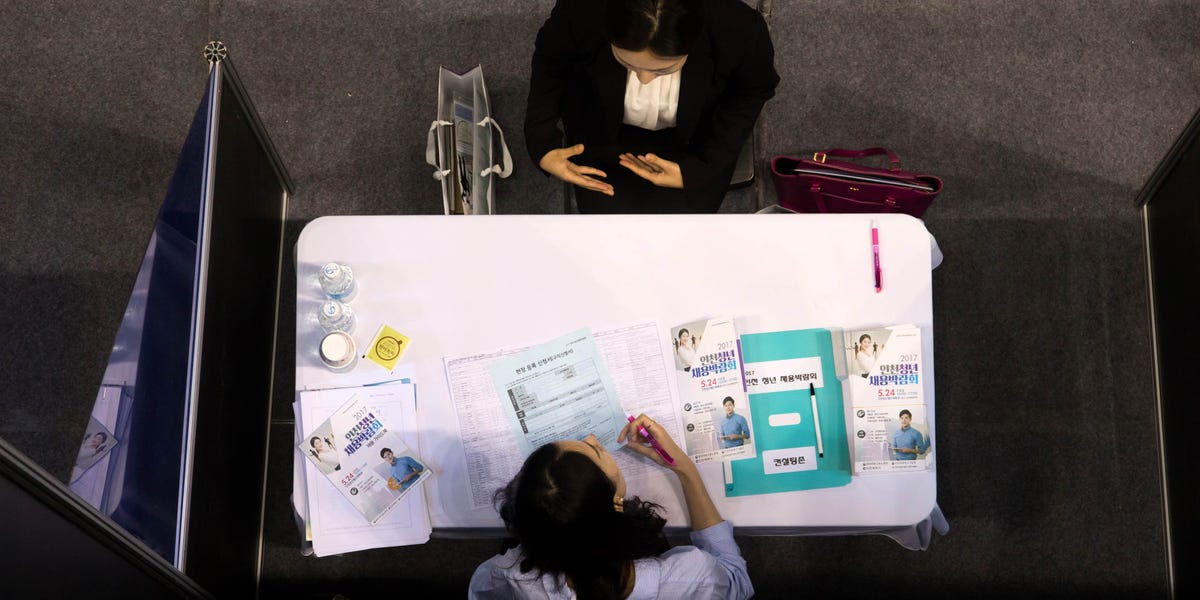
Tech companies are pulling job candidates back into the office for a reason that has nothing to do with collaboration or culture. They want to check whether the person on the other side of the screen is a human or a chatbot.
Stanford economics professor Nick Bloom, best known for his work on remote work, said AI has made virtual coding tests nearly useless. "A lot of tech firms used to hire folks based on coding tests. They can't do that anymore," Bloom said in a Financial Times podcast released Friday. Candidates can prompt an AI during an online interview and read the answers aloud, he explained. Some tech firms now hold final and middle interview rounds in person as a result. "Are you interviewing Claude or the person?" Bloom asked, referring to Anthropic's chatbot.
Data from Greenhouse's 2025 AI in Hiring Report, which surveyed more than 4,100 job seekers, recruiters, and hiring managers across the US, UK, Ireland, and Germany, showed that 39% of US hiring managers were conducting more in-person interviews "to verify" candidates. The firm's 2026 report, covering a smaller sample in the UK, Ireland, and Germany, found a continuation of the trend. Employers were adding hands-on validation steps to confirm skills and fit, Greenhouse said, citing worries about AI-assisted applications and fraud.
Not every tech company is banning AI in interviews. Business Insider reported earlier this year that Google launched a pilot letting software engineering candidates use an approved AI assistant. Startups like Cognition, Base44, and Replit have embraced AI in technical hiring. Some employers that allow AI use are shifting their focus to problem-solving, critical thinking, and culture fit, Business Insider reported. Cisco, for instance, is moving from conventional coding challenges toward project-based exercises that observe how candidates operate in AI-enabled workflows. "The human element of oversight and expertise is more crucial than ever," Scott McGuckin, Cisco's VP of global talent acquisition, told Business Insider this month.
The split between companies that police AI use and those that encourage it is likely to widen as the tools become more capable. Bloom's warning suggests the in-person interview, long seen as a legacy practice, may become a standard screening tool again for roles that rely on technical skills.