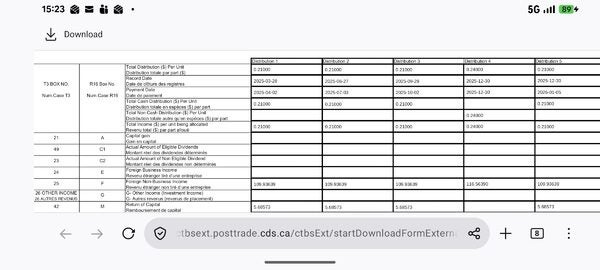
Tax Reporting Discrepancies Emerge in BMO S&P 500 Index ETF Distributions

Investors in the BMO S&P 500 Index ETF (ZSP.TO) are reporting a discrepancy between actual cash distributions and T3 tax summaries, complicating annual tax reconciliation.
Alpha Score of 55 reflects moderate overall profile with moderate momentum, moderate value, moderate quality. Based on 3 of 4 signals — score is capped at 90 until remaining data ingests.
Alpha Score of 45 reflects weak overall profile with strong momentum, poor value, poor quality, weak sentiment.
Alpha Score of 53 reflects moderate overall profile with poor momentum, strong value, strong quality, moderate sentiment.
Alpha Score of 47 reflects weak overall profile with moderate momentum, poor value, moderate quality. Based on 3 of 4 signals — score is capped at 90 until remaining data ingests.
A recurring discrepancy in the 2025 T3 tax reporting for the BMO S&P 500 Index ETF (ZSP.TO) has surfaced, with investors reporting five distinct distribution entries on tax summaries despite receiving only four cash payments throughout the fiscal year. This administrative misalignment creates immediate friction for retail holders attempting to reconcile their investment income against official tax documentation provided by financial institutions.
Reconciliation Challenges for ZSP.TO Holders
The core issue stems from the divergence between actual cash flow events and the tax reporting structure applied to the ETF. Investors typically track distributions based on the four quarterly cash payments deposited into their accounts. When a T3 summary lists five entries, it often indicates an accounting adjustment, a phantom distribution, or a reclassification of income that does not correspond to a direct cash event for the shareholder. This creates a reporting burden where the investor must verify whether the fifth entry represents a non-cash reinvestment or a correction of prior-period data.
For those managing portfolios across multiple institutions, the inconsistency complicates the aggregation of tax data. Because the discrepancy appears across different brokerage platforms, the issue likely originates at the fund provider level or within the data transmission process to tax authorities. Investors are currently tasked with verifying whether these entries reflect taxable income that was never realized as cash or if they represent a reporting error that requires a corrected T3 slip.
Structural Implications for Index ETF Reporting
This event highlights the sensitivity of passive investment vehicles to administrative reporting standards. While ZSP.TO remains a primary vehicle for Canadian investors seeking exposure to the stock market analysis landscape, the complexity of cross-border tax treatment for S&P 500-tracking ETFs often leads to these reporting anomalies. The inclusion of a fifth distribution entry can trigger automated tax flags, forcing investors to manually reconcile their holdings against the fund's official distribution history.
- Verify the specific distribution dates listed on the T3 summary against the fund provider's official distribution schedule.
- Check for non-cash reinvestment notices that may have been issued in lieu of or in addition to standard cash payments.
- Contact the brokerage firm's tax department to determine if the fifth entry is a placeholder for a tax-deferred return of capital or a reporting error.
Next Steps for Tax Reconciliation
The immediate path forward involves a formal review of the fund's distribution history to isolate the source of the fifth entry. Investors should prioritize obtaining a breakdown of the T3 components from their respective financial institutions to determine if the additional entry carries a tax liability. If the brokerage confirms the entry is an error, the issuance of a corrected T3 slip becomes the necessary resolution. The next concrete marker for affected investors is the deadline for receiving corrected tax documentation, which typically follows the initial filing period. Until then, holders should maintain documentation of their actual cash receipts to support any potential adjustments during the tax filing process.
AI-drafted from named sources and checked against AlphaScala publishing rules before release. Direct quotes must match source text, low-information tables are removed, and thinner or higher-risk stories can be held for manual review.