Stocks● Neutral
Takashi Wickes: AI Prototyping Needs Intentional Friction
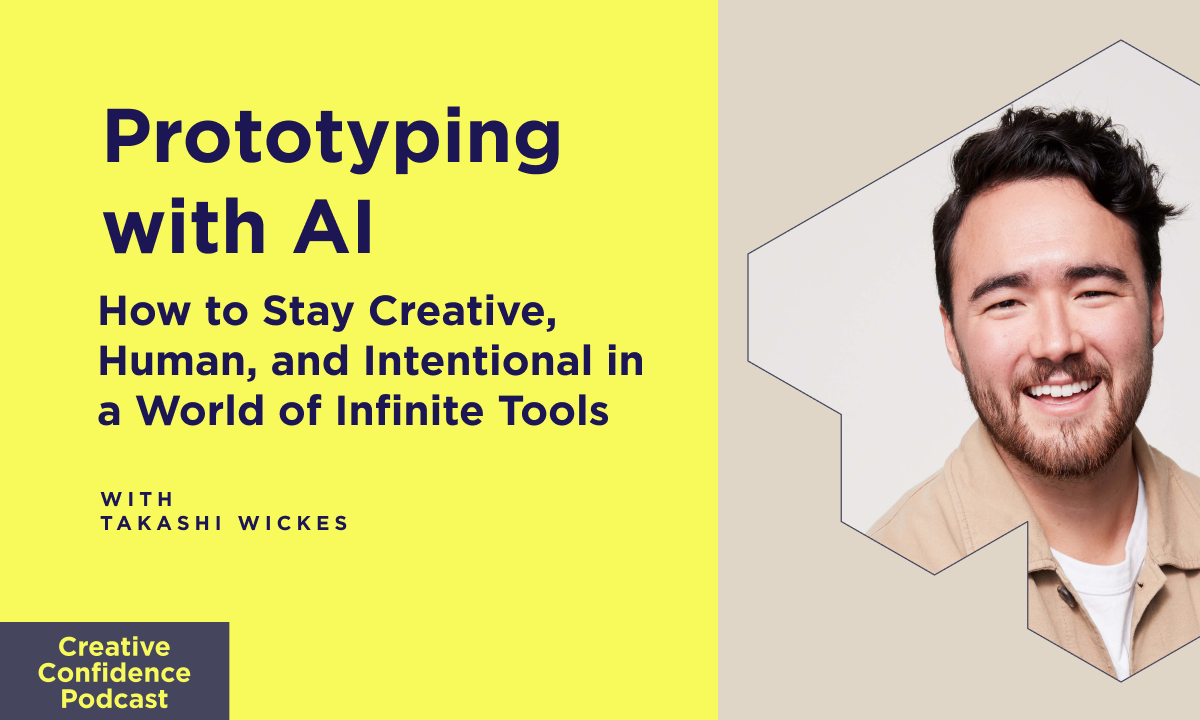
Interaction designer Takashi Wickes explains the Director–Curator–Craftsman model and why slowing down with AI produces better creative outcomes than speed alone.
Continue with
The Creative Confidence Podcast recently featured interaction designer Takashi Wickes to discuss the new IDEO U course Prototyping with AI. Wickes made a case that contradicts the dominant efficiency narrative: the most productive use of AI in creative work is intentional friction, not speed.
Wickes draws on a decade of prototyping experience at IDEO, including a project where he used ChatGPT to learn the mechanics of surgical procedures before interviewing surgeons. The AI helped him shape interview questions that surfaced deeper user insights. The device design itself stayed human-driven. The lesson: AI works best as a curiosity engine, not a solution generator.
What AI Prototyping Is (and What It Is Not)
Wickes defines AI prototyping as the craft of using AI tools to make ideas tangible for testing and iteration. It applies to physical products, services, and experiences. The goal is faster learning, not faster finishing.
The common mistake is treating AI as a shortcut to the perfect answer. Wickes does the opposite: he uses AI output as a benchmark. If the AI produces the same solution he arrived at independently, that is a signal he has not pushed his thinking far enough. The better use is as a curiosity machine that generates new questions and expands the possibility space.
Why Output Volume Does Not Equal Value
A naive approach to AI prototyping is to ask the tool to solve a brief completely. That often produces generic results. Wickes warns that this commoditizes the output – every team using the same tools gets similar answers. The distinguishing factor is human direction: what you choose to ask, what you discard, and what you build from.
The Director–Curator–Craftsman Framework
Wickes introduced a model for balancing human judgment with machine capability. The framework has three mindsets:
- Director – Sets the creative vision and gives AI direction. Decides what story to tell and how to prompt with intention.
- Curator – Selects, edits, and makes sense of abundance. Decides what is worth showing and what meaning to draw from it.
- Craftsman – Experiments with tools, hones taste, and builds fluency. Decides which AI tools to use and why.
Wickes moves fluidly through these roles when prompting, evaluating outputs, and selecting tools. The cycle is direction, exploration, refinement.
The Curator's Role Is the Hardest
AI can generate unlimited ideas. Wickes advises teams to resist showing every option. When too many concepts are presented, stakeholders make quick, surface-level choices. The better practice is to bring fewer, sharper, and more intentional concepts that invite deeper discussion.
Key insight: The company or team that builds curation discipline around AI outputs will produce more differentiated work than the one that maximizes generation volume.
Why Intentional Friction Beats Speed
Most AI conversations focus on speed and efficiency. Wickes argues that removing all friction from the creative process destroys the space for reflection and deeper engagement.
"Friction allows us to think. It helps us pace ourselves and engage more deeply," he said. "Without it, we lose the space to absorb and make meaning."