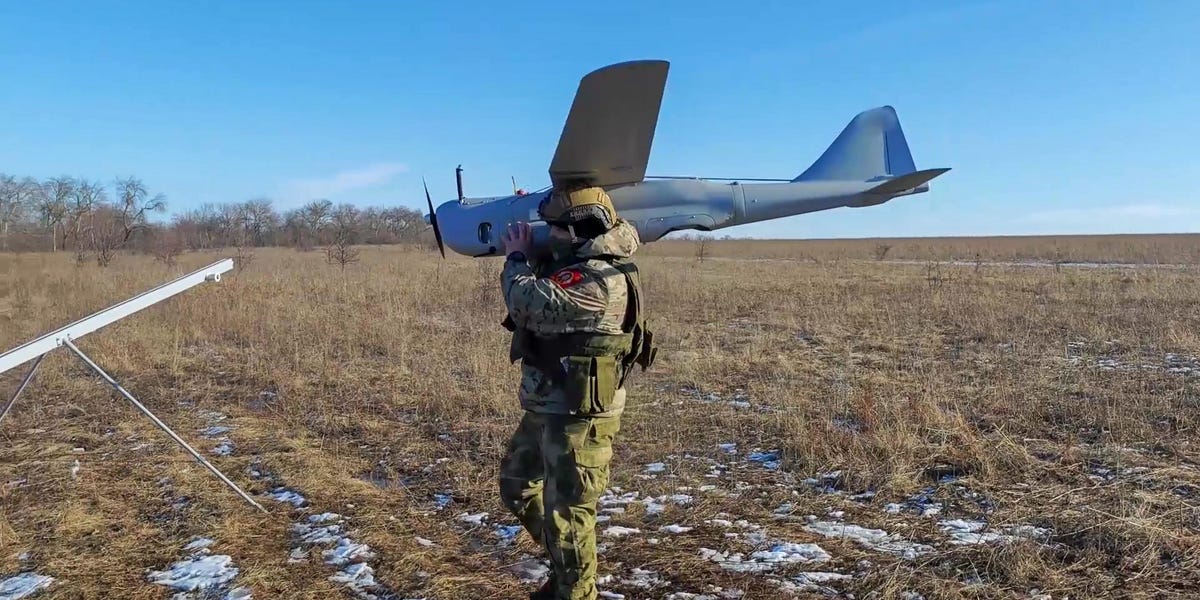
The deployment of the Orlan-10 reconnaissance drone as a launch platform for first-person-view (FPV) quadcopters marks a significant shift in the operational reach of small-scale loitering munitions. By utilizing the Orlan-10, which possesses a flight range of approximately 74 miles, operators have effectively extended the strike radius of short-range FPV assets that typically rely on local signal relay or proximity to the pilot. This integration transforms a standard intelligence, surveillance, and reconnaissance asset into a mobile delivery system for precision strikes.
Operational Reach and Signal Constraints
The primary limitation of FPV quadcopters in current conflict zones remains the restricted range dictated by radio frequency connectivity and battery life. By mounting these units under the wings of a medium-range reconnaissance drone, the tactical bottleneck of the initial transit phase is bypassed. The Orlan-10 acts as a mothership, carrying the payload into the target area before deployment. This configuration allows for the engagement of targets deep behind the forward line of contact, where FPV drones would otherwise be unable to reach due to signal degradation or insufficient flight time.
This development forces a re-evaluation of how defensive perimeters are established against small unmanned aerial systems. Traditional jamming and electronic warfare measures focused on the immediate vicinity of the front line may prove insufficient if the launch point is decoupled from the strike point. The ability to deploy multiple FPV units from a single reconnaissance platform suggests a move toward distributed, multi-stage drone operations that prioritize persistence and reach over simple mass.
Sector Read-through and Hardware Dependencies
The reliance on established reconnaissance platforms to facilitate strike capabilities highlights the ongoing integration of modular payloads within the broader defense sector. As drone technology continues to evolve, the focus is shifting from the development of bespoke, expensive munitions to the adaptation of existing, reliable airframes. This trend is visible across various stock market analysis frameworks, where companies specializing in sensor fusion, flight control software, and lightweight propulsion systems are becoming central to the defense supply chain.
AlphaScala data currently reflects a diverse landscape for firms involved in these technologies. For instance, Agilent Technologies, Inc. holds an Alpha Score of 55/100, reflecting its role in the broader healthcare and instrumentation sector, while ON Semiconductor Corporation maintains an Alpha Score of 45/100, indicating the mixed sentiment surrounding companies heavily exposed to the semiconductor and power management components required for advanced drone hardware. Amer Sports, Inc. sits at 47/100, illustrating the varied performance metrics across consumer and industrial-adjacent sectors.
The Next Marker for Drone Integration
The next critical indicator for this tactical shift will be the frequency of observed encounters involving these mothership configurations. If the Orlan-10 deployment becomes a standard operating procedure, the focus will shift toward the development of long-range detection systems capable of identifying the specific acoustic or radar signatures of these combined drone systems. Future reports will likely center on the efficacy of counter-drone measures that target the mothership rather than the individual FPV units, as the loss of the carrier platform represents a significantly higher cost to the operator than the loss of a single quadcopter. Monitoring the evolution of these engagement patterns will be essential for understanding the shifting cost-benefit analysis of modern aerial warfare.