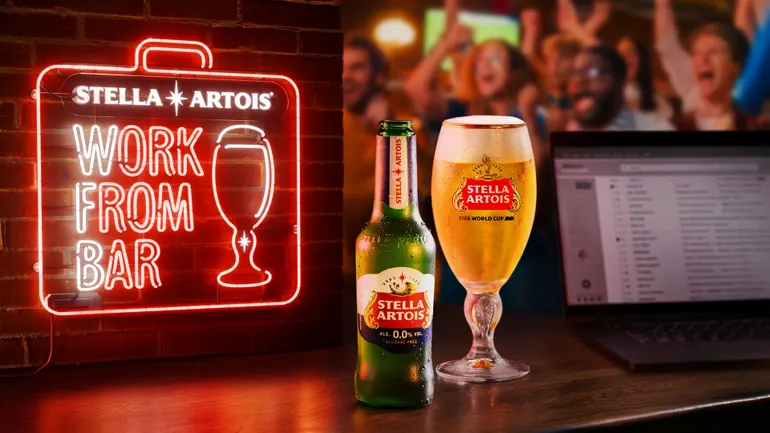
AB InBev is using Stella Artois to capture the 86% of World Cup matches that fall within weekday working hours in at least one U.S. time zone. The brewer's “Work From Bar” program, launched June 11, encourages consumers to expense a round at a bar instead of watching from an office or home.
The campaign is a direct test of on-premise elasticity for Stella Artois, a key driver of AB InBev's premium portfolio. The brewer reported Q1 revenue of $15.27 billion, up 12.03% year over year. Stella Artois revenue outside its home market climbed 14%, helping lift the overall premium portfolio by 11%.
The World Cup Scheduling Problem AB InBev Sees
Weekday Matches Create an On-Premise Opportunity
Most World Cup matches in the 2026 tournament kick off between 9 a.m. and 5 p.m. Eastern Time, according to data cited in a Stella Artois press release. That timing puts the games directly against office hours for the majority of U.S. workers.
Stella Artois' “Work From Bar” program uses wordplay to frame bar attendance as a legitimate work expense. Consumers can visit participating bars during matches and “expense” their first Stella Artois. On June 28, a pop-up “Work From Bar HQ” opens at Brookfield Place in Manhattan, featuring a sports bar, charging stations, and a bookable conference room. The pop-up runs through the knockout rounds.
The effort is structured around the “Taste Worth More” brand platform, which launched in 2024 to drive Stella Artois' on-premise business. A prior campaign under the same platform featured global ambassador David Beckham and encouraged consumers to watch matches at a bar surrounded by other fans rather than alone or in a stadium.
Stella Artois' “Work From Bar” Mechanics
- Consumers locate participating bars via Stella Artois' digital channels.
- They order a Stella Artois and submit the receipt as an “expense” – the brand covers the cost of the first drink.
- The Brookfield Place pop-up requires booking for the conference room starting June 22.
- The campaign targets weekday matches specifically, with the brand citing data that 37% of workers plan to adjust their schedules for the tournament.
The campaign is designed to convert World Cup viewership into on-premise foot traffic during typically low-volume weekday periods. The risk is that consumers may not treat the “expense” as a sufficient pull if they prefer watching from home or work.
AB InBev's Premium Portfolio Lift
Stella Artois Revenue Jump Outside Home Market
AB InBev's Q1 earnings show the premium portfolio segment growing 11%, with Stella Artois revenue outside its home market rising 14%. Those figures suggest the brand's on-premise strategy is gaining traction independent of the World Cup bump.
AB InBev has positioned Stella Artois as a premium import that can command higher margins than mainstream domestic beers. The “Taste Worth More” platform (a deliberate play on both the brand's taste and the premium price) reinforces that positioning by linking the beer to experiences – bar gatherings, live sports, shared viewing.
The “Taste Worth More” Platform
The platform launched in 2024 with a focus on on-premise rather than retail. Unlike a standard beer brand that competes on price in stores, Stella Artois is investing in the bar environment where the experience can justify a higher price point. The Beckham campaign and the “Work From Bar” effort are extensions of that same logic: if the brand can own the World Cup viewing occasion in bars, it changes the consumer's reference price for a premium lager.
Key insight: AB InBev is not trying to win on volume. It is trying to win on share of wallet during a high-emotion event where substitutes (domestic beer, cocktails, non-alcoholic options) are easily available. The campaign works only if it changes the consumer's default choice at the point of purchase.
Competition for the On-Premise Dollar
Heineken's Volunteer Time Off Play
Heineken is running a parallel campaign that invites consumers to use unused “volunteer time off” benefits to watch matches while giving back to local communities. That approach positions the brand as socially responsible rather than purely indulgent.
Coors Light and Diageo's Buchanan's
Coors Light temporarily elongated its brand name as a nod to sportscaster Andrés Cantor. Diageo's Buchanans Scotch whisky launched a music-forward campaign starring Rauw Alejandro in April. Molson Coors is also expected to run on-premise activations around the tournament.
All three competitors are fighting for the same on-premise occasion. The differentiation is in the execution: Stella Artois relies on the “expense” gimmick, Heineken on altruism, and Coors on brand-name humor. AB InBev has the advantage of scale – it can afford a pop-up HQ and a Beckham deal – but that also means the campaign carries a higher fixed cost.
Diageo's Alpha Score Mixed in Consumer Staples
Diageo (DEO), the owner of Buchanan's and a direct competitor in the premium spirits space, holds an Alpha Score of 41/100 with a label of Mixed in the Consumer Staples sector. The score reflects a balanced but not compelling risk-reward profile. Diageo's World Cup activation is less committed to on-premise than Stella Artois', focusing instead on music and cultural moments.
The contrast matters for investors watching the beer vs. spirits competition during the tournament. If Stella Artois captures significant on-premise share, it could pressure Diageo's premium Scotch and beer portfolios. If the “Work From Bar” campaign fails to generate incremental foot traffic, AB InBev may need to reallocate marketing dollars to retail promotion.
Proprietary Data: DEO at 41/100
Diageo's Alpha Score of 41 places it in the middle of the Consumer Staples universe. The Mixed label indicates that neither the bull nor bear case strongly outweighs the other. For investors using the score as a filter, Stella Artois' campaign is a micro catalyst that could shift sentiment toward AB InBev (Ticker: BUD) if it drives measurable on-premise lift, while Diageo remains a more defensive play tied to spirits distribution.
What Confirms or Weakens the Thesis
Confirmation signals:
- Positive same-store sales data from on-premise accounts running the “Work From Bar” program during weekday matches.
- AB InBev's next earnings report shows acceleration in Stella Artois revenue growth outside home market beyond 14%.
- Competitors (Heineken, Molson Coors) report flat or declining on-premise traffic during match hours, suggesting Stella Artois captured share.
Weakening signals:
- Consumers redeem the “expense” offer but do not return for subsequent purchases at full price.
- On-premise operators report no incremental traffic from the campaign, indicating consumers watch matches at home or work regardless of the incentive.
- World Cup group-stage matches fail to generate high interest due to time zone conflicts, reducing the addressable audience.
Risk to watch: The “expense” model may teach consumers to expect a discount on premium beer, undercutting the “Taste Worth More” premiumization thesis. If Stella Artois cannot convert the offer into full-price repeat purchases, the campaign becomes a cost center rather than an investment in brand equity.
For traders monitoring the consumer staples sector, the World Cup represents the highest-stakes on-premise test in four years. How Stella Artois performs will inform whether AB InBev's premium strategy can scale beyond its core European market. The first real data point arrives with June same-store sales from on-premise accounts in New York and other target cities. Until then, the thesis rests on the assumption that a free beer can change habits.