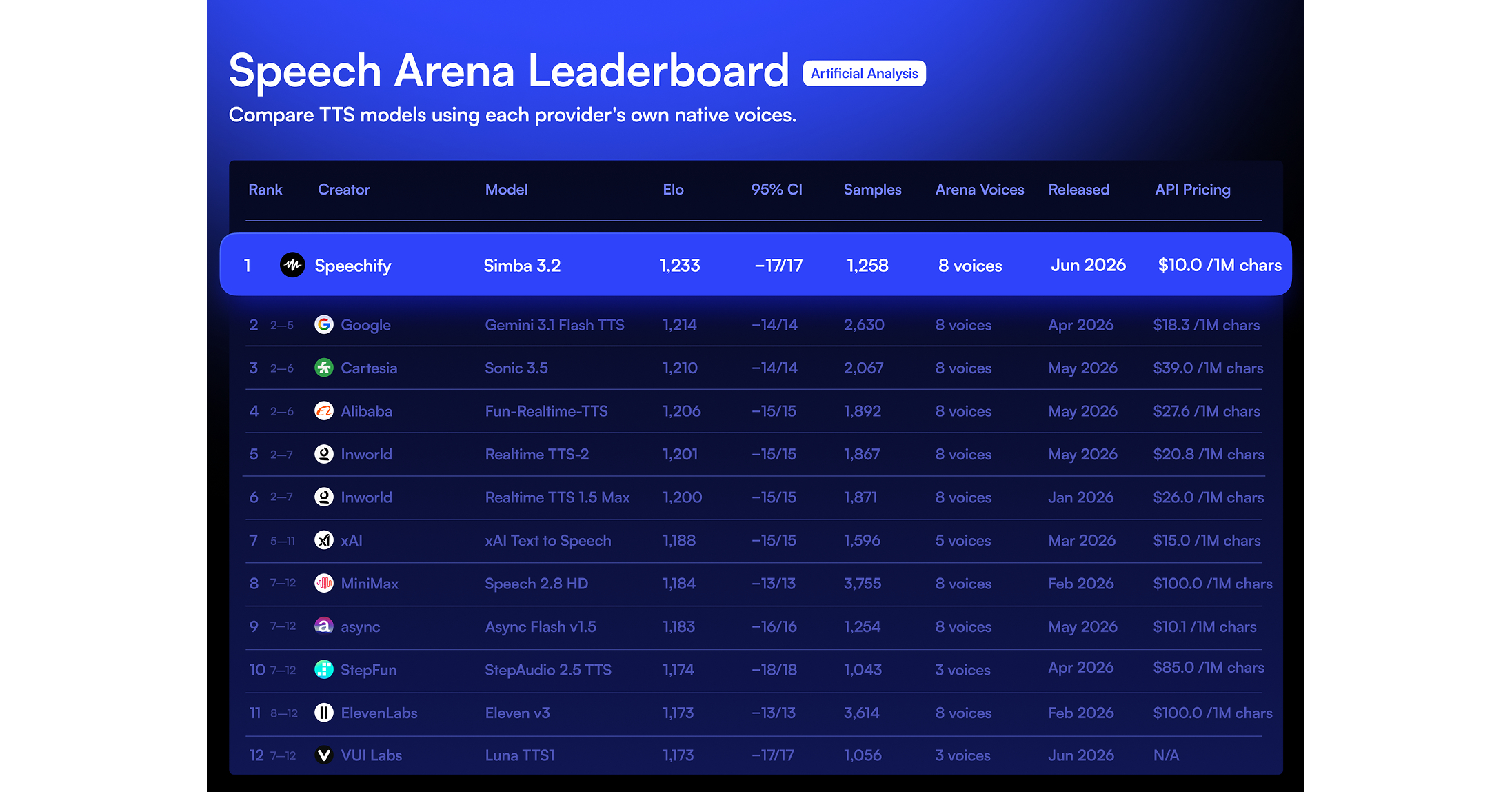
Speechify's Simba 3.2 model hit first place on the independent Artificial Analysis text-to-speech leaderboard this week, ranking above flagship models from ElevenLabs, Cartesia, OpenAI, and Google DeepMind. The same model took joint second place on Voice Arena's blind listener rankings. Among real-time models that can be deployed in production today, Simba 3.2 is the highest-rated option at its price point: $10 per million characters on the entry tier, dropping to $6 per million at scale.
Neither benchmark is operated by Speechify. Neither uses self-reported numbers. Both leaderboards update as new models ship, and both placed Simba 3.2 at or near the top this week.
For teams building voice agents, live readers, phone systems, and other applications where the voice responds in real time, a model that cannot stream is not a candidate regardless of how it sounds. Removing non-real-time models from the Voice Arena rankings leaves Simba 3.2 as the top-rated voice a team can put in production today at its price.
Best-sounding real-time and lowest-cost do not usually describe the same model. At $10 per million characters on its entry tier, Simba 3.2 is the least expensive model in the leaderboard's top ten. On the Scale tier the rate drops to $6 per million characters, pricing built for production volume rather than demos.
“This is the underdog story for API providers,” said Luke Oliff, Head of Developer Relations at Speechify. “We spent years making our models run efficiently because our consumer business demanded it, tens of millions of listeners, with some of the best voices on the planet. That work is why we can now put the best-rated model in the world on our API at about as cheap as it comes. Most labs built for the benchmark and priced for the enterprise. We built for listeners and priced for production.”
Voice Arena evaluates models through blind listener voting. Panels of native speakers hear two audio clips generated from identical text, without knowing which model produced which, and vote for the clip that sounds more natural. Votes are aggregated into an Elo rating for each model. The methodology covers six languages, uses a balanced voice slate per model rather than each vendor's best-sounding default, and evaluates sentences written for the contexts where text to speech actually ships. The methodology was developed with advice from Prof. Shinji Watanabe of Carnegie Mellon University.
There is no self-reported mean opinion score, no vendor-selected sample, and no internal evaluation. The rankings reflect objective measurement and blind human listening.
Simba 3.2 is a streaming-native model with lower time-to-first-byte than previous generations, fine-grained emotional control, and SSML prosody support. Emotion is modeled at the prosody level, covering the rhythmic and tonal patterns that convey feeling rather than only speed and pitch. The model supports instant voice cloning from short reference clips and native-quality speech across more than 30 locales, with mixed-language input handled automatically.
For teams currently shipping on other text-to-speech providers, the gap between a better-sounding, lower-cost model and an actual switch involves real engineering work: voices to re-map, SSML to port, and latency to re-verify under production load. Speechify provides tooling and support to close that gap. The Speechify Cookbook is an open-source repository of runnable migration recipes, with SDK and native REST versions side by side so engineering teams can see exactly what goes over the wire. For customers with production volume, Speechify's forward-deployed engineers embed with the customer's team and handle voice mapping, prosody parity, load testing, and cutover until quality holds at scale.
Simba 3.2 is available now through the SpeechifyAI platform. Developers can create a free API key at platform.speechify.ai and compare Simba 3.2 against any other model on their own text. Current rankings are published at artificialanalysis.ai and voicearena.com, where anyone can participate in blind listener voting.
Speechify's consumer products serve more than 60 million users. In 2025, the company received the Apple Design Award at WWDC. The SpeechifyAI developer platform provides the same voice technology as an API, including streaming text to speech, instant voice cloning, emotional control, and support for more than 30 languages.