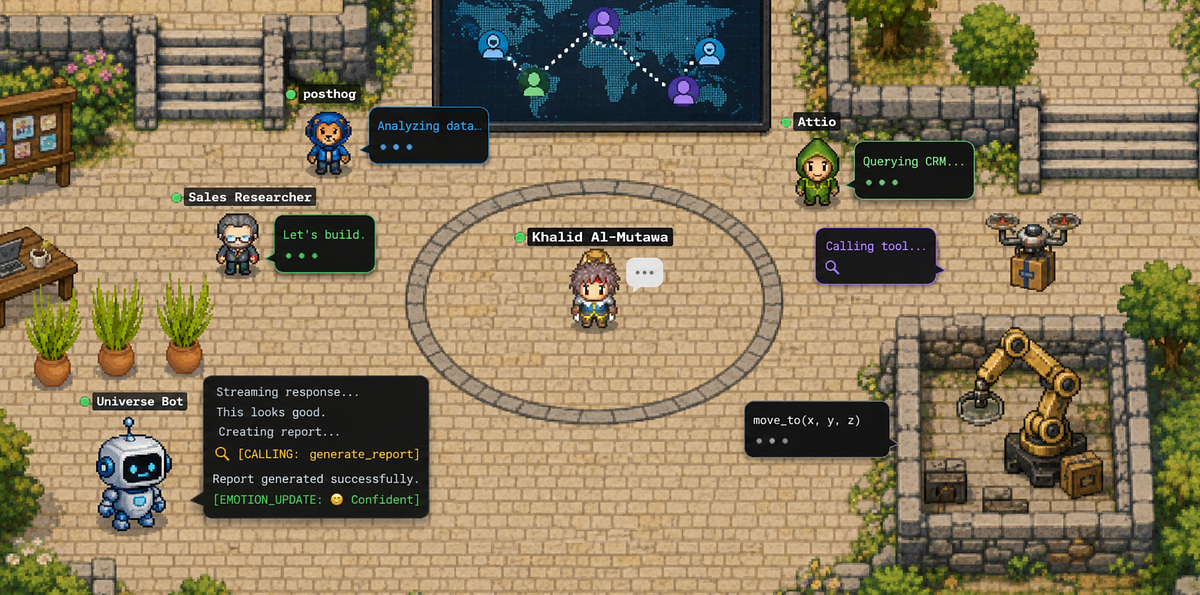
The Model Context Protocol is solving one problem cleanly: giving AI agents a standard way to connect to databases and CRM tools. MCP standardizes how an LLM discovers and calls external tools – same initialize, tools/list, tools/call handshake across every provider. It is the boring, necessary layer that makes agent ecosystems interoperable.
A different problem remains. Agents cannot perceive or act in physical space. They have no concept of proximity, no awareness of a shared environment, no way to coordinate through spatial context rather than message queues.
The Universe platform from BAWES team addresses exactly that split. It is a fork of WorkAdventure re-architected for AI-native spatial experiences. In Universe, agents have bodies. They walk through virtual rooms, react to proximity, express emotions through avatars, and stream token-by-token responses into real-time chat bubbles. The experience looks more like interacting with a game NPC than sending a prompt.
What ties the two layers together is MCP. Every bot in Universe can be assigned MCP servers – with OAuth 2.0, bearer tokens, or API key authentication, the BAWES team says. Tool sets are auto-discovered via the standard handshake. A bot with Attio MCP access queries CRM records mid-conversation. A bot with a custom database MCP runs analytics. A bot with an e-commerce MCP creates orders. The bot decides when to call these tools based on conversation context, routed through the standardized transport.
This closes a loop. MCP connects agents to software. Universe connects agents to space. The abstraction – position, perception, action – is identical whether the agent is navigating a virtual lobby or a warehouse floor.
Supporting infrastructure is already in place. The platform supports full OAuth 2.0 authorization code flow including PKCE and RFC 9728 metadata discovery. User tokens are encrypted at rest per server with AES-256-GCM and refreshed automatically on 401 responses. No hardcoded integrations required.
Bots in Universe are first-class citizens with behavior systems. An idle bot waits for interaction. A patrol bot walks waypoints. A social bot greets nearby users. The behavior determines when and how the bot initiates conversation.
More striking is that bots can create other bots. A manager bot can spawn a worker bot, assign it MCP servers, give it a behavior and personality, and let it operate autonomously in a room. The spawned bot uses the same virtual world, the same databases, the same MCP tooling. When a bot encounters a problem it cannot solve – missing data, unavailable tool – it requests a new MCP server or spawns a specialized sub-agent. No human deployment pipeline.
This is recursive self-improvement stripped of science fiction. No AGI flash. No Skynet. Just a bot spawning another bot because the workload demands it.
The economic implication is agent-to-agent (A2A) exchange. When a procurement agent negotiates directly with a supplier's sales agent through shared MCP handshakes, the B2B sales cycle collapses from weeks to milliseconds. When an analytics agent buys data from a third-party data agent via an MCP call, data licensing becomes automated bilateral negotiation. Universe provides the spatial substrate where agents discover each other, negotiate access, and coordinate.
MCP already works for software tools. The same protocol, same initialize handshake, can standardize how an AI talks to a 3D printer, a drone, a robotic arm. In Universe, the spatial layer is already there. The coordinate system a bot uses to navigate a virtual room maps directly to GPS coordinates. Proximity detection that triggers a greeting in a lobby triggers a drone delivery in a warehouse. The connector does not care whether it sends a create_ticket or a move_to(x,y,z).
What would confirm the thesis. Over the next twelve months, the signal is open-source adoption of the Universe platform beyond the BAWES team. If independent developers build MCP servers for physical devices – drones, sensors, laboratory equipment – and connect them through Universe, the abstraction holds. Another confirmation: enterprises adopting MCP as the standard bridge between their AI agents and existing tooling, then layering spatial context for logistics or warehouse operations.
What would weaken the thesis. Protocol fragmentation is the biggest risk. If major AI providers diverge from MCP or create competing standards, the network effects collapse. Latency and reliability of real-time spatial coordination remain unproven at scale. And the vision depends on affordable spatial hardware becoming widespread – a timeline that has slipped repeatedly.
The next milestone to watch is the open-source release of Universe and its integration with major MCP server directories. BAWES team has committed to openness. If the community takes the spatial extension and runs with it, the loop closes.
That loop is running today in production on real infrastructure. Intelligence is a utility, metered by the token. The new bottlenecks are physical: energy, silicon, real-world latency. Human roles shift from writing every line of code to setting intent and governing outcomes. The Singularity is not a flash. It is a process that started when an LLM wrote production code that another LLM later improved. Universe is where that process meets space.