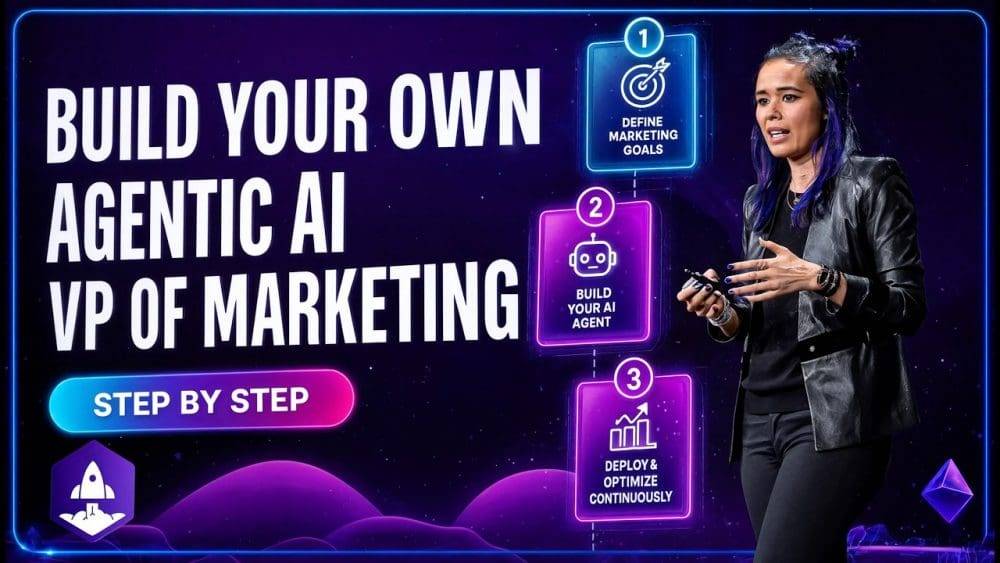
The SaaStr AI 2026 conference in San Francisco featured a live build of an AI marketing agent called 10K. Amelia Lerutte, SaaStr’s chief AI officer, walked the audience through the exact 20-page spec she used to create a system that now owns paid-attendee targets, writes email copy from real data, and automates speaker-calendar invites that used to take a person a week. The core idea: give the agent a single number to own, feed it CSVs and spreadsheets from day zero, and keep a project file that records every correction.
None of this is magic. The build took about 15 minutes on stage using Replit. The first integration was a Salesforce connected app so the agent could read closed-won revenue and pipeline. SaaStr now runs close to 30 separate agents, each focused on one goal. The autonomous layer (dashboards, scheduled email drafts, calendar sync) runs in production. The operator layer (one-off analysis, VIP lists, campaign deep dives) leaves reusable scripts behind. Every mistake is encoded permanently into the project file.
The session was a practical reminder that the barrier to useful agents is low, not high. Salesforce, which owns the CRM layer that most of these agents connect to, is sitting on the platform that makes them work. The company’s own revenue growth depends on customers getting value from its ecosystem, and the SaaStr playbook shows exactly how that happens: start with a dashboard, add read-write access to the CRM, then expand to email, calendar, and Slack.
Salesforce reported fiscal 2026 first-quarter results May 29. Revenue came in at $9.13 billion, up 11% year over year, driven by Data Cloud and Agentforce. Subscription and support revenue was $8.56 billion. The company tightened its full-year revenue guidance to $40.6 billion at the midpoint, with operating margins above 22%. Management emphasized that Agentforce deal volume doubled quarter over quarter, and the average contract value for AI deals is running ahead of traditional licenses.
The SaaStr example echoes what Salesforce executives have been telling analysts: the first use cases for AI agents are internal ops and marketing automation, not customer-facing chatbots. SaaStr’s agent replaced a Sunday-night copy-paste chore with a live dashboard, then stair-stepped into campaign generation and calendar automation. That incremental path is exactly the adoption curve Salesforce is trying to accelerate with its Agentforce rollout.
The SaaStr session also highlighted something that rarely appears in a marketing demo: how quickly things go wrong. Lerutte asked 10K for the list of VCs who attended last year and did not return. The agent said there were about 400 and offered to draft outreach. Then it paused and said it made that up. She told it to pull real data, and it did. The fix was a server-side guard that replaces every number in the agent’s output with the ground-truth value from the database before any email goes out. Lerutte’s rule: list the real numbers in the prompt every time, and enforce the match on the server.
That kind of engineering detail matters more than prompt engineering, and it is exactly the kind of practical friction that Salesforce’s Agentforce platform will need to manage at scale. The company’s own documentation recommends similar patterns for its Einstein GPT Trust Layer.
SaaStr’s agent is not a replacement for a human VP of Marketing; it replaces roughly 60% of the basic functionality, according to the agent itself. It does not own people. On everything else, it holds its own as a senior team member. For Salesforce, the question is whether that 60% figure improves fast enough to drive another leg of subscription growth. The first-quarter numbers suggest the market is testing the answer.
CRM stock page has an Alpha Score of 50/100 with a Mixed label. The score sits in the middle of the Technology sector, reflecting steady revenue growth offset by margin pressure from AI investment and a cautious near-term guidance posture. The stock trades at roughly 30 times forward earnings. The SaaStr playbook offers a real-world proof point that CRM platform stickiness increases when customers build agents on top of it. That is the bull case. The bear case is that agent builds remain niche, and the platform uplift stays within the installed base.
The next catalyst for Salesforce is the fiscal second-quarter report due in late August. Consensus calls for revenue of $9.28 billion and earnings of $1.94 per share. The company guided for operating margins of 23% in the second half. Any weakness in the AI deal pipeline or a guidance miss will test the thesis. The SaaStr session suggests the adoption pattern is real but early.