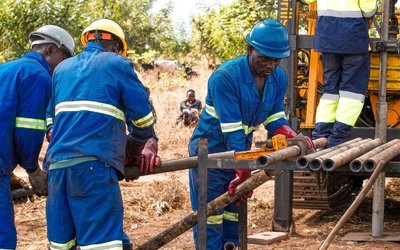
Sovereign Metals (ASX: SVM) has identified monazite and critical heavy rare earth elements (REE) across multiple pits at its Kasiya rutile-graphite project in Malawi. The discovery opens a potential third revenue stream from the project’s tailings stream with near-zero additional capital expenditure.
Monazite Discovery at Kasiya: Heavy REE Ratios Seven Times Above Peers
The concentrate recovered from the planned Babbler, Kingfisher, Sparrow and Mousebird pits contains dysprosium, terbium, and yttrium at ratios that far exceed those of the world’s largest rare earth producers. The oxide ratios of these elements in the total rare earth oxide (TREO) basket average 2.5% dysprosium-terbium and 11.8% yttrium. That is approximately seven times higher than the ratios demonstrated by the world’s five largest rare earth producers, which average 0.4% dysprosium-terbium and 1.7% yttrium.
Within six metres of the surface, the highest ratios reached 3.1% dysprosium-terbium and 17.2% yttrium. Kasiya contains all four magnetic REEs – neodymium, praseodymium, dysprosium, and terbium – plus highly critical yttrium.
Applications in Defence and Advanced Manufacturing
Dysprosium and terbium are essential for high-temperature permanent magnets used in advanced defence systems, precision weapons, aerospace applications, and next-generation electric drivetrains. Yttrium is integral to radar and laser systems, high-performance alloys, and the manufacture of semiconductors and aerospace thermal barrier coatings.
The findings come as the US accelerates efforts to decouple heavy rare earth supply chains from China, described by the US Department of War as a “matter of national security”.
Near-Zero Cost By-Product: How Monazite Fits the DFS Flowsheet
Monazite recovery would not require any additional mining or primary processing circuits. The mineral is recoverable from the non-conductor tailings stream of the definitive feasibility study (DFS) flowsheet, alongside rutile and graphite. Sovereign considers it a potential third source of revenue that could be achieved at near-zero additional cost to the DFS base case.
Managing director Frank Eagar said the company was keen to assess the capital and operating cost implications of including monazite in the production mix.
What This Means for the DFS Economics
Practical rule: A by-product stream with near-zero incremental capital can lift project NPV without changing the primary production plan. The key question is whether the monazite grade and recovery rates in the tailings stream match the assumptions in the independent price report.
Pricing Premium: US$16,000/t Base Case vs Benchmark US$6,142/t
An independent price report for a monazite concentrate has been prepared for Sovereign based on the composition of a 60% TREO basket. The 2026 forecast base-case price is US$16,000 per tonne, against a current benchmark price for 54-55% TREO grade monazite concentrate of approximately US$6,142 per tonne based on the Shanghai Metals Market. The high case is US$19,000 per tonne.
| Price Scenario | US$ per tonne | TREO Grade Assumption |
|---|
| Benchmark (current) | ~6,142 | 54-55% |
| Sovereign base case (2026) | 16,000 | 60% |
| Sovereign high case (2026) | 19,000 | 60% |
The premium reflects the higher TREO grade and the composition of the basket, which includes a higher proportion of heavy REEs compared to typical monazite concentrates.
Strategic Demand: US Decoupling and Defence Applications
The US push to secure non-Chinese sources of heavy REEs adds a geopolitical layer to Sovereign’s project. Dysprosium and terbium are classified as critical minerals by multiple governments. Yttrium is used in radar, laser systems, high-performance alloys, and semiconductor manufacturing.
Sovereign’s Kasiya project is already one of the world’s largest rutile and graphite deposits. The addition of a monazite by-product stream could improve the project’s economics without altering the primary rutile-graphite production plan. The company is advancing additional mineralogical and metallurgical work to quantify the potential upside.
Risk to Watch
The independent price report assumes a 60% TREO grade for the monazite concentrate. Actual recovery rates and concentrate grade from the tailings stream will determine whether the premium is achievable. The DFS base case does not yet include monazite revenue, so any positive outcome would be incremental to the current valuation.
For investors tracking ASX small-cap resource plays, the Kasiya monazite discovery offers a potential catalyst tied to US defence spending and rare earth supply chain reshoring. The next concrete marker will be the results of the metallurgical test work and any update to the DFS economics.
For a broader view of the sector, see our stock market analysis. If you are considering adding ASX-listed resource stocks to your portfolio, review the latest best stock brokers for execution quality on small-cap names.