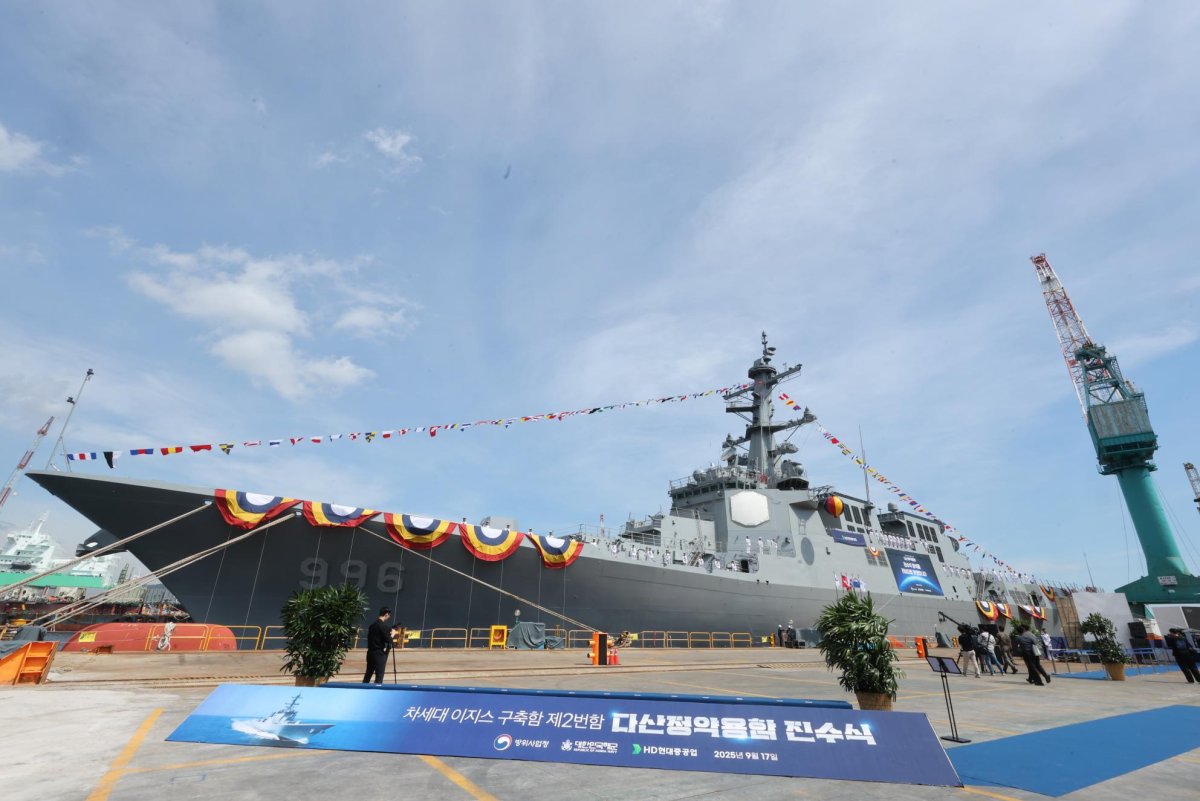
South Korea approved a 530 billion won ($351.5 million) project on Friday to acquire U.S. Standard Missile-6 (SM-6) shipborne interceptors and deploy them by 2034. The decision cuts the acquisition budget by nearly half from the $650 million Foreign Military Sales (FMS) case that Washington authorized in November 2023 and extends the timeline by three years beyond the original 2023-2031 schedule.
The Defense Acquisition Program Administration (DAPA) said the Defense Project Promotion Committee approved the procurement for three 8,200-ton Aegis destroyers. The scale-back and delay reflect prolonged negotiations between Seoul and Washington over technical integration and logistics.
SM-6 Budget Cut and Timeline Slip
The original FMS package covered up to 38 SM-6 missiles. At a per-missile cost near $17.1 million, the approved 530 billion won project would fund about 20 interceptors, a reduction of roughly 47 percent. DAPA did not disclose the exact quantity in its statement.
Budget Reallocation and Negotiations
A DAPA official attributed the revision to the length of the negotiation process. "The negotiation process took time even though we have been pushing ahead with the project since 2023," the official said. "The system will be rolled out in stages in accordance with the schedule agreed upon with the U.S. side."
The 530 billion won figure represents a sharp reduction from the earlier $650 million case. Budget constraints within South Korea's defense ministry may have forced the scale-back. The country's defense spending growth slowed to 4.5 percent in 2024, putting pressure on large hardware programs.
New Deployment Window
The deployment timeline now runs from 2023 through 2034, with initial installations expected later this decade. The original 2023-2031 window implied full capability by 2031. The three-year extension indicates that Aegis combat system integration and interoperability testing will take longer than initially forecast.
Which Vessels Get the Interceptors
DAPA named three destroyers that will receive the SM-6 interceptors:
- ROKS Dasan Jeong Yakyong – scheduled to enter service later this year, this 8,200-ton Aegis destroyer will be the first to receive the system.
- ROKS Daeho Kim Jong Seo – a second vessel of the same class, also planned for SM-6 installation.
- ROKS Jeongjo the Great – already deployed, this destroyer will receive the interceptors through future capability upgrades.
"The project is expected to enhance ship-to-air defense capabilities of Aegis destroyers against enemy anti-ship ballistic missiles, aircraft and cruise missiles, as well as improve their anti-ballistic missile defense," the DAPA said.
The SM-6 has a maximum range of 460 kilometers and an altitude ceiling of 36 km. Its active radar seeker allows each missile to track targets independently, enabling a single destroyer to engage multiple threats simultaneously.
Why the Delay Matters for Defense Contractors
The FMS process added friction during technical specification talks, training program design, and logistics support agreements. South Korea is one of several allies queued for the SM-6, and U.S. Defense Security Cooperation Agency staff must manage production slots across multiple programs.
Revenue Impact for the U.S. Prime Contractor
Although the source text does not name the contractor, the SM-6 is built by Raytheon, a division of RTX. The $351.5 million approved project reduces total potential revenue from the original $650 million case by about 46 percent. While that gap is not material for RTX's $15.6 billion defense segment, it signals that FMS programs carry execution risk. Budget reallocations, sovereign credit pressures, or shifts in U.S. export policy could further alter the program.
Integration Complexity
The SM-6's active seeker must interface with the Aegis combat system and South Korea's indigenous command-and-control network. Any integration hiccup could push the timeline further. The phased rollout means the destroyers will not reach full SM-6 capability until the early 2030s at best.
Key insight: The three-year delay reflects the complexity of integrating a foreign missile system with domestic Aegis variants. Traders should watch for DAPA reports of successful live-fire tests or revised contract announcements.
Satellite R&D Opens a Separate Procurement Path
The Defense Project Promotion Committee also approved a 1.27 trillion won research and development plan for a new military communications satellite system. The project will run from this year through 2032, led by the Agency for Defense Development.
Scope and Timeline
- Develop and acquire a dedicated geostationary military communications satellite.
- Replace older satellite and ground equipment.
- Sign a contract agreement with a prototype developer by March next year.
This program competes for funding with the SM-6 buy and other priorities within South Korea's defense budget. Domestic defense electronics firms stand to benefit from the satellite R&D contract.
Decision Points for Traders
For traders evaluating defense equities or South Korean shipbuilders, the SM-6 timeline creates a concrete catalyst path.
Confirmation Signals
- Formal contract signing with the U.S. contractor for the reduced quantity, expected within the next 12 months.
- Successful integration testing of the SM-6 on a South Korean Aegis destroyer, likely in 2027–2028.
- U.S. congressional notification of any revised FMS case with a lower dollar value.
Risk Factors
- Further budget cuts: political pressure to fund social programs could squeeze hardware buys.
- Technical integration delays: any hiccup with the Aegis interface could push the timeline again.
- U.S. production capacity: if global demand for SM-6 outpaces factory output, South Korea's order may be deprioritized.
The SM-6 acquisition is intact but smaller and later than planned. The 530 billion won approval keeps the program alive while deferring the projected defense enhancement. For traders tracking defense procurement in Asia, the 2034 deployment is the target, FIFO patterns in FMS suggest further slippage is possible.
Bottom line for traders: The SM-6 program now carries a longer wait for revenue realization. South Korean shipbuilders and electronics contractors gain a clearer R&D path from the satellite follow-on. Watch for DAPA's next budget submission in late 2025 for any funding reallocations.