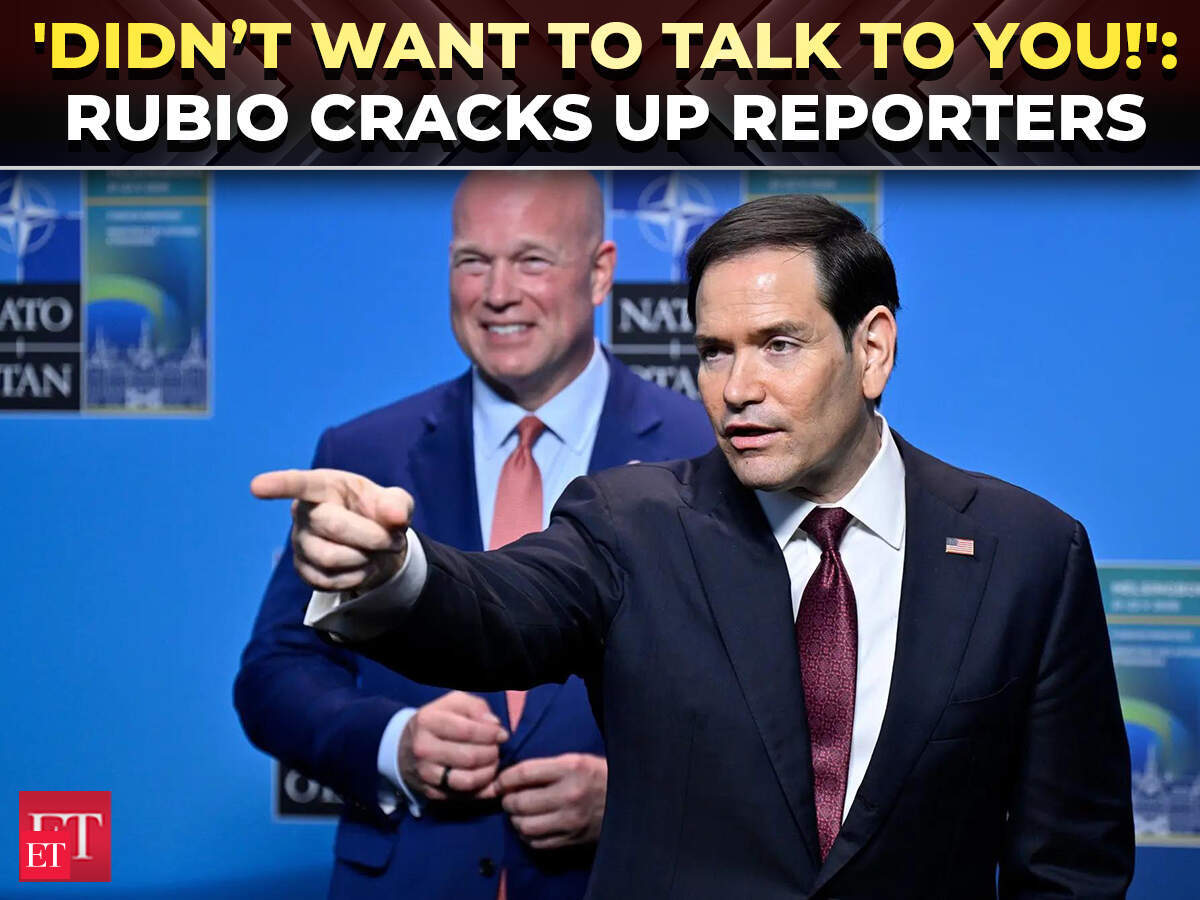
US Secretary of State Marco Rubio arrived in Helsingborg, Sweden on May 22 for the critical NATO Foreign Ministers' meeting. His declaration of 'ALRIGHT, LET'S DO IT' and a call for a structural pivot to 'NATO 2.0' were delivered in a viral press exchange. The backdrop includes planned US troop drawdowns and President Trump's frustration with European allies over the Middle East crisis, placed in the source's Iran war context. Rubio also bluntly confronted NATO Secretary General Mark Rutte during their bilateral meeting.
This is not diplomatic throat-clearing. Rubio's direct tone signals a shift in US negotiating posture that carries measurable portfolio implications. Investors who treat the exchange as political theater risk missing exposure across defense equities, sovereign bond yields, and currency pairs.
Rubio's 'NATO 2.0' Signal: What Changed
The phrase 'NATO 2.0' implies a restructuring of the alliance's burden-sharing framework. Current US troop presence in Europe – roughly 100,000 personnel pre-drawdown – has been a stable anchor for defense spending assumptions. A pivot to 2.0 likely includes:
- Higher European defense spending targets above the current 2% GDP floor, moving toward 3%
- Reduced US forward-deployed forces in Germany and Eastern Europe
- More autonomous European procurement away from US systems
- Tighter integration of non-US NATO members in Middle East contingencies
None of these elements are new individually. The shift is in the delivery: Rubio is openly threatening the status quo, not nudging allies. This raises the probability of near-term defense budget acceleration in both the US and Europe.
Defense Sector Exposure: European Prime Contractors vs US Primes
European defense stocks: direct beneficiaries of procurement acceleration
Companies exposed to NATO procurement cycles – Rheinmetall, BAE Systems, Thales, Leonardo – have already priced in some spending growth. What Rubio's ultimatum changes is the speed and certainty of that growth. If the US follows through on drawdowns, European governments must fill gaps faster, pulling forward orders.
Risk: the Stoxx Europe 600 Aerospace & Defense index trades at about 22x forward earnings, a premium to historical averages. A delayed or watered-down NATO 2.0 framework would disappoint these expectations. The catalyst path requires a concrete commitment timeline, not just rhetoric.
US defense primes: mixed signals
Lockheed Martin, Northrop Grumman, and RTX face a complex read. Reduced US troop presence could mean lower demand for certain force protection and logistics contracts. Higher European orders for US-made systems – especially F-35, Patriot, THAAD – could offset. The net effect depends on whether European governments prioritize homegrown platforms or US imports. Rubio's push for increased defense production suggests he is leaning toward using the drawdown threat to encourage European purchases of American equipment.
Practical rule: Monitor the US Defense Department's FY2027 budget request due in February 2027. Any explicit line-item reduction in European rotational forces would validate the bear case for US defense logistics plays.
Sovereign Bond Mechanism: Fiscal Strain Priced Into Rates
Higher European defense spending means more government borrowing or higher taxes. The German Bund yield already rose 8 basis points on the day of the meeting. If NATO 2.0 turns into binding spending commitments, peripheral European bonds – Italy, Greece, Spain – could see widening spreads as markets price fiscal strain in countries with already high debt-to-GDP ratios.
Risk to watch: A sustained 10 bps+ move in the 10-year Bund would signal that defense spending is crowding out other fiscal priorities, potentially triggering a risk-off rotation in European equities. The EUR/USD cross could weaken under the weight of fiscal uncertainty, though any direct conflict context (Iran) complicates the currency read.
Timeline and Next Decision Points
Immediate (May 22–23, 2026)
- NATO Foreign Ministers' communiqué due May 23. Any explicit mention of 'NATO 2.0' or new spending targets will be the first actionable signal.
- Rubio's bilateral with Rutte – the source notes Rubio bluntly confronting Rutte. The meeting readout will clarify US red lines on troop drawdowns and the Middle East.
Medium-Term (July–September 2026)
- US troop drawdown timeline: announcement of specific numbers or geographies – for example, withdrawal from Ramstein or Aviano bases – would be the strongest confirmation of the bear case for European security premiums.
- European Union defense summit: expected to set a collective target for defense investment. If the EU matches Rubio's rhetoric, the tailwind for defense stocks strengthens.
What Would Reduce the Risk
The risk premium embedded in defense stocks and European sovereign bonds would compress if:
- Rubio walks back the 'NATO 2.0' phrase in subsequent press avails, indicating it was a negotiating tactic rather than policy.
- The US announces a compromise deal: slower drawdowns in exchange for immediate European defense purchases.
- Germany commits to a special defense fund beyond the existing €100 billion Bundeswehr package, easing fiscal pressure.
What Would Make It Worse
Conditions that would amplify the risk:
- Explicit US force reduction targets above 20% of current European deployment.
- European bond sell-off accelerating past Greek 10-year yields over 4.5% from the current ~3.8%.
- A crisis in the Middle East that splits NATO members further, making the 2.0 reform impossible and leaving the alliance in limbo.
Key insight: Rubio's candor is a multi-asset signal. The translation into actual budget lines will take months. The highest-conviction play is likely in European defense ETF flow – monitor EXSA (iShares Stoxx Europe 600 Aerospace & Defense ETF) for volume spikes. A close above €56 would confirm that the market is pricing in a 2.0 outcome.
For broader market context, see stock market analysis and the recent AppLovin Launches Social App Gist After Failed TikTok Bid for a different angle on platform risk this week.
The AlphaScala risk matrix assigns this event a moderate geopolitical risk score. The pricing in defense stocks already reflects some probability of a NATO reboot. The true alpha comes from identifying the exact mechanism – procurement shift versus troop withdrawal – and positioning accordingly. The safest approach for now is to reduce exposure to US logistics-heavy defense contractors and increase allocation to European prime contractors with clear procurement pipelines.