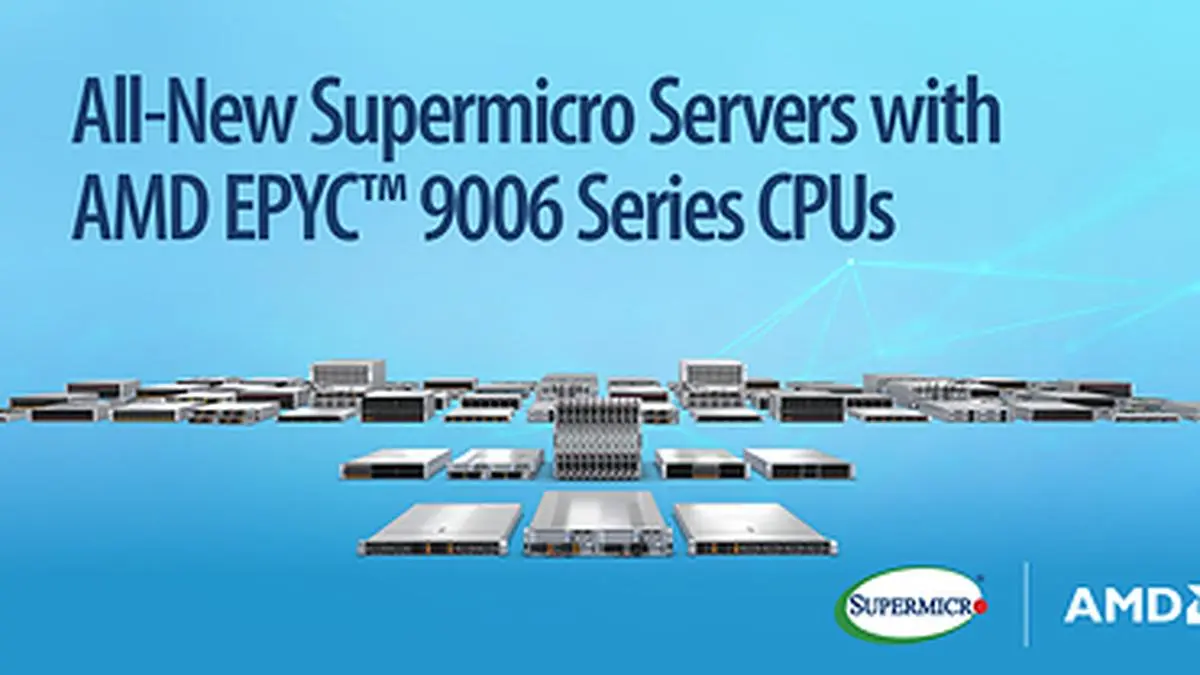
Super Micro Computer launched a new server line built around AMD's latest 256-core processor, the EPYC 9006 series, claiming a 1.7x performance jump over the prior generation. The H15 portfolio covers seven system types, from the dual-socket Hyper for enterprise AI inference to the Petascale Storage box that holds up to 4.8 PB per chassis.
The announcement landed during AMD's Advancing AI Day in San Francisco, where Supermicro also showed a 42U rack packed with 96 EPYC 9006 CPUs using the FlexTwin system – a density play aimed at cloud providers that lease compute by the node.
Supermicro's own numbers tell the real story. The company has been riding the AI infrastructure wave harder than almost anyone. Its trailing-12-month revenue sits at $34.9 billion, up from $7.1 billion three years ago. Market cap has settled near $98 billion, down from the $120 billion peak it touched in early 2025 when the market was pricing in infinite AI buildout. The stock trades at about 2.8x trailing sales, a multiple that assumes the growth trajectory stays steep.
The H15 launch is a product cycle event, not a strategic pivot. Supermicro refreshes its server lineup on the same cadence as AMD and Intel ship new silicon. The relevant question for investors is whether the 1.7x generational improvement – a claim AMD itself validated via the SPECInt Rate 2017 benchmark – is enough to keep enterprise buyers upgrading on schedule. Data center operators have been stretching server lifecycles to preserve cash for GPU clusters. A CPU-only performance bump may not force a refresh the way an AI accelerator upgrade does.
Vik Malyala, Supermicro's chief business officer, framed the launch around agentic AI workloads. "Customers can run more concurrent AI agents, accelerate enterprise applications, and maximize host-node performance while operating within existing power envelopes," he said in the release. The "within existing power envelopes" clause matters. Data centers are hitting grid capacity limits in Northern Virginia, Silicon Valley, and Singapore. Any product that delivers compute without requiring a substation upgrade gets a hearing.
AMD's Dan McNamara, who runs the compute and enterprise AI group, stressed the efficiency side. By combining the EPYC CPUs, Instinct MI350P GPUs, and Pensando networking with Supermicro's modular racks, customers "can deploy AI infrastructure faster while improving utilization, reducing energy consumption, and lowering total cost of ownership," he said.
Supermicro's Alpha Score sits at 42 out of 100, a Mixed rating that reflects the stock's stretched valuation against its own history. The score isn't a judgment on the product pipeline. It's a reminder that the easy money in the AI infrastructure trade – when Supermicro went from $100 to $1,200 in 18 months – is behind everyone who bought at the start. The question now is whether the installed base upgrades on schedule.
The AMD EPYC 9006 series carries up to 256 cores and 512 threads. Supermicro's H15 systems support both air and liquid cooling, a flexibility point for operators who are retrofitting existing data centers rather than building new ones. The liquid-cooled Helios platform, aimed at frontier AI training, uses 72 Instinct MI455X GPUs per rack and will ship to customers who need dense compute without the power overhead of air-cooled clusters.
Supermicro also introduced two PCIe GPU servers, the AS-5126GS-TNRT and TNRT2, that hold up to ten Instinct MI350P GPUs in a 5U air-cooled chassis. Each MI350P carries 144 GB of HBM3e memory. For enterprise buyers who want to run inference workloads without switching to liquid cooling, that configuration keeps the barrier to purchase low.
The stock closed the session at $1,503, down 1.2% on a day when the broader tech sector slipped on weak software earnings. The product cycle is real. Whether it moves the share price depends on how many of those 42U FlexTwin racks actually ship this year.