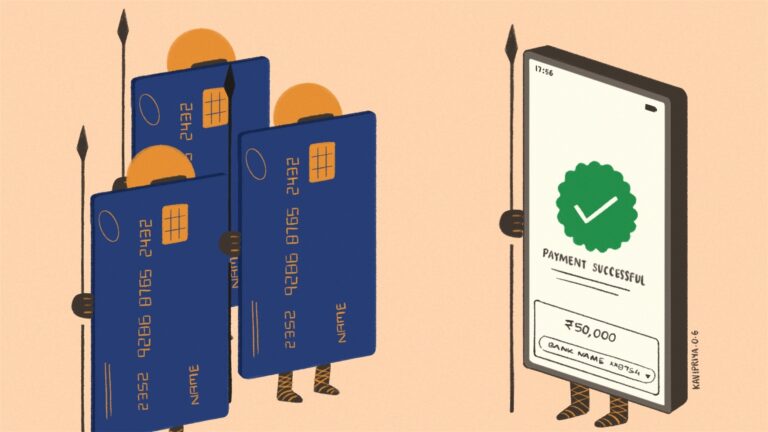
India's large private banks have long resented Paytm, Google Pay, and PhonePe for controlling over 80% of the country's UPI payments. The same four banks – HDFC, SBI, ICICI, and Axis – also control roughly 80% of India's credit-card market. They take about three-quarters of every rupee spent on a credit card in the country. Smaller players fight over what remains.
Then something shifted. In 2023, the National Payments Corporation of India (NPCI), UPI's governing body, stitched credit into its payments network. The product is called Credit-Line-on-UPI, or CLOU. At launch, industry projections put CLOU on track to exceed $1 trillion in transaction value by 2030.
The promise was straightforward. CLOU lets a bank extend a line of credit through any UPI app. A customer spends from it the same way they spend from a savings account. Scan a QR code, tap, pay. Interest-free for a period, like a credit card. Available at every merchant in the country that accepts UPI.
Unlike a credit card, CLOU can enable paying for a Rs 15 cup of chai on credit at a local tea shop. Credit stops feeling like a separate product and fades into everyday payments. The mechanism matches the ubiquity of UPI without inheriting its core problem – UPI generates almost no revenue for banks.
For two years, CLOU saw little adoption. That changed in recent months.
Suryoday Small Finance Bank provided the first real proof of concept. In a late-June white paper, the bank reported that its partnership with Paytm had sanctioned Rs 362 crore in CLOU to over 500,000 customers in eight months. Growth compounded at 63% month-on-month.
A single small finance bank was now sanctioning more than a third of what the entire country did on CLOU the last time NPCI publicly reported the figure in August 2024.
Suryoday's numbers suggest the addressable market is bigger than the big four banks assumed. CLOU lets a small finance bank offer credit to customers who would never qualify for a traditional credit card. The underwriting model is different. The distribution network is already in place – every UPI merchant is a potential acceptance point.
The big four still hold the advantage in rewards programs, premium card offerings, and corporate relationships. CLOU attacks the low end of the market, where transaction volume lives. A Rs 15 chai transaction generates zero revenue for UPI. On CLOU, it generates interchange income for the issuing bank.
That economics flips the UPI model. Banks that spent years complaining about UPI being a cost center now have a path to monetize it. The catch is that the monetization goes to whichever bank issues the credit line, not to the UPI app itself.
For the big four, the threat is not that they lose their premium cardholders. It is that the mass market migrates to CLOU through small finance banks before the incumbents build their own CLOU products at scale.
HDFC and Axis still control the premium end of credit cards. Suryoday is proving that the bottom of the pyramid is up for grabs.
NPCI has not published aggregate CLOU data since August 2024. Suryoday's white paper is the best public signal of where the product stands. If other small finance banks follow the same trajectory, the credit-card market share split could shift faster than the incumbents expect.
The next data point is NPCI's quarterly CLOU report. If the aggregate numbers show acceleration, the big four will have to decide whether to compete on CLOU or defend their traditional card business.