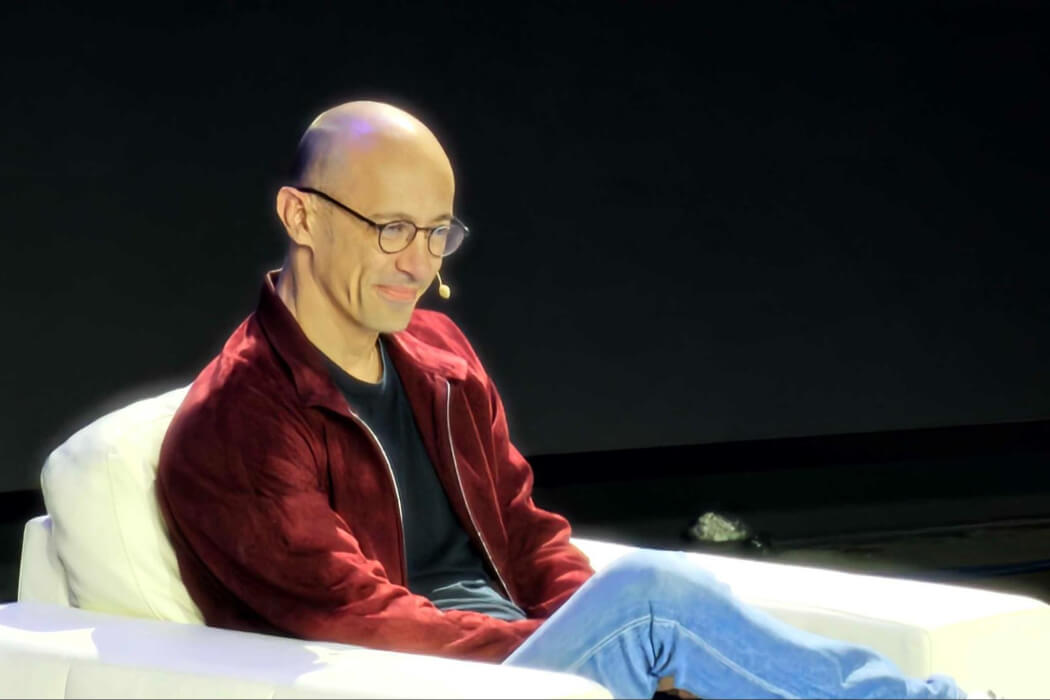
Tobi Lütke does not believe in the solo founder fantasy that AI has revived. Speaking on Wednesday at Toronto Tech Week's Homecoming event, the Shopify (SHOP) CEO told a crowd of more than 700 attendees that while AI has made it possible to build a billion-dollar company with one person, that option is worthless. His exact words: “I think the one-person company is bullshit.” Lütke acknowledged the technological feasibility. He immediately pivoted to a practical question: “Why the fuck would you not spend some of that money to have someone else around?”
The remark landed in a room full of founders, many of whom are grappling with the same tension between AI-driven efficiency and the human capital that built the last generation of tech giants. Lütke's co-panelist, Rostra founder and Shopify board member Lulu Cheng Meservey, helped steer the discussion away from “controversial” topics. The underlying message on company structure was anything but neutral.
The AI Efficiency Thesis and Its Limits
Wispr's Jump from 7 to 60 Employees
The Shopify founder pointed to Wispr, an AI voice dictation startup, as proof that lean operations can still scale fast. One year ago, Wispr had just seven employees. Today it has roughly 60. Its next funding round is expected to value the company at $2 billion USD. Lütke used the example not to celebrate minimal headcount. He showed that even companies built with AI tools eventually add people. The seven-person unicorn is a theoretical output. The real-world outcome is a 60-person company that still commands a multi-billion-dollar valuation.
The Valuation Signal in a Two-Person Billion-Dollar Company
Lütke's core insight for investors is that AI compresses the early stage but does not eliminate the need for organisational depth. If a company can reach a billion-dollar valuation with two or three people, the question becomes who captures that value when the company inevitably hires more staff. The market may start pricing AI-native startups differently, discounting those that lack a credible hiring pipeline. For public markets, this has direct read-through. Shopify itself has built an ecosystem of tools like Shopify Magic that automate catalog generation and customer service. It continues to employ thousands. The CEO's skepticism toward the extreme efficiency narrative suggests he sees limits to how far automation can go before collaboration becomes the binding constraint.
What This Means for Shopify's Own Layoff Cycle
Shopify's Repeated Cuts and the "Removed Layers" Rationale
Lütke's comments come as Shopify has been through multiple layoff rounds. The company said in November that it “removed layers that created complexity” after earlier cuts in 2023 and 2024. The pattern has raised questions about whether Shopify is structurally shrinking or simply pruning inefficiency. Lütke's Toronto Tech Week remarks reframe those cuts as part of a deliberate shape-shift. “Companies will be smaller, there will be vastly more of them,” he said. For current shareholders, this implies Shopify intends to operate with a flatter, more automated cost base. It does not intend to become a one-person shell.
Meta and Intuit: The Broader Tech Shift
Lütke is not alone in citing AI as a reason to reorganise. Meta and Intuit have both attributed large-scale layoffs to an organisational shift toward AI. The narrative has become a standard justification for cutting headcount across the tech sector. What sets Lütke's view apart is the counterbalance. He does not expect companies to atomise. The $2 billion Wispr case shows that even the most AI-optimised startups eventually hire. The hiring itself creates value that founders should not ignore. Investors watching the broader tech layoff cycle should weigh whether companies are using AI as a genuine efficiency driver or as a cover for demand-side weakness.
Canada's "Go-for-Bronze" Culture and the Meta Game
The Era of the Entrepreneur
The fireside chat was introduced by a short video hyping up “The Era of the Entrepreneur.” This added to the event's broader theme of building high-profile companies in Canada. Repeating past comments about the need to overcome Canada's “go-for-bronze” culture, Lütke encouraged attendees to instead go for gold. “There's a meta game of global companies [that] exists, and you plug in from wherever you are,” he said. “There are some places which make it harder. Canada is not one of them.”
The Decision Point for Founders and Investors
For founders in the audience, the message was clear: use AI to accelerate, do not use it as an excuse to isolate. For investors evaluating Shopify or its ecosystem peers, the CEO's framing provides a lens through which to assess management credibility. A company that claims AI will let it run with a skeleton crew may be understating the need for organisational resilience. A company that acknowledges the limits of automation, as Lütke did, may be more realistic about its growth trajectory. The practical rule for traders: when a tech CEO talks about AI-driven efficiency, listen for whether they also talk about hiring. The ones who only discuss the first part are the ones to question.
Bottom line for traders: Lütke's skepticism toward the one-person company narrative is a signal that Shopify sees collaboration and scale as durable competitive advantages. The company's own layoff cycle is about removing complexity, not retreating from organisational depth. For the broader tech sector, the Wispr example shows that AI-native startups still need people to capture value. The market should reward companies that balance automation with human capital, not those that chase the leanest possible headcount.