Crypto● Neutral
Senators Warn Treasury Not to Sideline State Stablecoin Rules
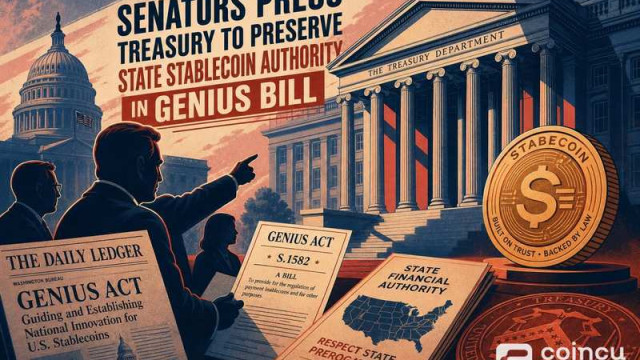
A bipartisan group of senators is pressing Treasury not to sideline state stablecoin regulators during GENIUS bill implementation. The dispute centers on how Treasury judges state regimes as equivalent to federal standards.
Continue with
A bipartisan group of US senators is telling the Treasury Department not to use the GENIUS bill's implementation to strip state regulators of their stablecoin oversight role. The warning, delivered in a letter focused on state implementation, targets how Treasury judges whether a state regime qualifies as equivalent to federal standards.
The core request is simple: do not write rules that effectively force state-chartered issuers into a federal-only pathway. The senators argue the bill's text was designed to preserve dual oversight. Treasury's interpretation of what counts as "substantially similar" will determine whether that design holds.
The Conference of State Bank Supervisors has already flagged concerns that Treasury's current approach sets the equivalence bar too high. The CSBS position is that the framing risks marginalizing state programs rather than integrating them. State regulators have spent the past decade building licensing and examination frameworks for money transmitters and digital asset firms. Several states have issued stablecoin-specific guidance or charters. The question is whether Treasury's implementation treats those frameworks as genuinely equivalent or imposes conditions that make them impractical.
For stablecoin issuers, the outcome shapes compliance costs and licensing strategy. A framework that preserves dual federal-state pathways gives issuers optionality. One that funnels everything through Treasury narrows the field, with potential effects on stablecoin flows across major exchanges.