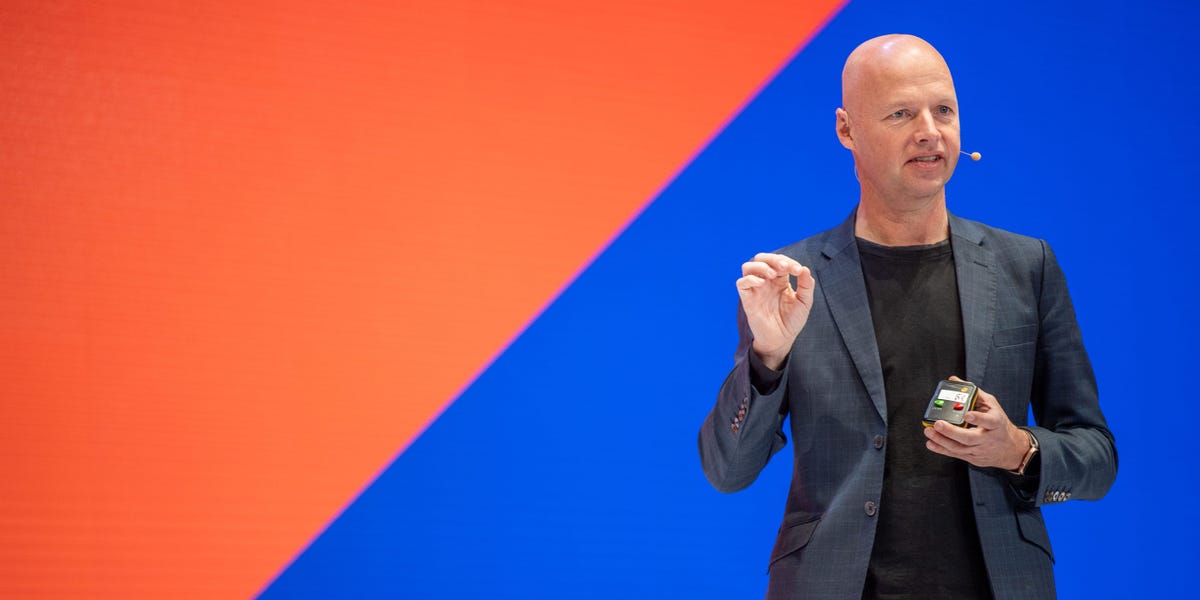
Sebastian Thrun, one of the architects of the modern self-driving industry, is working on a new robotics startup called Dulo.
He disclosed the venture at the end of a keynote address at Actuate, a robotics conference in San Francisco on Tuesday.
“I am not speaking about the company yet,” Thrun said. “It’s under stealth, it’s very small. It’s in robotics.”
Public details are scarce. A bare-bones website hosted by Stanford says Dulo is developing “foundation models for hardware design” with the goal of enabling “manufacturing at lightspeed.” The site lists team members from Waymo, Google Brain, and Stanford’s Artificial Intelligence Laboratory, which Thrun previously directed.
Thrun first came to Google’s attention in 2005 after his Stanford team won a landmark autonomous-vehicle race by completing a 132-mile desert course without a human driver. Google co-founder Larry Page later recruited him to lead what became Waymo. Thrun also co-founded Google Brain, Google X, and online education company Udacity. He later led the now-defunct flying-car startup Kittyhawk.
The new company’s focus on foundation models for hardware design puts it at the intersection of large AI models and computer-aided engineering. If Dulo can compress the cycle from concept to physical prototype, it could reshape how robotics and electronics companies develop new products. The approach mirrors the trajectory of foundation models in software, where a single trained model now powers many downstream tasks.
Hardware design has largely resisted that kind of abstraction. Each new chip, circuit board, or mechanical part typically requires bespoke engineering work. A model that learns the physics and constraints of manufacturing could let designers specify goals in natural language and get back a manufacturable design. That would have implications for any company that builds physical products, from automakers to consumer electronics firms.
Thrun gave no timeline for coming out of stealth. The Stanford-hosted site says Dulo is hiring.