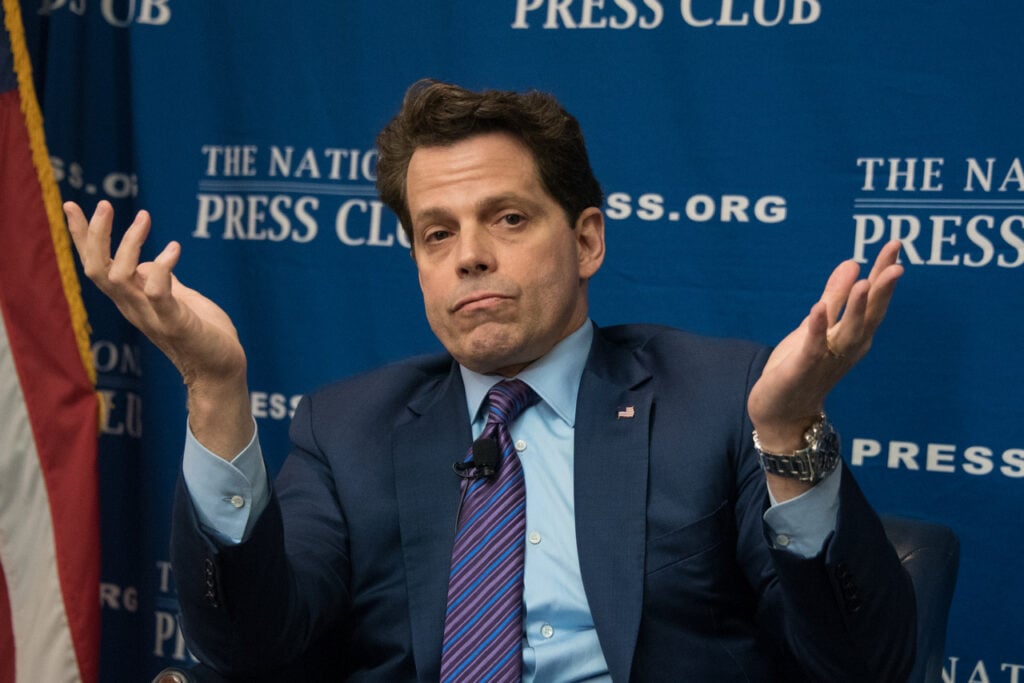
Anthony Scaramucci drew a sharp line between two power centers during a recent RiskReversal Media podcast. "On Wall Street, we are front stabbers. In Washington, they're backstabbers," the SkyBridge Capital founder said. He pointed to the treatment of Tesla CEO Elon Musk as evidence: "Look what they did to him."
The comment lands in a market already parsing political risk into stock valuations. For traders deciding whether to hold Goldman Sachs Group (GS) or Tesla (TSLA) into the next earnings window, Scaramucci's distinction offers a practical lens: Wall Street attacks are visible, priced, and often temporary. Washington attacks are hidden, slow, and can compound.
The Scaramucci Framework: Front-Stab vs Back-Stab
Scaramucci, who served 11 days as White House communications director in 2017, described his rapid education in Washington's operating style. After a press conference from the White House, a political ally warned him: "You can't talk like that from the White House. You're talking directly to the American people." The establishment moved fast. "We've got Republican senators asking me for opposition research on you," Scaramucci recalled being told. "Get this guy out of here."
Wall Street, by contrast, attacks openly. Scaramucci recalled being told by a Goldman Sachs partner that he was "the worst dressed person" the executive had ever seen during an early interview. He showed up in a cheap polyester suit. His response was practical: he went to J. Press, bought a woolen suit and cotton shirts, and re-interviewed. The problem had a fix. The feedback was direct.
What the distinction means for positioning
- Front-stab risk is transparent, often tied to quarterly results or analyst downgrades. It can be hedged with options or sector rotation.
- Back-stab risk is opaque, driven by regulatory, legislative, or media campaigns that unfold over quarters. It is harder to hedge and often shows up in multiple compression rather than immediate price gaps.
Goldman Sachs: A Wall Street Front-Stab Test Case
Goldman Sachs is the quintessential front-stab institution. The partner who criticized Scaramucci's suit was delivering a blunt signal: fit the culture or don't work here. That directness extends to market signals. GS currently carries an Alpha Score of 60 out of 100, labeled Moderate, in the Financials sector. The score reflects a balanced risk-reward profile where earnings beats and misses are quickly absorbed into price.
The valuation and earnings context
Goldman's last few earnings cycles have been driven by fixed-income trading and investment banking fees. The front-stab dynamic means that when a trading miss appears, analysts downgrade the next day, and the stock reprices within a week. There is no prolonged political drag. Scaramucci's own story shows that to succeed at Goldman, you fix the problem and re-interview. The same applies to the stock: beat the next quarter, and the front-stab is forgotten.
Risk to watch: A front-stab environment can create false bottoms. If the miss is structural (e.g., a permanent decline in M&A advisory), the initial drop may not be the entry point. Watch GS revenue from investment banking for two consecutive quarters before assuming the front-stab is over.
Tesla: The Washington Back-Stab Exposure
Tesla operates under a different risk regime. Musk's involvement in government reform efforts and the Department of Government Efficiency initiative has drawn political and media backlash that Scaramucci described as backstabbing. The attacks are not about Tesla's earnings per se – they are about Musk's public profile and its regulatory consequences.
TSLA sits at $426.01, up 1.95% on the session, with an Alpha Score of 44 out of 100, labeled Mixed, in the Consumer Discretionary sector. The Mixed label reflects the tension between strong vehicle demand and elevated political uncertainty.
How back-stab risk hits Tesla fundamentals
- Regulatory delays: Electric vehicle tax credits and charging infrastructure subsidies are subject to Congressional maneuvering. A back-stab can kill a bill without a floor vote.
- Consumer sentiment: Political polarization around Musk may affect brand perception in key markets. This shows up in delivery numbers with a lag.
- Cost of capital: If political risk raises the equity risk premium for TSLA, the stock's multiple contracts even if earnings are solid.
Contrast with front-stab dynamics
A front-stab for Tesla might be a missed delivery number or a build-quality report. Those are priced quickly. The back-stab of Washington investigations or tariff threats can linger for quarters without a clear resolution date. Scaramucci's advice to traders: assume that back-stab risk takes longer to clear than front-stab risk.
The Macro Backdrop: Inflation and Housing Affordability
Scaramucci also addressed the economic anxiety that fuels both Wall Street and Washington behavior. He said that inflation since 2020 has "stolen 30% of his life" from hourly workers whose wages haven't kept pace. The numbers support the claim.
This affordability gap creates political pressure for price controls, rent caps, or tax changes – all forms of back-stab risk for real estate and consumer discretionary stocks. It also drives voter sentiment that can shift regulatory winds.
What this means for GS and TSLA
- GS benefits from higher rate volatility but faces potential backlash if housing policy targets mortgage lending practices.
- TSLA relies on affordable vehicle financing. A housing crunch that squeezes consumer balance sheets could dampen demand, even if Washington leaves Tesla alone.
The Alpha Score Read: GS at 60, TSLA at 44
AlphaScala's proprietary scoring provides a quantified snapshot of the front-stab versus back-stab trade.
| Ticker | Alpha Score | Label | Sector | Current Price |
|---|
| GS | 60 | Moderate | Financials | N/A |
| TSLA | 44 | Mixed | Consumer Discretionary | $426.01 |
A Moderate score implies that front-stab risks – earnings volatility, short-duration analyst revisions – are already priced. The stock is likely to track its earnings trajectory with limited outsized moves. A Mixed score signals that back-stab risks are creating a wider range of outcomes. Political headlines can move TSLA more than earnings beats.
Practical Framework for the Next Quarter
Traders facing the Scaramucci choice – front-stab or back-stab – should ask two questions:
- Is the risk event visible and directly linked to the business? If yes, it's front-stab. Hedge with options for the earnings date or sector rotation.
- Is the risk driven by external political actors without a clear timeline? If yes, it's back-stab. Reduce position size or add longer-dated puts to protect against a slow bleed.
For GS, the next earnings report will be a front-stab moment. Miss and the stock drops 3-5% in a day; beat and it recovers. For TSLA, the US presidential election cycle and DOGE initiative fallout are back-stab risks that won't resolve on a single calendar date.
The trade setup
- GS: If the Alpha Score holds at 60, the risk-reward is balanced. Use earnings straddles rather than directional bets.
- TSLA: The Mixed label at 44 suggests caution. A back-stab headline (e.g., a congressional investigation) could send the stock to $390; a pro-EV policy win could push it to $460. Position for volatility, not direction.
Scaramucci's final observation cuts to the heart of the difference. Wall Street gave him a clear rejection: fix the suit. Washington gave him a hidden campaign: get opposition research. For stock pickers, the lesson is to distinguish between open-market signals and political noise. The first is tradeable. The second requires a thesis that can survive the back-stab.