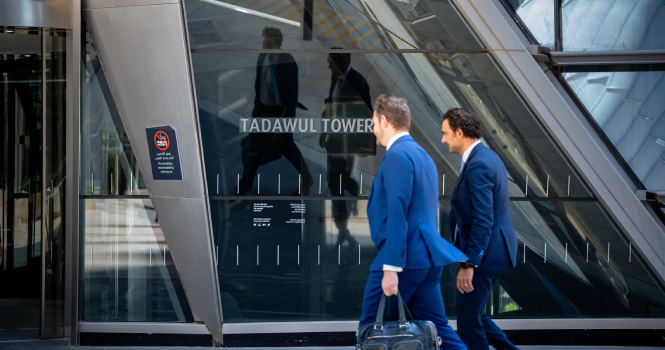
Non-institutional foreign investors trimmed their holdings in Tadawul-listed equities, excluding Saudi Aramco, to 11.18% last week from 11.21% the prior week. The stake now sits at SAR 354.57 billion in market value. The decline, though small in percentage terms, breaks a gradual uptrend that had pushed the figure up from 10.95% in early January.
The data covers retail accounts, family offices, and small discretionary funds -- the category of foreign investor most reactive to short-term risks. Excluding Saudi Aramco removes the distorting effect of a stock that alone accounts for roughly 15% of total market capitalization. The ex-Aramco figure therefore offers a cleaner gauge of foreign appetite for the broader Saudi equity market.
Non-Institutional Foreign Ownership Slips to 11.18%
The move from 11.21% to 11.18% represents a drop of roughly 0.3 percentage points. In absolute terms, the value of non-institutional foreign holdings fell by about SAR 1.5 billion, estimated from the percentage change and the total market cap of ex-Aramco stocks. That is not a dramatic outflow. It does break a pattern of steady accumulation that had pushed the ownership ratio from 10.95% in early January to 11.21% by mid-February.
Saudi Arabia has made foreign investment a central pillar of its Vision 2030 transformation. The Tadawul has introduced reforms including relaxed foreign ownership limits, index inclusion in MSCI and FTSE, and the launch of a derivatives market. Non-institutional foreign investors often serve as a leading indicator of broader sentiment because they react more quickly to short-term risks than large pension or sovereign funds.
The decline comes as global investors reassess exposure to emerging markets, with higher US interest rates and geopolitical uncertainty in the Middle East weighing on sentiment. Oil prices, a key driver of Saudi fiscal health, have remained volatile. A sustained drop in foreign ownership could pressure liquidity in mid-cap and small-cap names that depend on retail foreign flows. The Tadawul All Share Index (TASI) has traded in a range since January, and a further retreat in foreign participation could cap upside.
The exclusion of Aramco means the data reflects sectors such as banking, petrochemicals, and consumer goods -- areas where foreign investors have been increasing exposure over the past two years. A reversal in those sectors would signal a broader risk-off shift.
Next Decision Point
The next weekly data release will be the first test. A further decline below 11.10% would confirm that the dip is part of a trend rather than noise. That level would represent a return to December 2024 lows and suggest foreign investors are actively reducing positions.
A rebound above 11.25% would indicate last week's move was a temporary pullback, possibly tied to profit-taking or a specific sector rotation. Traders should also watch for policy signals from the Saudi Capital Market Authority, such as changes to foreign ownership thresholds or new listing rules that could attract fresh capital.
For now, the data offers a cautious signal. Non-institutional foreign investors are not fleeing. They are no longer adding. That shift alone is enough to make Saudi equities a watchlist item rather than a buy-the-dip opportunity.
For broader context on foreign flows and market positioning, see our stock market analysis and best stock brokers guides. The next weekly ownership update will be published on Sunday -- that print will determine whether this is a blip or the start of a larger rotation.