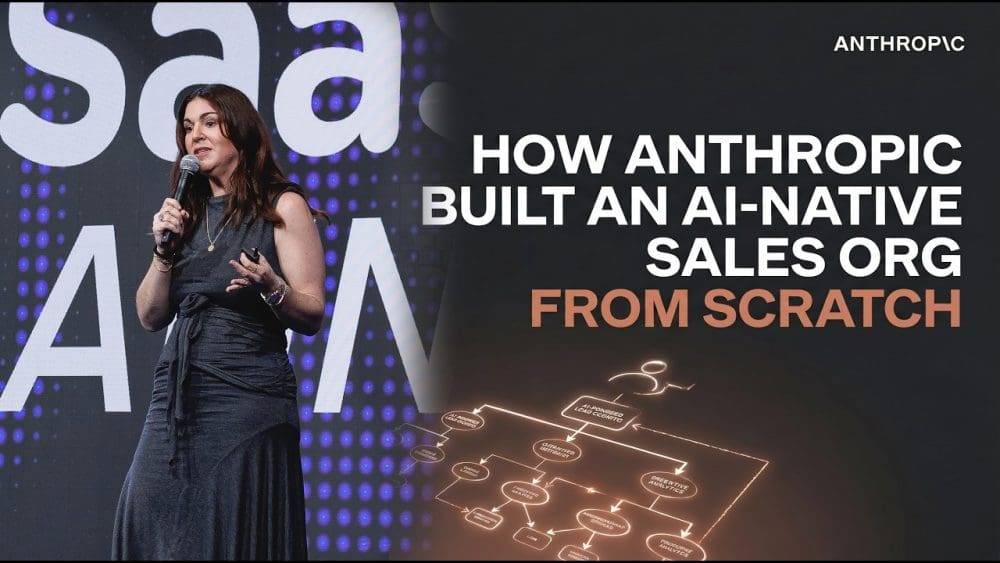
SaaStr AI 2026 in San Mateo was not a conference about whether to use AI agents in revenue teams. The speakers had already done that. They brought specific numbers and the problems they hit.
Eleanor Dorfman, head of industries at Anthropic, described what happened when a new Claude release sent enterprise demand vertical. The obvious move was to hire reps three to five times faster. She argued that would wreck the buying experience. Anthropic rebuilt the enterprise motion around AI instead. Four months later, 54% of new enterprise logos were closing through self-serve, she said. Not small accounts. Real enterprise logos, real contract terms, real invoicing, with no sales rep at the front door. The reps who used to run those deals got pointed at accounts where a human actually changes the outcome.
Gamma hit $100 million in annual recurring revenue with roughly 50 people. Profitably. 50 million users, 600,000 paying subscribers, almost all driven by word of mouth. Grant Lee, the company's CEO, told the audience his biggest regret was waiting too long to add a sales team. Inbound clearly works. Gamma proves it better than almost anyone thought possible. Even so, a world-class inbound motion leaves enterprise deals, expansion revenue, and larger accounts sitting on the table. If the company with the strongest excuse to wait wishes it had moved sooner, most founders riding inbound are later than they think.
Kyle Norton, CRO at Owner.com, put up the most concrete rep economics of the event. Owner is approaching $100 million ARR selling roughly $10,000 ACV software to independent restaurants. Norton said his AI-augmented reps are producing at a level that makes old benchmarks look outdated. A rep running at 3x or 4x compensation is no longer the ceiling. In an AI-native org, that is the floor.
PayPal put Agentforce on roughly 8,000 leads a month that no human was going to touch. These were not the good leads. These were accounts sitting at the bottom of the pile, already triaged out. Conversions on that pool jumped 50%, and the team saw it inside the first few months, Adam Alfano from Salesforce said in a joint session. Alfano noted that the fastest AI ROI is not better leads. It is the pipeline you already gave up on.
Sam Blond, co-founder and CEO of Monaco and former CRO at Brex, forced the question of comp math when an agent books the meeting, qualifies the lead, and writes the follow-up. If an agent does half the work, individual attribution stops meaning anything. The whole apparatus of sourced-versus-closed, SDR-to-AE handoff credit, and per-rep quota was built for a world where a person did every step. Blond said most orgs will hit this the hard way, mid-year, when a comp plan designed in 2025 collides with a team where agents do half the pipeline. Get ahead of it, he said.
Maia Josebachvili, GM of enterprise product at Stripe, sees the transactions across the fastest-growing AI companies. She identified two patterns. The fastest movers monetize far earlier than the previous generation did, and they are global from day one. The old sequence was build, scale users, then monetize, then expand geographically. The companies pulling away are compressing all of that. Tolerance for a clunky, delayed, US-only monetization motion is gone, she said. She also watched agents start to initiate and complete purchases inside real commerce flows. Not a human clicking buy after an agent does the research. The agent itself transacting. That means your checkout, your pricing page, and your buying process now have a non-human user. Josebachvili said the teams that make it easy for an agent to evaluate, quote, and buy will capture demand that never shows up as a lead in the CRM.
Jeanne DeWitt Grosser, COO of Vercel, put up the most concrete headcount number of the event. Vercel built a lead agent that took a function which used to need a team of 10 down to a single person, and returned 32x on what they put into it. The volume layer, the SDRs and researchers doing repeatable qualification and outreach, is exactly the work an agent does well. Grosser said the company rebuilt the workflow around the agent and kept one human to steer it. The closers stayed. The layer feeding them got automated.
Replit sent its CEO, CRO, and president to the event. Kody, who runs sales at Replit, correlated how much each rep used Replit internally against that rep's quota attainment. The pattern was clear: the reps leaning hardest on the AI were the ones hitting their numbers. Replit is approaching $1 billion in revenue. The company's read is that the only way to survive there is to amplify each person's output by 10x or more with agents. For a sales leader, that changes what you track. Add AI usage to the board, because it shows up in the number before the number does, the company's team said.
Norton also laid out an AI sophistication ladder. Level 1 is individual reps and RevOps building their own custom GPTs and prompts. It feels like progress. It is where most B2B companies are stuck. The problem is that every experiment stays local, and the great ideas never scale past the rep who built them. The compounding leverage lives at Level 3: centralized infrastructure, shared skills, and a common context library that every rep draws from. Norton said to stop letting reps run their own agents in isolation and stand up a GTM engineering function that builds for the whole team.
Blond evaluated hundreds of AI sales startups from inside Founders Fund. Most of them are dead on arrival, he said, and the pattern separating the real ones from the GPT wrappers is clear once you have seen enough. The discipline is knowing which questions actually predict whether a tool will work in your org versus which ones just produce a polished demo. Ask what happens on the deals that do not fit the happy path. Ask what it writes to your system of record and how it fails. The vendors who cannot answer are the ones whose product does not really work.
Several speakers said the middle of the sales org, the reps who were fine but never great, is under real pressure. AI agents are already better than mid-pack AEs and SDRs, Norton said. The best AI-native reps become worth more, not less, because they are now running the output of what used to take three people. The strongest AI-powered SDRs will command well above today's comp for far more output, he predicted. Anyone coming into a revenue leadership seat has to demonstrate real, hands-on AI usage, not enthusiasm about it.
Salesforce, which has an Alpha Score of 44, was represented by Adam Alfano, who discussed the PayPal collaboration. The session showed that even a company with a mature enterprise sales motion can get a fast payback by pointing agents at dead leads. The conference sessions made clear that the winning sales org from here is smaller, more senior, and AI-native. It points at pipeline humans used to write off, lets buyers who do not need a rep close on their own, and is ready for the buyers that turn out to be software rather than people.