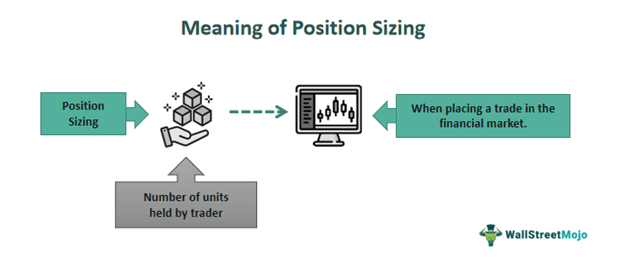
Position sizing is the number of units or shares a trader holds in a single position, on the buy side or the sell side. It sits at the core of stock market analysis, because the size of a trade decides how much capital it absorbs and what a losing trade costs the account. The method sees heavy use in intraday trading across equity and forex markets. In forex, the same idea sets the number of currency units a trade carries, from account size and risk tolerance.
The Two Risks Behind the Formula
Account risk is the share of the account's equity capital that a trader is willing to put at risk on one trade. Trade risk is what that trade could lose, measured by the distance between the entry price and the stop-loss.
The formula combines both: account equity times risk per trade, divided by the difference between the security price and the stop-loss. A trader with $10,000 in the account who risks 3%, or $300, on a trade can calculate the position size directly from those two numbers.
Samuel, who has traded shares and currencies for seven years, runs the same math. He holds $30,000 in his account and risks 4% of it, or $1,200. His stop-loss sits at $300, so account risk divided by trade risk comes to a position of 4 lots.
The Kelly Criterion and Other Sizing Rules
The Kelly criterion treats sizing as a probability problem. John Kelly proposed it in the 1950s to find the position size that maximizes gains and minimizes losses. The inputs are p, the probability of winning, and q, the probability of losing; the variable b is the ratio of net profit to net loss.
The other common approaches are simpler. Fixed-dollar sizing risks a set amount on every trade, say $300, no matter how much volatility the market is showing. A fixed-percentage version scales that amount with the account. The volatility-adjusted approach shrinks the position when the market runs hot, so a rough session costs less.
The same formula applies to options. Account risk there comes from the premium per contract multiplied by the quantity of underlying shares. A premium of $3 on 200 shares means $600 of account risk.
Most traders use a 5% to 10% rule of thumb for invested capital on each trade. On a $100,000 account, that puts the position between $5,000 and $10,000.
Position sizing is the alternative to full porting, where a trader puts 100% of the account into one trade. The rules above cap what any single position can cost.
The concept scales to real portfolios.
A March 27, 2024 analysis of hedge fund manager Bill Ackman's holdings found Alphabet and Chipotle Mexican Grill together made up 37% of his $10.4 billion portfolio. That concentration sits well above the 5% to 10% per-trade guidance. The analysis framed position sizing as central to portfolio management. It also weighed Alphabet's and Chipotle's financial standing and future growth potential.
Chipotle's Alpha Score comes in at 44 out of 100, labeled mixed, on the CMG stock page.