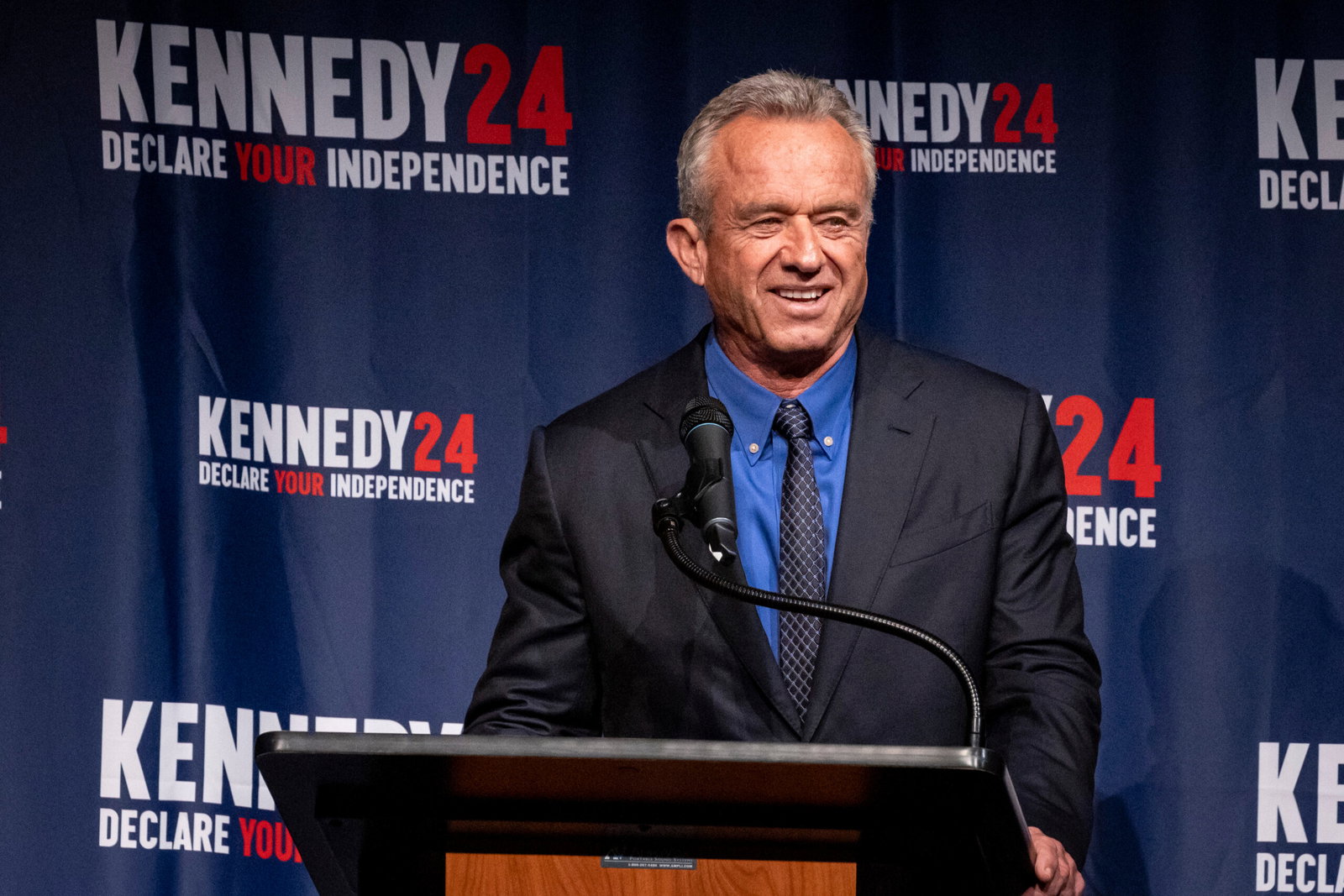
Political Volatility and the Intersection of Public Narrative and Market Sentiment

The recent controversy surrounding Robert F. Kennedy Jr.'s past comments highlights the risks of political volatility for sector-specific regulatory stability and market predictability.
Alpha Score of 44 reflects weak overall profile with moderate momentum, strong value, poor quality, poor sentiment.
Alpha Score of 45 reflects weak overall profile with strong momentum, poor value, poor quality, weak sentiment.
Alpha Score of 47 reflects weak overall profile with moderate momentum, poor value, moderate quality. Based on 3 of 4 signals — score is capped at 90 until remaining data ingests.
Alpha Score of 55 reflects moderate overall profile with moderate momentum, moderate value, moderate quality. Based on 3 of 4 signals — score is capped at 90 until remaining data ingests.
The recent exchange between Senator Angela Alsobrooks and Robert F. Kennedy Jr. regarding past commentary on the reparenting of Black children has introduced a new layer of friction into the current political discourse. While the public back-and-forth centers on the denial of specific remarks despite a prior apology, the incident underscores the heightened sensitivity surrounding public figures whose policy stances influence broader market expectations. For investors, the primary concern remains how such controversies impact the stability of regulatory environments and the predictability of legislative agendas.
Impact on Policy Predictability
When public figures oscillate between apologies and denials, the resulting ambiguity complicates the ability of market participants to price in future policy shifts. In sectors sensitive to government oversight, such as healthcare and environmental regulation, the consistency of a candidate's messaging is a primary input for risk assessment. The current situation creates a narrative vacuum where the focus shifts from substantive policy debate to character-driven controversy. This transition often leads to increased volatility in sectors that rely on clear, long-term regulatory frameworks to justify capital expenditure.
Sectoral Read-Through and Market Sensitivity
Political volatility frequently spills over into broader stock market analysis by altering the perceived risk premium of companies tied to government contracts or public health initiatives. When a figure like Kennedy, who has positioned himself as a disruptor of established institutional norms, becomes the center of a credibility debate, the ripple effects can be felt across industries that are currently navigating complex regulatory landscapes. Investors often look for stability to hedge against uncertainty, and the current cycle of denials and apologies provides little in the way of a predictable path forward.
AlphaScala data currently reflects a mixed outlook for several key industrial and technology players, including ON stock page with an Alpha Score of 45/100, B stock page with an Alpha Score of 70/100, and BE stock page with an Alpha Score of 46/100. These scores highlight the ongoing difficulty in maintaining a clear trajectory when external political noise disrupts fundamental analysis. The market is currently pricing in a high degree of caution, as evidenced by the divergence in performance across these sectors.
The Path Toward Regulatory Clarity
Moving forward, the next concrete marker for market participants will be the official policy filings and subsequent public appearances that clarify the candidate's stance on critical infrastructure and health policy. Investors should monitor whether this controversy results in a pivot toward more moderate messaging or if it signals a deepening of the current confrontational approach. The resolution of this narrative will likely dictate whether the current political friction remains a localized event or expands into a broader headwind for market sentiment. As the cycle progresses, the focus must return to the underlying economic proposals rather than the ongoing cycle of public denials.
AI-drafted from named sources and checked against AlphaScala publishing rules before release. Direct quotes must match source text, low-information tables are removed, and thinner or higher-risk stories can be held for manual review.