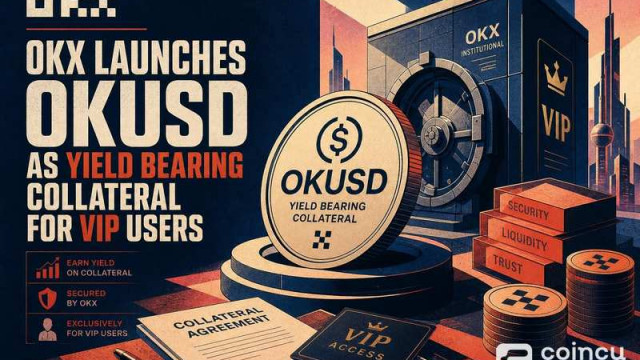
OKX's OKUSD lets VIP traders earn yield on idle margin collateral. The return compensates for concentrated exchange risk. Redemption limits and closed-loop design define the tradeoff.
OKX launched OKUSD on June 10, 2026. The token is pegged 1:1 to USDT, carries a 98% collateral discount rate, and is available only to VIP users. It can be posted as margin across flexible loans, VIP loans, and trading accounts. The core proposition is straightforward: idle USDT in margin accounts earns nothing. OKUSD lets that capital earn a variable, market-dependent return while still backing positions.
The structural trade is less obvious.
OKUSD is a closed-loop instrument with no on-chain component. It cannot be transferred off OKX or used in decentralized finance. The USDT backing sits on the exchange's books. The token is an internal credit entry. A VIP user who converts USDT to OKUSD replaces stablecoin issuer risk with exchange risk. The yield compensates for that concentration. Nothing more.
OKX did not disclose where the yield originates. The announcement describes the rate as variable and linked to market conditions. Without a stated source – no Treasury bill pool, no segregated lending fund, no third-party collateral – the yield depends on OKX's own lending demand or platform revenue. If trading volumes fall or the exchange faces a liquidity squeeze, the yield could shrink before the user can exit.
Two redemption paths make the mechanics concrete. Fast redemption charges 0.1% with a daily personal limit of 500,000 to 3,000,000 OKUSD. Standard redemption charges 0.025% with a daily limit of 1,000,000 to 20,000,000 OKUSD. The fast path costs four times more. A VIP trader in a volatile market may need liquidity faster than the standard path allows.
For a user converting $5 million of USDT into OKUSD, the fee spread is $3,750 at the standard rate and $5,000 at the fast rate. The difference is manageable under normal conditions. The redemption limit matters more in a stress scenario. The fast path caps daily exits at $3 million. A $10 million OKUSD position would take at least four days to fully unwind using fast redemptions, longer if multiple users redeem simultaneously.
The fee structure deserves a closer look. Standard stablecoin conversions on major exchanges typically cost 0.1% through market orders, or less through limit orders. OKUSD's fast redemption fee matches that. The standard rate of 0.025% is below market, which makes the product attractive for patient users. The constraint is the daily limit: $3 million per day on the fast path, $20 million on the standard path. A VIP trader managing a $50 million portfolio cannot exit a significant OKUSD position in a single session without using multiple days.
Competing products reveal the architectural choice.
Circle launched USYC for Binance institutional customers in July 2025. USYC is a yield-bearing token backed by Treasury bills, held at banks or through Ceffu as off-exchange collateral. The return is tied to the U.S. dollar risk-free rate, not to exchange activity. The counterparty risk shifts from Binance to the custodian and the U.S. government.
Standard Chartered and OKX piloted a collateral mirroring programme under Dubai VARA rules in April 2025. Standard Chartered acted as independent regulated custodian in DIFC. That model keeps assets off the exchange's balance sheet while allowing them to be used as margin.
OKUSD uses neither model. There is no external custodian and no segregated off-exchange vault. The product is exchange-native and self-contained. OKX controls issuance, redemption, and yield distribution directly. The user's claim on OKUSD is a claim on OKX's internal ledger, not a separately held reserve.
The launch timing adds context. The crypto market is in a risk-off phase. The Fear and Greed Index sits at 9, extreme fear territory. OKB traded at $70.65, down roughly 3% over the prior 24 hours. The product asks VIP users to move assets deeper into an exchange's balance sheet during a period when risk appetite is minimal and stablecoin solvency is under periodic scrutiny.
OKX has been building institutional infrastructure for over a year. The Standard Chartered pilot, the VIP loan suite, and now OKUSD form a pattern of exchange-native products aimed at high-volume traders. Each product reduces the user's dependence on external custodians and smart contracts. Each product also increases the user's dependence on OKX's solvency.
The closed-loop design avoids smart contract risk. On-chain yield protocols have been hacked, drained, or exploited multiple times. An off-chain ledger is not subject to on-chain attacks. It is subject to operational errors, internal fraud, regulatory seizure, or a coordinated withdrawal run. The tradeoff is between code vulnerability and counterparty concentration.
Jurisdictional restrictions also apply. OKX did not list the excluded regions in the announcement. The exchange has previously restricted products in the United States and other highly regulated markets. Traders should confirm eligibility before depositing.
OKUSD fills a genuine gap. VIP traders with large USDT balances on margin have limited options to earn carry on that collateral without moving funds elsewhere. OKUSD offers that carry within the same platform. The question is whether the yield premium over leaving USDT idle is worth the shift in counterparty exposure from a stablecoin issuer to the exchange itself.
OKX did not publish a fixed APR. The yield will vary. The first real test of OKUSD will come during a sharp market event, when multiple VIP users attempt to redeem simultaneously and the exchange's internal liquidity is the only constraint.
Prepared with AlphaScala editorial tooling from the source reporting linked above. Indexable analysis may include a cited Alpha Score value. Publishing checks screen each story before release. Educational coverage, not personalized advice.