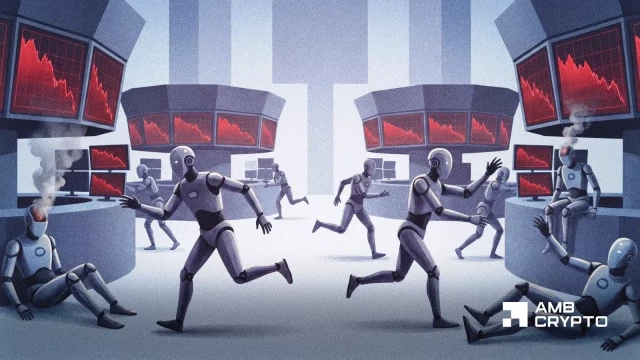
On Oct. 10, 2025, the crypto market lost $19 billion in liquidations over a single day. The worst came in a 40-minute window starting at 20:50 UTC when $13.3 billion vanished. The trigger? A $60 million spot dump of the synthetic dollar USDe on Binance.
USDe de-pegged to $0.6567. Binance's Automatic Deleveraging (ADL) system, designed to clear bankrupt accounts, misread the move. It priced USDe, wBETH, and BNSOL using only the exchange's internal order books, not the broader market. The ADL began liquidating over-leveraged positions at any price. Market makers could not get orders through. The buy side of the order book disappeared.
Binance had announced an oracle pricing update on Oct. 6, scheduled for Oct. 14. That created an eight-day vulnerability window. The crash hit right in the middle of it. The system liquidated $19.3 billion against a price that existed nowhere else in the world. Panic selling spread to other platforms. Cosmos's ATOM token fell from $4 to $0.001 on Binance.
Autonomous AI agents amplified the cascade. On Solana, bots built on open-source frameworks like ElizaOS and Valory's Olas accounted for over 70% of DEX volume during peak launches in early 2026. They scrape social media sentiment, analyze liquidity, and execute trades in fractions of a second. During the crash, they did exactly what they were programmed to do: sell to protect profits. Nic Puckrin, founder of Coin Bureau, said, "Fines and bans can't be aimed at the code itself. They have to be aimed at whoever is actually allowing the bot."
The event exposed a structural gap. Crypto operates 24/7 with no circuit breakers. Traditional markets have pauses, regulations, and human oversight. Puckrin said the fix involves "not trusting any single price source" and having "automatic safeguards that kick in when conditions deteriorate: leverage limits that tighten as liquidity thins, and kill switches."
Nikita Prokopenko, executive legal associate at SBSB FinTech Lawyers, pointed to a deeper issue: "The real issue is the data AI takes on. If the data is analyzed poorly, it can trigger a sequence of non-grounded trades, leading to pump-and-dump schemes."
The Oct. 10 crash was not a hack. It was a perfect storm of a botched oracle transition, a single liquidation engine that ignored external prices, and thousands of self-preserving algorithms executing what they were told. The next vulnerability window is already ticking on every exchange that runs a similar ADL model.
For more on how these risks play out across the broader market, see AlphaScala's crypto market analysis.