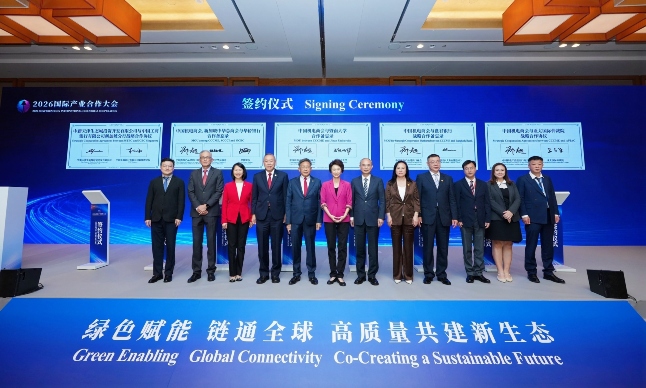
Singapore's second-largest bank signed a strategic cooperation agreement with the Singapore Chinese Chamber of Commerce & Industry (SCCCI) and the China Chamber of Commerce for Import and Export of Machinery and Electronic Products (CCCME). The deal aligns with OCBC (SGX: O39.SI) recently launched corporate strategy, The Next Frontier, and its Asia Shift pillar that targets rising trade and investment flows between ASEAN and Greater China.
The simple read is a three-way marketing deal. The better read is a structural play on the fastest-growing corridor in global trade, backed by a clear acceleration in client demand.
The Catalyst: Tripartite Agreement on the China-ASEAN Corridor
OCBC combines its regional banking capabilities with CCCME network of more than 10,000 Chinese enterprises and SCCCI business connections across Southeast Asia. The partnership will support small and medium-sized enterprises and mid-sized corporates seeking cross-border opportunities in both regions.
The collaboration will concentrate on sectors that drive future growth: green technologies, sustainable development, digitalisation and advanced manufacturing. The three organisations also plan to strengthen trade and financing ecosystems that facilitate cross-border business activity. A joint coordination group will monitor progress and ensure implementation.
“Chinese enterprises have accelerated their internationalisation in recent years, creating a growing need for stronger on-the-ground support when entering new markets,” said Roy Tan, Head of Enterprise Banking International at OCBC.
Tan added that the partnership allows OCBC to combine financing solutions with business matching and market-entry support, helping Chinese companies expand into ASEAN more efficiently while creating opportunities for businesses on both sides.
The agreement was signed during the 2026 Conference on International Industrial Cooperation in Singapore. At the event, SCCCI also launched the Singapore Investment Guide 2026/2027, a market-entry handbook designed to help foreign companies establish operations in Singapore and the wider ASEAN region. OCBC contributed the ASEAN-focused sections.
Why the Simple Read Misses the Mechanism
A chamber partnership alone is not a catalyst. The mechanism is the bank’s positioning to capture a surge in Chinese companies expanding into ASEAN that is already underway.
OCBC reported that the number of new Chinese businesses it supported in establishing operations in Southeast Asia increased by 50 percent in 2025, following growth of 30 percent in the prior year. These numbers show acceleration, not a one-off event. The partnership is a scale-up move, not a new-direction announcement. The bank already has the flow; now it is building the pipeline capacity.
Three Numbers That Confirm the Direction
- 50% increase in new Chinese businesses supported in 2025.
- 30% increase in the prior year, establishing a trend.
- 10,000+ Chinese enterprises in CCCME network available for cross-referral.
These figures suggest the partnership is not speculative. CCCME members are already active in machinery, electronics and manufacturing – sectors that overlap directly with the targeted growth areas. OCBC’s contribution to the Singapore Investment Guide adds a tangible output, not just a press release.
What Could Invalidate the Thesis
Geopolitical risk remains the primary threat. US-China tariffs or restrictions on technology flows could slow Chinese companies’ expansion into ASEAN. A sharp economic slowdown in China would also reduce the number of companies seeking overseas bases.
Execution risk is material. The joint coordination group could produce meetings rather than deal flows. OCBC must convert chamber introductions into trade finance loans, letters of credit and cross-border cash management mandates. Competitors like DBS and Oversea-Chinese Banking Corporation are also targeting the same corridor.
Currency risk is a secondary factor. A weak yuan makes Chinese exports cheaper but also raises the cost of setting up ASEAN operations in local currencies. OCBC’s own currency exposure to the SGD and CNY could affect the profitability of trade finance products.
The Next Marker: Sector Execution and the Joint Group
The partners identified green tech, sustainable development, digitalisation and advanced manufacturing as focus sectors. The joint coordination group is tasked with monitoring progress. The next concrete catalyst will be an announcement of specific financing facilities, referral volumes or a joint lending programme.
For traders and analysts tracking structural trade flows, OCBC’s quarterly disclosures on cross-border trade finance volumes and SME client additions will provide the first real test. The Asia Shift strategy has a clear leading indicator: if Chinese client growth continues at or above the 50 percent pace, the partnership becomes a revenue multiplier. If it decelerates, the agreement is a low-cost option that still signals a rational strategic pivot.
OCBC’s chamber pacts are not a headline trade. They are a mark of a bank that already sees the flow and is building the conduit.